

A crypto hedge fund lets you invest in digital assets like Bitcoin and Ethereum with professional managers making decisions for you. Most crypto hedge funds accept only accredited investors, so you need to meet certain financial requirements. These funds use many strategies to grow your money, but you must understand the risks first. Beginner investors often feel overwhelmed, but you can learn to spot safe crypto hedge funds with careful research. Remember, every crypto hedge fund works differently, so you need to look closely at how each one operates.
Key Takeaways
Crypto hedge funds let you invest in digital assets with expert managers who use active strategies to grow your money.
These funds carry high risks and fees, so only accredited investors who meet financial requirements can usually join.
Understanding fund structure, security, and management helps protect your investment from fraud and mistakes.
Different strategies like long/short, arbitrage, and market-making offer ways to balance risk and seek profits.
Always research funds carefully, ask key questions, set clear goals, and use risk management to invest safely.
What Is a Crypto Hedge Fund?
A crypto hedge fund is a type of investment fund that pools money from investors to buy and sell digital assets. You will find that these funds focus on cryptocurrencies like Bitcoin, Ethereum, and other blockchain-based projects. Professional managers run these funds and use advanced strategies to try to make profits from the ups and downs of the crypto market. Unlike traditional funds, crypto hedge funds often use active trading, which means they buy and sell assets frequently to take advantage of price changes.
Key Features
When you look at crypto hedge funds, you will notice several important features:
Active trading strategies: Managers buy and sell cryptocurrencies quickly to catch market swings.
High-risk profile: These funds can bring big gains, but you also face the chance of large losses because the crypto market changes fast.
Professional management: Experts with deep knowledge of crypto markets and risk management handle your investments.
Diversification: Crypto funds invest in many types of digital assets, such as Bitcoin, Ethereum, altcoins, and even early-stage blockchain startups. This spreads out risk and gives you exposure to new projects.
Multiple strategies: You might see strategies like arbitrage, lending, staking, and venture capital investments.
High fees: You may pay management fees between 1% and 4%, plus performance fees up to 20%. These fees reflect the risks and the skill needed to manage crypto funds.
Limited availability: Most crypto hedge funds only accept accredited investors, which means you need to meet certain income or asset requirements.
Exclusive opportunities: Some funds give you access to investments in new blockchain projects that are not open to the public.
Note: Crypto hedge funds offer you a way to invest in the fast-growing world of digital assets, but you must understand the risks and costs before joining.
Crypto funds stand out because they use both systematic and discretionary strategies. Systematic strategies follow set rules, while discretionary strategies rely on the manager’s judgment. You get the benefit of professional oversight, which can help you avoid common mistakes in the volatile crypto market. Many crypto investment funds also provide access to decentralized finance (DeFi) protocols, giving you more ways to earn returns.
Accredited Investors
Most crypto hedge funds are not open to everyone. You usually need to be an accredited investor. This means you must meet certain financial standards, such as having a high income or a large amount of assets. The reason for this rule is simple: crypto funds carry higher risks than traditional investments. Regulators want to make sure that only people who can afford to lose money can join these funds.
Since 2017, more accredited investors have shown interest in crypto hedge funds. These investors look for new ways to grow their wealth and diversify their portfolios. You will see that crypto funds have grown in size and popularity, with assets under management reaching billions of dollars. However, the performance of these funds can vary a lot. Some managers deliver strong returns, while others may lose money. This makes it very important for you to research each fund and its managers before investing.
Regulations around the world are changing to make crypto hedge funds safer and more transparent. For example, the European Union has introduced new rules to protect investors and prevent market abuse. Countries like Singapore and Switzerland support innovation, while others set strict controls. These rules help create a safer environment for you and other investors, but you still need to do your homework.
How Crypto Funds Work
Understanding how crypto funds work helps you make smarter investment choices. These funds use a special structure and active management to handle your money and digital assets. You need to know the main parts of their setup and how managers try to grow your investment.
Fund Structure
When you look at how crypto funds work, you will see that they have several important parts. Each part plays a key role in keeping your investment safe and running smoothly. Here is a table that shows the common components of crypto funds:
Component | Description |
|---|---|
Fund Manager | Makes investment decisions, manages the portfolio, and ensures the fund follows the rules. |
Investors | Pool their money together to get exposure to cryptocurrencies and blockchain projects. |
Custodian | Keeps digital assets safe by holding wallets and private keys securely. |
Advisor/Analyst | Provides expert advice, market research, and technical analysis for better strategies. |
Fund Structure Type | Usually set up as limited partnerships or trusts to protect investor rights and allow liquidity. |
Fees | Includes management and performance fees that reward managers for good results. |
You will notice that crypto funds often use independent custodians to protect your assets. After the crypto market crashes in 2022, most funds now demand asset segregation and regular audits. This means your money stays separate from the fund’s own assets, and outside experts check the fund’s finances. Many funds also require independent reserve statements to prove they hold enough assets.
Crypto funds face unique challenges compared to traditional hedge funds. Many managers worry about unclear regulations and tax rules. Over half of crypto funds have improved their risk management since 2022. They also focus more on liquidity and platform security. You should always check if a fund uses independent auditors and custodians before you invest.
Tip: Always ask about a fund’s structure, security measures, and audit process. These steps help protect your investment from fraud and mistakes.
Active Management
Active management is a big part of how crypto funds work. Fund managers do not just buy and hold digital assets. They use research, analysis, and quick decisions to try to beat the market. You benefit from their skills and experience, but you also need to understand the risks.
Here is how crypto funds work when it comes to active management:
Market Research & Analysis: Managers use blockchain data, economic trends, and market sentiment to spot opportunities.
Portfolio Allocation: They spread your money across different cryptocurrencies, DeFi projects, and tokenized assets to balance risk and reward.
Risk Management: Managers set stop-loss orders, limit exposure, and target certain levels of volatility to protect your investment.
Security Protocols: Funds use multi-signature wallets, cold storage, and regular audits to keep assets safe.
Regulatory Compliance: Managers follow anti-money laundering (AML) and know-your-customer (KYC) rules to meet legal standards.
Empirical studies show that active management in crypto funds can lead to better performance than passive approaches. Some managers have shown real skill by delivering higher returns, not just by luck. These results appear across different strategies, such as long-term holding, long-short trading, and multi-strategy funds. However, not every fund outperforms the market. You should look at several performance measures, like alpha, value at risk, and maximum drawdown, before choosing a fund.
Crypto funds also face operational challenges. Many funds now require asset segregation, regular audits, and independent reserve statements. Liquidity and platform security have become top priorities. Over half of crypto funds have upgraded their risk management since recent market events. Traditional hedge funds often hesitate to invest in crypto because of regulatory uncertainty and client reputation risks.
Note: Active management can help you get better returns, but it also brings higher fees and more risk. Make sure you understand how crypto funds work before you invest.
Crypto investment funds use these structures and management styles to give you access to the fast-moving world of digital assets. By learning how crypto funds work, you can make better decisions and protect your money.
Crypto Hedge Fund Strategies
Crypto hedge funds use a range of strategies to help you manage risk and seek returns in the digital asset market. Each investment strategy has its own strengths and challenges. Understanding these can help you choose the right crypto funds for your goals.
Long/Short
Long/short strategies let you profit from both rising and falling prices. You go “long” when you expect a cryptocurrency to rise and “short” when you think it will fall. Many crypto hedge funds use this approach to balance risk and reward. Some funds, like Lemvi, have achieved annualized returns of 8-10% with options and futures arbitrage, often staying close to market neutral. These strategies rarely use leverage but may reach up to 200% gross exposure on hedged trades. The table below shows how systematic long/short strategies compare to passive Bitcoin investing:
Metric | Systematic Long/Short | Bitcoin (Passive) | Crypto Basket |
|---|---|---|---|
Mean Annual Return | ~224% | 108% | Similar to Bitcoin |
Volatility | Similar to Basket | Slightly lower | Baseline |
Sharpe Ratio | 1.96 | 1.18 | 1.12 |
Maximum Drawdown | 62% | 84% | 93% |
Mean Drawdown | 24% | ~48% | Higher |
Alpha (vs Bitcoin) | +0.01 | N/A | N/A |
Beta (vs Bitcoin) | 0 | N/A | N/A |
You can see that long/short strategies in crypto hedge funds often deliver higher returns and lower risk than simply holding Bitcoin.
Arbitrage
Arbitrage takes advantage of price differences for the same asset across different markets. Crypto funds have used this investment strategy to profit from gaps in prices between exchanges or derivatives. In the early days, these opportunities were common and profitable. Over time, as markets became more efficient, these gaps shrank. Today, you will find fewer easy arbitrage trades, but some crypto hedge funds still find success, especially in ether derivatives during high trading volume or network congestion.
Algorithmic Trading
Algorithmic trading uses computer programs to make fast, data-driven trades. Crypto hedge funds rely on algorithms to spot trends, manage risk, and execute trades at high speed. You benefit from this approach because it removes emotion from trading and can react to market changes in milliseconds. Many crypto funds use Python or other programming languages to build these systems. Algorithmic trading helps funds capture small profits many times a day, which can add up over time.
Market-Making
Market-making strategies help provide liquidity to crypto markets. As a market maker, a fund places buy and sell orders to keep trading active. Success in market-making depends on tight spreads, deep order books, and strong risk management. Some common approaches include cross-exchange liquidity mirroring, delta neutral market making, and grid trading. High-frequency trading software and low latency systems give funds a competitive edge. Good market makers help stabilize prices and earn profits from the spread between buy and sell orders.
Tip: Market-making can be risky if you do not manage volatility and sudden price swings. Always check how a fund handles risk before investing.
Hedging with Options
Hedging with options lets crypto hedge funds protect against big losses. By buying or selling options, a fund can limit downside risk while still aiming for gains. This strategy works well in volatile markets. You might see funds use options to lock in profits or guard against sudden drops in price. Hedging helps keep your investment safer, especially when markets move quickly.
Returns and Fees
Sources of Profit
You want to know how crypto hedge funds make money. These funds use many strategies to earn profits for you. Some managers buy and sell digital coins at the right time. Others use complex trades like arbitrage or market-making. Many funds also use computer programs to spot trends and act fast.
A key reason for profit comes from the skill of the fund manager. Research by Bianchi and Babiak shows that crypto hedge funds often beat simple buy-and-hold strategies. Skilled managers can find extra returns, called “alpha,” that go beyond what you get from just holding Bitcoin or Ethereum. This means you can benefit from their experience and quick decisions. However, when you look at many funds together, these extra profits can shrink. Not every fund will always beat the market.
You may also see profits from lending, staking, or investing in new blockchain projects. Some funds earn money by providing liquidity to exchanges. Others get early access to tokens before they become popular. Each fund has its own mix of strategies, so you should always ask how they plan to make money for you.
Tip: Always check if a fund’s profits come from real skill or just lucky bets. Past performance does not guarantee future results.
Performance Fees
Crypto hedge funds charge fees for managing your money. You usually pay two main types:
Management Fee: This is a yearly fee, often between 1% and 4% of your investment. It covers the cost of running the fund.
Performance Fee: This fee rewards the manager for making profits. Most funds take 10% to 20% of any gains above a set target.
Here is a simple table to help you understand:
Fee Type | Typical Range | What It Covers |
|---|---|---|
Management Fee | 1% – 4% | Fund operations and salaries |
Performance Fee | 10% – 20% | Profits earned for you |
You should always read the fee details before you invest. High fees can eat into your returns, so compare different funds to find the best value.
Risks of Crypto Hedge Funds

When you invest in crypto hedge funds, you face unique risks that do not exist in traditional finance. You need to understand these risks before you decide to invest your money.
Market Volatility
Crypto hedge funds operate in markets that can change very quickly. Prices of digital assets like Bitcoin can swing up or down by large amounts in a single day. You cannot count on crypto to protect your money during stock market crashes. For example:
The chance that Bitcoin will lower stock market volatility by 10% is almost zero.
When stock markets drop sharply, Bitcoin only helps reduce volatility 2% to 28% of the time, depending on the market.
Other cryptocurrencies do even less to protect you.
You can see how risky crypto can be in this table:
Measure | Value/Description |
|---|---|
Annualized Volatility | 81% (Bitcoin) |
Residual Risk | 91% unexplained risk for Bitcoin since 2015 |
Correlation to Global Equity | 18% average; peaked at 60% during COVID crisis |
Beta to Global Equity | 0.74 (Bitcoin) |
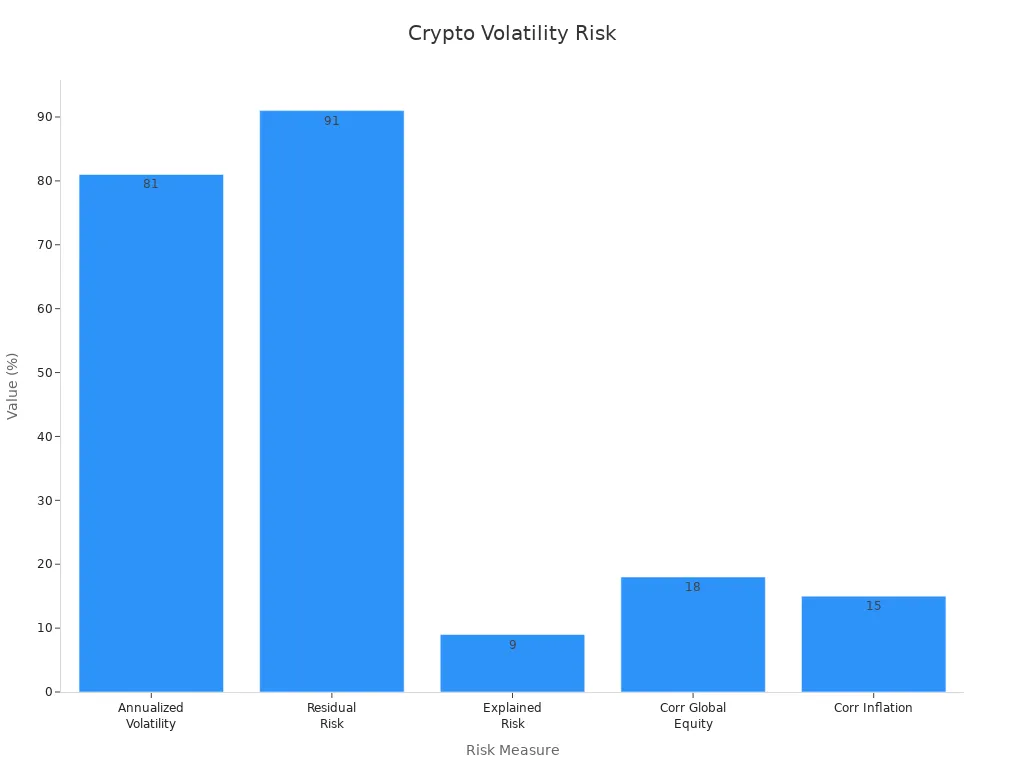
You should always remember that extreme volatility can lead to big gains but also large losses.
Security and Regulation
Security is a major concern for every crypto hedge fund. You trust the fund to keep your digital assets safe. However, risks like hacking, fraud, and poor management can put your money in danger. Crypto hedge funds must use strong security tools, such as cold storage and multi-signature wallets. Regular audits and clear reporting help protect your investment.
Regulation is another challenge. Laws about digital assets change often. Crypto hedge funds must follow rules from groups like the SEC and CFTC. They need to check if they have the right licenses and keep up with new laws. Good funds have strong risk policies and report risks to their boards. You should always ask how a fund handles security and follows the law.
Scams and Red Flags
Scams are a real threat in the crypto world. In 2022, scammers stole over $40 million using crypto ATMs. You should watch for red flags, such as:
Multiple payments from different ATM companies sent to one wallet
Sudden project shutdowns or missing managers
Promises of guaranteed high returns
Here is a table of common scams:
Scam Type | Description | Key Red Flags |
|---|---|---|
Investment Fraud | Fake investments or unregistered projects | Large funds sent to unknown platforms |
Ponzi & Pyramid Schemes | New investors pay old ones; no real profits | High returns, pressure to recruit others |
Pig Butchering Scams | Scammers build trust, then steal savings | Emotional manipulation, complex fund movement |
Exit Scams (Rugpulls) | Project leaders disappear with funds | Sudden shutdowns, missing updates |
You must do your own research before you invest in any crypto hedge fund. Always check for audits, clear management, and real business activity.
Choosing a Crypto Hedge Fund
Due Diligence
You need to do careful research before you invest in crypto hedge funds. Good due diligence helps you avoid scams and poor performance. Start by looking at how the fund reports its results. Reliable funds show clear data on returns, holdings, and how they value their assets. They also explain their risk management steps and current exposures.
Check if the fund follows rules set by regulators, such as filing SEC Form PF. Look for key numbers like Total Value to Paid-In Capital (TVPI), Distributed to Paid-In Capital (DPI), and Residual Value to Paid-In Capital (RVPI). These numbers help you see if the fund is growing and returning money to investors.
A strong fund uses good data controls. This means their reports are accurate, complete, and on time. You should also expect regular updates and clear reports in a standard format. Good corporate governance and strong operations show that a fund is trustworthy. Many top funds use advanced tools to make their reports better and faster.
Tip: Always ask for detailed investor updates and check if the fund uses independent audits.
Questions to Ask
You can spot problems early by asking the right questions. Here are some important things to check:
Does the fund have a professional website with up-to-date information?
Can you read a clear white paper that explains the fund’s goals and strategies?
Is there active community engagement on social media, like Twitter or Discord?
Who manages the fund, and do they have a good track record in crypto investment funds?
What do the market numbers show? Look at returns, volatility, and risk-adjusted returns like the Sharpe ratio.
How does the fund protect against big losses? Check for downside protection and steady outperformance.
What are the fees, and how long is your money locked up?
Does the fund share details about its holdings and risk controls?
You should also review the fund’s size and the reputation of its managers. Compare historical returns, fee structures, and transparency. These steps help you choose crypto hedge funds that match your goals and risk level.
Getting Started
Setting Goals
You should set clear goals before you invest in crypto hedge funds. Start by thinking about why you want to invest. Maybe you want to grow your wealth, learn about new technology, or try trading. Decide how much risk you can handle and how long you plan to invest. Use the SMART framework to help you. This means your goals should be Specific, Measurable, Achievable, Relevant, and Time-bound. For example, you might aim for a 10% return in one year or want steady growth over five years. Setting these goals helps you avoid chasing trends and keeps you focused.
Researching Funds
You need to research crypto funds carefully. Look for funds that share monthly performance data and use clear strategies. Reliable sources like the HFR database and VisionTrack give you information on fund returns, assets under management, and strategy types. Top-performing funds often show strong results in categories like Fundamental or Quant Directional strategies. Always check if the fund reports data every month and uses standard methods. This helps you compare funds and spot the best options.
Research Step | What to Look For |
|---|---|
Performance Data | Net-of-fees returns, monthly updates |
Strategy Segmentation | Composite, Fundamental, Quant, Market Neutral |
Data Sources | HFR, VisionTrack, fund websites |
Transparency | Consistent, clear reporting |
Risk Management
Managing risk is key when you invest in crypto funds. You can use dollar-cost averaging to spread out your investments over time. Set stop-loss and take-profit orders to limit losses and lock in gains. Hedge with options or futures to protect against big price swings. Rebalance your portfolio often to match your goals. Use tools like Value-at-Risk (VaR) to see how much you could lose in tough markets. These steps help you stay safe and make better choices.
Dollar-cost averaging
Stop-loss and take-profit orders
Hedging with derivatives
Regular portfolio rebalancing
Using risk tools like VaR
Tip: Always check if the fund uses strong risk controls and reports them clearly.
Security Tips
You must protect your investments from hacks and scams. Store large amounts of crypto in hardware wallets with strong encryption. Only keep small amounts in online wallets for daily use. Use real-time monitoring tools to watch for suspicious activity. Whitelist trusted addresses to stop fraud. Review wallet permissions often and remove old approvals. Diversify your holdings across different platforms and exchanges. Make sure the fund uses independent audits and has a plan for security incidents. Learn about common threats like phishing and always double-check before sending funds.
Ongoing Monitoring
Diversification
You need to keep your investments safe by spreading them across different assets. Diversification helps you lower risk and avoid big losses if one part of the market drops. Many crypto funds use several strategies to achieve this. Here is a table that shows common ways to diversify in the crypto world:
Diversification Strategy | Description | Examples / Models |
|---|---|---|
Asset Allocation | Spread your money across different cryptocurrencies. | Conservative: 60% Bitcoin, 30% Stablecoins, 10% Altcoins; Balanced: 40% Bitcoin, 40% Altcoins, 20% Stablecoins; Aggressive: 20% Bitcoin, 70% Altcoins, 10% Stablecoins |
Sector Diversification | Invest in different crypto sectors. | DeFi (Uniswap, Maker), NFTs (Decentraland), Layer 1 Protocols (Ethereum, Solana) |
Market Cap Diversification | Mix large, mid, and small market cap coins. | Conservative: 70% Large Cap, 20% Mid Cap, 10% Small Cap; Balanced: 50% Large Cap, 30% Mid Cap, 20% Small Cap; Aggressive: 30% Large Cap, 40% Mid Cap, 30% Small Cap |
Emerging Tech Investment | Add new blockchain projects for growth. | Polkadot (DOT), Chainlink (LINK), Cosmos (ATOM) |
You can also diversify by adding tokenized assets like real estate, art, or music. Some investors choose to buy into initial coin offerings (ICOs) for higher growth, but these carry more risk. Advanced strategies include using crypto derivatives or investing across different countries to manage regulatory risk. Remember, these methods can reduce risk, but they may also make your portfolio more complex.
Tip: Review your portfolio often and adjust your diversification as the market changes.
Staying Informed
You need to stay updated to make smart choices in the fast-moving crypto market. Reliable information helps you track your investments and spot new trends. VisionTrack is one of the best platforms for this. It gives you monthly reports on crypto hedge fund performance, market trends, and economic changes. You can search and sort data from over 2,000 funds worldwide. VisionTrack updates its database daily, so you always get the latest numbers.
VisionTrack offers fund-level details, including historical fees and lock-up periods.
The platform provides a premium research library and covers global funds.
You can use VisionTrack to compare different funds and see how your investments perform.
By using trusted sources, you can make better decisions and avoid surprises. Always check for updates and learn about new rules or risks in the crypto space. Staying informed helps you protect your money and grow your knowledge.
You have learned that crypto hedge funds offer high potential returns but also come with greater volatility than traditional funds. The table below shows that Bitcoin and Ethereum drive much of this performance, with Bitcoin having a strong positive effect. You should always research, stay cautious, and invest only what you can afford to lose. Keep learning and watch for changes in the crypto world.
Metric | Crypto Hedge Funds | Traditional Hedge Funds |
|---|---|---|
Mean Return | Higher | Lower |
Volatility | Higher | Lower |
Bitcoin Impact (Coefficient) | 0.68 | N/A |
Ethereum Impact (Coefficient) | 0.16 | N/A |
FAQ
What is the minimum investment for a crypto hedge fund?
Most crypto hedge funds require you to invest at least $100,000. Some funds may ask for more. Always check the fund’s rules before you decide to join.
Can you lose all your money in a crypto hedge fund?
Yes, you can lose your entire investment. Crypto prices change quickly. Funds can make risky trades. Only invest money you can afford to lose.
How do you know if a crypto hedge fund is safe?
You should look for independent audits, clear reports, and strong security. Ask for proof of licenses. Read reviews from other investors.
Tip: Never trust a fund that promises guaranteed returns.
How do you get your money out of a crypto hedge fund?
You must follow the fund’s withdrawal rules. Some funds let you take money out monthly. Others have lock-up periods. Always ask about exit terms before you invest.
Do crypto hedge funds pay taxes for you?
No, you are responsible for your own taxes. The fund may send you a tax form. You must report your gains or losses to the IRS.

