
If you compare kraken vs coinbase in 2025, Kraken clearly leads in security. Kraken stopped recent social engineering attacks, while Coinbase suffered a major breach that affected nearly 70,000 customers and cost up to $400 million. You see major differences: Kraken offers strong security, advanced crypto tools, and lower fees. Coinbase stands out for user-friendliness and strict regulatory compliance. Choosing the right exchange depends on your needs. Beginners often prefer Coinbase for its simple experience. Advanced crypto users choose Kraken for its features and protection.
Metric | Coinbase (2025) | Kraken (2025) |
|---|---|---|
Verified Users (U.S.) | ||
30-Day Trading Volume | $350 billion (retail) | $60 billion |
Customer Assets | N/A | $42.8 billion |
Key Takeaways
Kraken offers stronger security with no major hacks, proof-of-reserves audits, and advanced cold storage, making it ideal for experienced users who value transparency and protection.
Coinbase provides a beginner-friendly platform with easy navigation, insurance coverage for digital assets and USD balances, and independent security audits, giving extra peace of mind.
Kraken has lower trading fees, more advanced trading tools, and supports a wider range of cryptocurrencies and staking options, which benefits active and professional traders.
Coinbase excels in fast onboarding, simple design, and unique features like a Visa crypto card and an NFT marketplace, making it great for new crypto investors.
Both exchanges comply with strict regulations and offer two-factor authentication, but Kraken leads in cryptographic transparency while Coinbase focuses on public audits and insurance.
Kraken vs Coinbase Overview
Quick Comparison Table
Aspect | Kraken | Coinbase |
|---|---|---|
Security | ISO/IEC 27001:2013 certified, SOC 2, cold storage, 2FA, no major hacks | Publicly traded, cold storage, 2FA, FDIC insurance, past breaches |
Features | 200+ cryptocurrencies, margin, futures, staking, Forex, OTC, dark pool | 250+ cryptocurrencies, staking, debit card, social trading, easy wallet |
Usability | Advanced tools, supports many fiat currencies, best for experienced | Beginner-friendly, simple app, fewer fiat options, large user base |
Fees | Lower trading fees, free crypto deposits, variable withdrawal fees | Higher trading fees, 25% staking commission, some free ACH, higher wires |
Compliance | Licensed globally, strong KYC/AML, operates in 190+ countries | Publicly listed, strict US/EU/Asia licenses, some staking limits |
Customer Support | 24/7 chat, email, phone, positive reviews | 24/7 support, mixed reviews, some delays |
Main Differences
When you compare kraken vs coinbase, you see two very different approaches to a cryptocurrency exchange. Kraken focuses on advanced crypto trading platform features, lower fees, and strong security. You get access to margin trading, futures, Forex, and dark pool trading. Kraken also supports more fiat currencies for deposits and offers staking for non-US clients. Its security features include ISO/IEC 27001:2013 certification, SOC 2 audits, and cryptographically verifiable proof-of-reserves. Kraken has not reported any major hacks, which builds trust among experienced crypto users.
Coinbase, on the other hand, stands out for its user-friendly design and regulatory compliance. If you are new to crypto, you will find Coinbase easy to use. The platform offers over 240 cryptocurrencies, a debit card for spending, and social trading through TradingView. Coinbase provides FDIC insurance for USD deposits and covers fiat assets, but it has faced security breaches in the past. Its regulatory compliance is strong, with licenses in the US, Europe, and Asia.
Security

Security Practices
When you choose a cryptocurrency exchange, security should be your top priority. Both Kraken and Coinbase invest heavily in security measures to protect your assets. Kraken uses a multi-layer security approach that includes cold storage, advanced security protocols, and continuous monitoring. Over 95% of user funds stay in air-gapped cold storage, protected by physical security and surveillance. You benefit from strong security features like encrypted communications and a dedicated security team. Kraken also performs regular proof of reserves audits, which increase transparency and trust.
Coinbase also takes security seriously. The platform holds 98% of user funds in cold storage, using multi-signature vaults for large withdrawals. Coinbase stands out as the first crypto custodian to receive both SOC 1 and SOC 2 Type 2 certifications from Deloitte in the past year. These independent audits confirm Coinbase’s controls over security, privacy, and financial reporting. You get state-of-the-art security with multi-factor authentication, cold storage solutions, and strict internal controls.
Security Practice | Kraken | Coinbase |
|---|---|---|
Cold Storage | 95%+ of funds, air-gapped, physical security | 98% of funds, multi-signature vaults |
Proof of Reserves | Regular third-party audits | Not published |
Security Certifications | No new audits in past year | SOC 1 & SOC 2 Type 2 by Deloitte |
Security Team | Dedicated, 24/7 monitoring | Dedicated, 24/7 monitoring |
Advanced Security | Yes | Yes |
Both exchanges require two-factor authentication for account access. Kraken supports hardware security keys and FIDO2 protocols for sign-in and master key functions. Coinbase offers passkeys, biometric authentication, and hardware security keys for multi-factor authentication. You can see that both platforms use comprehensive security measures, but Coinbase leads in independent security certifications.
Insurance
Insurance coverage adds another layer of user safety. Coinbase provides insurance for digital assets held online and offers FDIC insurance for USD balances up to $250,000. This means you have some protection if a security breach affects your fiat funds. Coinbase also covers digital assets with crime insurance, which protects against theft from hacking.
Kraken does not specify insurance coverage for digital assets. The platform relies on strong security features, cold storage, and strict withdrawal protocols to reduce risk. Both exchanges use hot and cold wallet storage, but only Coinbase clearly states its insurance policies.
Feature | Kraken | Coinbase |
|---|---|---|
Cold Storage | Yes, for most funds | Yes, for most assets |
Insurance Coverage | Not specified | Yes, digital asset insurance |
FDIC Insurance | No | Yes, for USD balances |
Additional Security | Master key, strict withdrawals | Vault, 24-hour withdrawal delay |
Note: Insurance does not cover losses from your own mistakes, such as sharing passwords or falling for phishing scams. Always use strong security measures and multi-factor authentication to protect your account.
User Protections
You want to know your crypto exchange has your back. Kraken and Coinbase both offer user protection features to keep your account safe. Kraken uses two-factor authentication, encrypted communications, and a Global Settings Lock (GSL) to prevent unauthorized changes. The platform secures its servers with physical barriers and advanced software security.
Coinbase provides two-factor authentication, account locking, and the Coinbase Vault. The Vault requires co-signed transactions and a 24-hour delay for withdrawals, giving you extra time to react if someone tries to access your funds. Both exchanges have account lock or freeze mechanisms. If you notice suspicious activity, you can freeze your account and work with support to restore access.
Kraken user protections:
Two-factor authentication
Encrypted communications
Global Settings Lock (GSL)
Physical server security
Account lock/freeze procedures
Coinbase user protections:
Two-factor authentication
Account locking
Coinbase Vault with withdrawal delay
Insurance on digital assets
Account freeze and recovery steps
If a security breach occurs, Coinbase has publicly committed to reimbursing affected customers, as seen after the December 2024 incident. The company also offers free credit monitoring and identity protection for one year. This gesture shows a commitment to user safety, even though it is not a legal requirement. Kraken has not reported major breaches or compensation policies, which reflects its strong security record.
Security Verdict
You want a crypto exchange that puts security first. Kraken and Coinbase both deliver comprehensive security measures, but their approaches differ. Kraken stands out for its clean security record, regular proof of reserves audits, and transparent security practices. You get advanced security and multi-factor authentication, with over 95% of funds in cold storage. Kraken’s state-of-the-art security and multi-layer security protocols make it a top choice for experienced users who value transparency and strong security features.
Coinbase excels in independent security certifications, insurance coverage, and user-friendly security features. You benefit from 98% cold storage, multi-factor authentication, and insurance for digital assets and fiat funds. Coinbase’s state-of-the-art security and comprehensive security measures make it ideal for beginners and those who want extra peace of mind.
Tip: Choose Kraken if you want advanced security, transparency, and a proven track record. Pick Coinbase if you value insurance, independent audits, and user-friendly security features.
In 2025, both Kraken and Coinbase set high standards for security in the cryptocurrency exchange industry. Your choice depends on whether you prioritize transparency and advanced security or prefer insurance and certified security protocols.
Features
Trading Tools
You want powerful trading tools when you use a crypto trading platform. Kraken and Coinbase both offer advanced options, but they serve different types of users. Kraken gives you multiple interfaces. You can start with a simple layout or move to the professional Kraken Terminal. This terminal includes integrated charting, technical indicators, and a wide range of order types. You can use Market, Limit, Stop Loss, Take Profit, and more. If you want even more control, you can connect the Good Crypto app to access trailing stops and other advanced orders.
Coinbase focuses on simplicity. Its main interface feels like a banking app. You get Market, Stop, and Limit orders. Coinbase Advanced Trade adds TradingView charts, but you still find fewer order types than on Kraken. This makes Coinbase a good choice for beginners, while Kraken appeals to experienced traders who want more customization.
Feature | Kraken | Coinbase Advanced Trade |
|---|---|---|
Simple, Advanced, Kraken Terminal (pro tools, charting) | Beginner-friendly, TradingView charts | |
Order Types Supported | Market, Limit, Stop Loss, Take Profit, Trailing Stop, and more | Market, Stop, Limit |
Target User | Beginners to professionals; advanced customization | Beginners; easy to use |
Additional Notes | Kraken Pro combines spot, margin, and staking; Good Crypto app extends order types | Educational tools, fewer advanced trading features |
You can see that Kraken stands out for its trading features. You get more order types and deeper customization. Coinbase keeps things simple, which helps new users feel comfortable.
Feature | Kraken | Coinbase |
|---|---|---|
Up to 3x (spot) | Up to 5x | |
Futures Leverage | Up to 50x | Up to 20x (commodity), 5x (crypto) |
Fees | 0.02% maker, 0.05% taker; rollover fees every 4 hours | 0.06% taker fees; 8% annualized interest |
Available Cryptos | 250+ | 250+ |
Funding Options | Fiat, Crypto, Card | Coinbase Pro Account |
Additional Features | Advanced API, proof of reserves, pro trading interface | US regulated by CFTC, simple to use |
Disadvantages | Smaller number of supported cryptos | Lesser known cryptos unavailable |
Supported Assets
You want access to a wide range of cryptocurrencies. Both Kraken and Coinbase support over 250 assets. Kraken lets you trade major coins, stablecoins, and many altcoins. You can also trade Forex pairs and access dark pool trading for privacy. Coinbase offers a similar number of assets, but focuses on the most popular and regulated coins. You can buy, sell, and hold all ERC-20 tokens and assets on EVM-compatible networks.
Kraken supports 9 blockchains and over 2,000 cryptocurrencies for wallet storage. Coinbase supports all ERC-20 tokens and EVM networks, making it easy to manage your crypto portfolio. If you want to explore less common coins, Kraken gives you more options. If you want mainstream coins and tokens, Coinbase covers your needs.
Staking and Earning
You can earn passive income by staking your crypto. Kraken and Coinbase both offer staking, but their programs differ. Kraken supports staking for 24 cryptocurrencies, including Ethereum, Solana, and stablecoins. You can choose bonded staking for higher yields or flexible staking for more liquidity. Kraken offers estimated annual yields that vary by asset and staking type.
Asset | Bonded Staking APR | Flexible Staking APR |
|---|---|---|
Ethereum (ETH) | 2.25% – 6.5% (14 days) | 1% – 3% |
Solana (SOL) | 7% – 12% (3 days) | 3% – 6% |
Cardano (ADA) | N/A | 2% – 6% |
Cosmos (ATOM) | 14% – 20% (21 days) | 7% – 11% |
Kraken charges a commission on staking rewards. The rate drops as you stake more ETH, starting at 20% and going down to 10% for large amounts. This commission is lower than Coinbase, which charges about 25% on staking rewards.
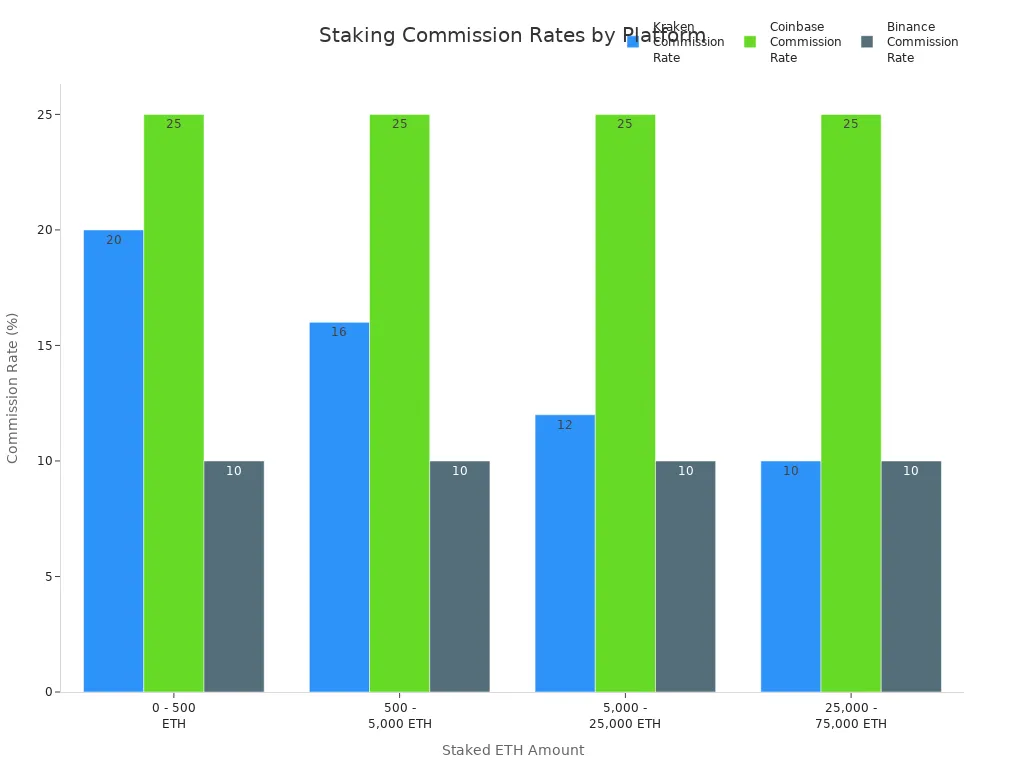
Coinbase offers staking for Ethereum and Solana, with yields around 2.23% for ETH and 7.05% for SOL. You can stake in the US on Coinbase, but Kraken does not offer staking to US users due to regulations. Coinbase makes staking easy for beginners, but you pay a higher commission.
Note: Staking rewards and availability can change based on regulations and network conditions. Always check the latest rates and supported assets before you stake your crypto.
Unique Offerings
You want to know what sets each crypto trading platform apart. Kraken and Coinbase each have unique features that make them stand out.
Feature/Product Category | Kraken (Unique Features) | Coinbase (Unique Features) |
|---|---|---|
Futures Trading | Demo account for futures; 300+ perpetual contracts; up to 5x leverage | Zero trading fees on perpetual futures (limited time); up to 20x leverage on commodities |
NFT Marketplace | NFT marketplace closed in 2025; withdrawal-only | Native NFT marketplace for trading and minting NFTs |
Crypto Wallet Support | 9 blockchains, 2,000+ cryptocurrencies | All ERC-20 tokens, EVM-compatible networks |
Card Offering | None | Visa card for US users with crypto rewards |
Staking | Available in 37 US states, 17 assets, APY up to 17% | Staking for 147 assets, APY up to 12%, flex staking |
Security & Certifications | ISO/IEC 27001:2013, Proof of Reserves, bug bounty, never breached | Multi-approval withdrawals, auto-enrolled 2FA, Vault |
Apps | Desktop app, three mobile apps for different users | Beginner-friendly app, advanced charting for Advanced users |
Educational Programs | N/A | Learning Rewards program (earn by learning) |
Premium Subscription | N/A | Coinbase One: zero trading fees, boosted staking rewards |
Kraken gives you a demo account for futures trading, advanced security, and a professional desktop app. Coinbase offers a Visa card, a native NFT marketplace, and a Learn and Earn program. If you want to try new products or earn rewards for learning, Coinbase gives you more options. If you want advanced trading features and security, Kraken stands out.
Features Verdict
You want the best features for your crypto journey. Kraken leads in advanced trading tools, order types, and customization. You get more control, deeper analytics, and a professional experience. Kraken also offers lower staking commissions and a demo account for futures trading. If you are an experienced trader or want to explore advanced features, Kraken is your top choice.
Coinbase shines for beginners. You get a simple interface, easy staking, and a wide range of educational resources. Coinbase offers unique products like a Visa card and a native NFT marketplace. If you want a user-friendly crypto trading platform with strong educational support, Coinbase fits your needs.
User reviews and expert ratings confirm these strengths. Kraken scores higher for advanced features and value for money. Coinbase wins for ease of use and educational content. Both platforms offer strong features, but your choice depends on your experience level and what you want from your crypto trading platform.
Usability
Interface
You want a crypto exchange that feels easy to use. Coinbase gives you a clean, minimalist design. You see simple buy and sell buttons and basic portfolio tracking. The layout helps you find what you need fast. Beginners often prefer Coinbase because the navigation feels natural and the interface does not overwhelm you.
Kraken takes a different approach. The platform shows you more trading data, order books, and charts right away. This information-rich layout helps active traders make quick decisions. If you want advanced trading tools, Kraken delivers. The interface may feel complex at first, but you gain powerful features as you learn. Both exchanges offer mobile apps that match their desktop style. Coinbase keeps things simple, while Kraken gives you a full trading command center.
Coinbase | Kraken | |
|---|---|---|
Design | Minimalist, beginner-friendly | Information-dense, advanced tools |
Navigation | Simple, quick buy/sell | Detailed, trading-focused |
Mobile App | Easy to use | Powerful, feature-rich |
Onboarding
You want to start trading quickly. Coinbase makes onboarding fast. You sign up, verify your identity, and begin trading in minutes. The process feels smooth and clear. You also get educational resources that help you understand crypto basics.
Kraken asks for more information during signup. The verification process takes longer, especially if you want higher withdrawal limits. You may need to upload documents and wait for approval. This extra step adds security but can slow you down. Once you finish onboarding, Kraken opens up advanced features for you.
Support
You need reliable support when using a crypto exchange. Kraken offers 24/7 support through live chat, phone, email, and a chatbot. Some users report that Kraken resolves problems in about 20 minutes. However, reviews show mixed satisfaction. Common complaints include delayed responses and account lockouts.
Coinbase also provides 24/7 support by chatbot, phone, and email. The team follows strict security rules and never asks for your password or multi-factor authentication codes. While Coinbase does not share detailed response times, you can expect professional help at any hour.
Usability Verdict
You want an exchange that matches your experience level. Choose Coinbase if you value a simple interface, fast onboarding, and easy navigation. The platform works best for beginners and casual users. Pick Kraken if you want advanced trading tools and do not mind a steeper learning curve. Kraken suits active traders who need detailed data and robust features. Both exchanges support multi-factor authentication, so you stay secure while trading.
Fees
Trading Fees
When you trade on an exchange, fees can impact your profits. Kraken uses a maker-taker fee model. You pay as little as 0.16% for makers and 0.26% for takers. If you trade more, your fees drop. Kraken rewards high-volume traders with lower rates. Coinbase charges higher trading fees. You pay up to 0.60% for takers and 0.40% for makers on the standard platform. Coinbase Advanced Trade offers lower fees, but they still remain above Kraken for most users. If you want to save on trading costs, Kraken gives you a clear advantage.
Other Costs
You need to watch for extra costs beyond trading fees. Kraken does not charge for deposits. You can fund your account with a bank transfer or crypto deposit for free. For withdrawals, Kraken charges a fixed fee for each cryptocurrency. For example, you pay 0.0002 BTC to withdraw Bitcoin. Fiat withdrawals have variable fees, depending on the method and currency. Some methods are free, while others cost up to $35. Kraken also uses a 72-hour withdrawal lock for first-time deposits, which adds security.
Coinbase offers free ACH deposits and withdrawals in the US. Other deposit methods come with fees. If you use wire transfers or cards, you pay extra. Coinbase charges fixed fees for crypto withdrawals and passes on network fees. You can subscribe to Coinbase One for about $30 per month. This subscription removes trading fees and gives you other perks.
Fee Type | Kraken Details | Coinbase Details |
|---|---|---|
Deposit Fees | Free bank transfer deposits for US and European banks; no deposit fees for crypto deposits. | Free deposits only via ACH; fees apply for other deposit methods even within the US. |
Withdrawal Fees | Fiat withdrawals via bank transfer only; fees vary by currency and method (e.g., USD fees range from free to $35); minimum withdrawal limits apply. Crypto withdrawals have fixed fees per coin (e.g., 0.0002 BTC for Bitcoin). | Free ACH withdrawals; fixed fees charged for other withdrawal methods. |
Crypto Network Fees | Both platforms charge network fees for crypto transactions, which fluctuate with network conditions. | Both platforms charge network fees for crypto transactions, which fluctuate with network conditions. |
Additional Notes | Kraken offers more flexible deposit and withdrawal options with tiered fees; some first-time deposits trigger a 72-hour withdrawal lock. | Coinbase offers a subscription (Coinbase One) for ~$30/month with zero trading fees, relevant for fee considerations. |
Note: Both Kraken and Coinbase charge network fees for crypto transactions. These fees change based on blockchain activity.
Value Verdict
You want the best value from your exchange. Kraken stands out for low trading fees, free deposits, and flexible withdrawal options. You keep more of your profits, especially if you trade often. Coinbase offers a simple experience but charges higher fees unless you subscribe to Coinbase One. If you want to minimize costs and maximize value, Kraken is the better choice for most traders. Coinbase may suit you if you value convenience and do not mind paying extra for ease of use and insurance on fiat funds held in cold storage.
Compliance
Regulatory Status
You need to know if your crypto exchange meets the highest standards for regulatory compliance. Both Kraken and Coinbase operate under strict rules in the US and Europe. Kraken holds a MiCA license in the EU, granted by the Central Bank of Ireland. This license allows Kraken to offer regulated digital asset services across 30 European countries. In the US, Kraken moved its headquarters to Wyoming and secured a special-purpose bank charter. This charter lets Kraken provide deposit and custody services under state and federal supervision. The SEC dropped a civil lawsuit against Kraken in March 2024, showing a more cooperative approach to regulatory compliance.
Coinbase also focuses on regulatory compliance. The company chose Luxembourg as its EU base and expects to receive a MiCA license soon. In the US, Coinbase operates under federal oversight but does not have a special state-level charter like Kraken. Both exchanges show strong commitment to following local laws and regulations.
Exchange | Jurisdiction | Regulatory Status | Details |
|---|---|---|---|
Kraken | EU | Holds MiCA license | Licensed by Central Bank of Ireland, enabling fully regulated digital asset services across 30 EEA member states. |
Kraken | US (Wyoming) | Special-purpose bank charter | Relocated global HQ to Wyoming, a crypto-friendly state; holds a bank charter allowing deposit-taking and custody services under state and federal supervision. |
Kraken | US (Federal) | Regulatory cooperation | SEC dropped civil lawsuit in March 2024, indicating a more cooperative regulatory stance. |
Coinbase | EU | Expected MiCA license | Chose Luxembourg as EU base for regulatory clarity and innovation; expected to obtain MiCA license soon. |
Coinbase | US | Operates under federal oversight | Continues to operate under US federal regulatory framework without special state-level charters. |
Transparency
Transparency helps you trust your exchange. Kraken leads the industry by offering full Proof of Reserves. You can verify your bitcoin and ether balances using cryptographic tools. Independent accounting firms audit these reserves and publish detailed reports. Kraken also holds ISO 27001 certification and meets SOC 2 standards. You get 24/7 support if you have questions about audits or security.
Coinbase takes a different approach to transparency. As a publicly traded company, Coinbase undergoes annual audits by Deloitte. The company does not use Proof of Reserves. Instead, Coinbase founder Brian Armstrong says that institutional clients prefer regulatory audits over public cryptographic proofs. Some industry leaders have criticized this choice. Coinbase relies on regulatory compliance and financial audits to build trust, but it does not offer the same level of cryptographic transparency as Kraken.
Note: Kraken has never experienced a major hack and provides advanced security controls. Coinbase suffered a data breach in 2025, which exposed sensitive user data. This difference may affect your trust in each platform’s transparency and security.
Trust Verdict
You want to choose an exchange with a strong reputation for regulatory compliance and public trust. Kraken claims a 90% client satisfaction rating and receives high marks for customer support. Independent auditors rank Kraken #1 in security and customer service. The platform holds licenses in the US, Canada, UK, Australia, and Japan. Kraken remains well-funded and respected in the crypto industry. However, Kraken faces an ongoing lawsuit with the SEC, which it plans to defend.
Coinbase does not have a specific public trust rating, but it remains a well-known name in crypto. The company’s regulatory compliance and public audits help build confidence. However, the lack of Proof of Reserves and the recent data breach may concern some users.
Choose Kraken if you value cryptographic transparency, strong regulatory compliance, and a proven security record.
Choose Coinbase if you prefer a platform with public audits and a focus on regulatory compliance, even if it does not offer Proof of Reserves.
Choosing the right crypto exchange depends on your needs. If you want advanced security and professional trading tools, kraken stands out for experienced users. coinbase works best for beginners, offering a simple interface, insurance, and strong regulatory transparency. Both platforms support two-factor authentication and cold storage for your cryptocurrency.
kraken: Best for advanced traders, higher staking rewards, and security-focused users.
coinbase: Ideal for new crypto investors, easy navigation, and insurance coverage.
Explore demo accounts or official resources to see which platform fits your crypto journey. Stay informed as the cryptocurrency world evolves.
FAQ
Is Kraken safer than Coinbase in 2025?
You get stronger security with Kraken. The platform has never reported a major hack. Kraken uses proof-of-reserves audits and advanced cold storage. Coinbase offers insurance and independent audits, but it experienced a breach in 2025.
Tip: Always enable two-factor authentication for extra protection.
Which exchange has lower fees for trading?
Kraken charges lower trading fees than Coinbase. You pay as little as 0.16% for makers and 0.26% for takers on Kraken. Coinbase fees start higher unless you subscribe to Coinbase One.
Exchange | Maker Fee | Taker Fee |
|---|---|---|
Kraken | 0.16% | 0.26% |
Coinbase | 0.40% | 0.60% |
Can beginners use Kraken or Coinbase easily?
You find Coinbase easier to use. The interface feels simple and clear. Kraken offers more advanced tools, which may feel complex at first. Beginners often start with Coinbase, then move to Kraken as they gain experience.
Coinbase: Best for new users
Kraken: Best for advanced traders
Does either platform offer insurance for your funds?
Coinbase provides insurance for digital assets and FDIC insurance for USD balances up to $250,000. Kraken does not specify insurance coverage but relies on strong security and cold storage.
Note: Insurance does not cover losses from your own mistakes, like sharing passwords.

