

Recent data highlights a clear winner in the kraken exchange vs coinbase debate when it comes to security. Kraken stands out due to its robust defenses and zero reported breaches over the past three years. In contrast, Coinbase faced a major data breach in May 2025, exposing sensitive information of nearly 70,000 users and leading to significant financial losses. Security, fees, and trading tools affect every trader differently. An in-depth review helps users find the platform that matches their needs best.
Key Takeaways
Kraken offers stronger security with no breaches in recent years and advanced protections like cold storage and regular audits.
Coinbase provides a beginner-friendly experience with simple trading, educational resources, and FDIC insurance for USD balances.
Kraken supports more cryptocurrencies, advanced trading tools like margin and futures, and generally lower fees for active traders.
Coinbase suits new users who want easy deposits, a simple interface, and quick access to popular cryptocurrencies.
Choosing between Kraken and Coinbase depends on your experience, trading needs, and priorities for security, fees, and features.
kraken exchange vs coinbase
Key Differences
The kraken exchange vs coinbase comparison reveals clear distinctions in security, trading features, fees, and user suitability. Both platforms rank among the most popular cryptocurrency exchanges, but each targets different types of users and trading needs.
Feature | Kraken | Coinbase |
|---|---|---|
Security | 95% cold storage, 2FA, encryption, audited Proof of Reserves, bug bounty | 98% cold storage, FDIC insurance, 2FA, PGP encryption, physical security keys |
Trading Features | Advanced charting, derivatives trading, margin trading (select users) | Advanced charting, derivatives trading (non-US customers), beginner-friendly interface |
Fees | 0 – 0.40% (volume-based discounts), higher instant buy fees | 0 – 0.60%, generally beginner-friendly fee structure |
User Suitability | Better for experienced traders, advanced features, steeper learning curve | Best for beginners and casual users, easy-to-use interface, educational Learn and Earn |
Customer Support | Faster, higher quality support via phone, email, live chat | Offers phone and live chat support, criticized for slower response, priority support via subscription |
Availability | 190+ countries, limited fiat options (7 fiat currencies) | 100+ countries, supports more fiat currencies |
Mobile App | Advanced interface, biometric authentication, price alerts | Better user experience, biometric authentication, Web3 dApp browser, Apple & Google Pay support |
Regulatory Issues | Settled with US Treasury OFAC for sanctions violation | Facing SEC legal challenges related to securities registration and staking program |
Security stands as a major differentiator. Kraken employs air-gapped cold storage for 95% of assets, FIDO2-based two-factor authentication, and regular proof of reserves audits. The platform also holds ISO/IEC 27001:2013 and SOC 2 Type I certifications. Coinbase, on the other hand, stores 98% of funds in cold wallets, uses multiparty computation, and provides FDIC insurance for USD balances. However, Coinbase does not publish public proof of reserves audits and experienced a data breach in May 2025.
Trading features also set these cryptocurrency exchanges apart. Kraken offers advanced order types, margin trading, and a broader range of trading pairs. Coinbase focuses on simplicity, providing a user-friendly interface and educational resources for beginners. Both exchanges support derivatives trading, but only Kraken provides a wider selection of fiat currencies for institutional users.
Fees differ significantly. Kraken uses a tiered fee structure, with maker fees starting at 0.25% and taker fees at 0.40%, dropping with higher trading volumes. Instant buy fees can reach 1.5%. Coinbase charges up to 0.60% for trading, with a more straightforward fee schedule for beginners. Both exchanges offer discounted fees for high-volume traders, but Kraken remains more cost-effective for active users.
User suitability depends on experience level. Coinbase best serves beginners and retail investors with its intuitive interface and educational content. Kraken appeals to advanced traders and institutions, offering sophisticated tools, lower trading fees, and enhanced security features.
Tip: Beginners may find Coinbase easier to navigate, while experienced traders benefit from Kraken’s advanced features and lower costs.
Quick Comparison
A side-by-side look at kraken exchange vs coinbase highlights their strengths and weaknesses:
Aspect | Coinbase | Kraken |
|---|---|---|
Target User Base | Beginners, new users | Experienced traders |
User Interface | Intuitive, simple, user-friendly | More complex, advanced |
Educational Resources | Learn and Earn program to educate users | Limited educational resources |
Trading Features | Basic buying/selling, Coinbase Advanced for more | Advanced order types, margin, futures trading |
Fiat Currency Support | Wide range, easy bank and payment integration | More limited fiat currency support |
Security Measures | FDIC pass-through insurance, cold storage, 2FA | Air-gapped cold storage, Telegram support |
Fees | Higher transaction fees | Lower trading fees (starting at 0.25% maker) |
User Experience Focus | Simplicity, accessibility, educational support | Advanced trading capabilities, cost efficiency |
Kraken and Coinbase both offer 24/7 customer support, but Kraken’s response times and escalation process often outperform Coinbase, especially during periods of high demand. Kraken also supports a wider range of cryptocurrencies, with over 350 assets available, compared to Coinbase’s more limited selection.
Actionable Verdict:
U.S. users who value ease of use, seamless deposits and withdrawals, and staking options may prefer Coinbase.
International users, advanced traders, or those seeking lower fees, more cryptocurrency options, and enhanced security should consider Kraken.
Both exchanges provide strong security, but Kraken’s transparency and certifications give it an edge for users prioritizing operational resilience.
Beginners benefit from Coinbase’s educational resources and simple interface, while Kraken suits those ready for advanced trading tools and lower trading costs.
Note: Users should review geographic restrictions and withdrawal lock periods before choosing between coinbase vs kraken.
Overview of Kraken and Coinbase
Kraken Overview
Kraken stands as one of the oldest and most respected names among cryptocurrency exchanges. Jesse Powell founded Kraken in San Francisco in 2011, motivated by the need for a secure crypto exchange after the Mt. Gox hack. The platform launched officially in 2013, focusing on Bitcoin spot trading and prioritizing security and transparency. Over the years, Kraken expanded its offerings to include more cryptocurrencies, fiat pairs, and advanced trading features.
Year | Milestone Description |
|---|---|
2011 | Kraken founded by Jesse Powell in San Francisco. |
2013 | Official launch with Bitcoin spot trading. |
2014 | Listed on Bloomberg Terminals, signaling legitimacy. |
2016 | Acquired Coinsetter and Cavirtex, expanding in North America. |
2017 | Significant growth during crypto bull run. |
2018 | Launched OTC desk for high-volume traders. |
2019 | Acquired Crypto Facilities, entering futures trading. |
2020 | Secured Wyoming SPDI banking charter. |
2022-2025 | Focused on regulatory compliance, DeFi, and new product development. |
Kraken built trust by using robust security measures like cold storage and proof-of-reserves audits. The exchange also became one of the first to offer institutional-grade services. Today, Kraken supports hundreds of cryptocurrencies and serves users in over 190 countries. Many consider Kraken a trusted cryptocurrency exchange for both retail and institutional clients.
Coinbase Overview
Coinbase began in 2012 when Brian Armstrong and Fred Ehrsam set out to make Bitcoin trading simple and secure. The company received early funding from Y Combinator and quickly grew its user base. Coinbase launched its trading platform in 2013, making it easy for anyone to buy and sell cryptocurrency.
Year | Key Milestone |
|---|---|
2012 | Coinbase founded by Armstrong and Ehrsam. |
2013 | Platform launch, expanding user access. |
2015 | Introduced API for developers, raised $75 million in Series C funding. |
2016 | Began supporting Ethereum. |
2017 | Launched Coinbase Custody and Wallet, valuation surpassed $1 billion. |
2018 | Launched Coinbase Pro for advanced trading. |
2021 | Direct listing on Nasdaq, valued at $85 billion. |
2023 | Reported $95 million net income in Q4. |
Coinbase expanded its services to include more cryptocurrencies, institutional products, and developer tools. The exchange became the first major crypto exchange to go public in 2021. Today, Coinbase remains a popular choice for beginners and institutions, offering a user-friendly interface and strong regulatory compliance. The platform supports a wide range of cryptocurrencies and continues to innovate in the crypto industry.
Security Comparison

Security on Kraken
Kraken has built a reputation for industry-leading security. The platform uses advanced security protocols to protect user funds and data. Key security features include:
Most user funds are stored in offline, air-gapped cold storage, reducing exposure to online threats.
Advanced encryption protects both infrastructure and user data.
Regular Proof of Reserves audits by external auditors verify asset backing and transparency.
Two-factor authentication is mandatory for login, withdrawals, and trading, with support for authenticator apps and hardware security keys.
Identity verification requires government-issued IDs, proof of address, and face photos.
Withdrawal address whitelisting restricts transfers to pre-approved addresses.
Kraken monitors accounts for suspicious activity and provides access logs for users.
The platform complies with global regulations and maintains robust internal controls.
Kraken holds ISO/IEC 27001 and SOC 2 Type I certifications. The exchange earned a triple-A security ranking from CER, passing penetration tests and maintaining a public bug bounty program. Its data centers remain undisclosed, guarded 24/7, and no single person can access physical systems alone. These advanced security measures have helped Kraken avoid major breaches, making it a trusted choice for users seeking high-level security.
Security on Coinbase
Coinbase also implements industry-leading security to protect its users. The platform uses AES-256 encryption, a standard in banking, to secure sensitive information. About 98% of customer funds are kept offline in geographically distributed cold wallets. Security features include:
Two-factor authentication is required, with options like SMS, authenticator apps, and hardware security keys.
Address whitelisting restricts withdrawals to approved addresses.
Biometric logins and passkeys, such as fingerprint and facial recognition, add another layer of protection.
Vault services require multiple approvals and a 48-hour withdrawal delay.
Real-time alerts notify users of suspicious activity.
Coinbase holds crime insurance for digital assets and FDIC insurance for fiat balances up to $250,000.
The platform complies with KYC and AML regulations, collecting personal data to prevent fraud.
After a data breach in 2025, Coinbase improved monitoring, added scam awareness prompts, and expanded employee security training. The exchange also holds SOC 1 Type 2 and SOC 2 Type 2 certifications for its custody services, audited by Grant Thornton LLP. These steps show Coinbase’s commitment to advanced security and user protection.
Security Verdict
Security Aspect | Kraken | Coinbase |
|---|---|---|
History of Hacks | Never hacked | Experienced a hack in 2021 and 2025 |
Two-Factor Authentication | Yes | Yes |
Encryption | Yes | Yes |
Customer Funds Held Offline | 1:1 reserve | 1:1 reserve |
Proof of Reserves | Audited | Audited |
Insurance Coverage | None currently | FDIC and crime insurance |
Security Certifications | ISO 27001, SOC 2 Type I, CER AAA | SOC 1 Type 2, SOC 2 Type 2 |
Kraken stands out for its advanced security, transparency, and clean breach record. Coinbase matches many security features but has faced breaches, prompting further improvements. Both exchanges offer industry-leading security, but Kraken’s high-level security and certifications give it an edge for users who prioritize operational resilience.
Trading Features

Supported Assets
Kraken and Coinbase both support a wide range of cryptocurrency assets. Kraken lists over 350 cryptocurrencies, making it one of the top choices for users who want access to a large number of cryptocurrencies supported. Coinbase, while not as extensive, still offers more than 240 cryptocurrencies. Both platforms cover major coins like Bitcoin, Ethereum, and Solana. Users who want to trade a diverse portfolio will find both exchanges suitable, but Kraken stands out for those who prioritize the number of cryptocurrencies supported.
Users seeking exposure to new or emerging cryptocurrency projects often choose Kraken for its broader selection.
Trading Tools
Advanced trading tools help users manage risk and maximize returns. Kraken provides margin trading with up to 5x leverage and futures trading with up to 50x leverage. Coinbase does not offer margin or futures trading. Both exchanges feature professional trading terminals and API access for automated strategies. Kraken supports advanced order types through third-party apps, while Coinbase offers limited options.
Advanced Trading Tool | Kraken Availability | Coinbase Availability |
|---|---|---|
Margin Trading | Yes, up to 5x leverage | No |
Futures Trading | Yes, up to 50x leverage | No |
Professional Trading Terminal | Yes | Yes |
API Access | Yes, supports API keys for trading | Yes, supports API keys for trading |
Advanced Order Types | Yes, via third-party apps | Limited (not specified) |
Traders who need leverage or futures products often select Kraken. Coinbase appeals to those who prefer a simpler trading experience.
Staking and Rewards
Both Kraken and Coinbase offer staking and rewards programs. Kraken supports staking for 24 cryptocurrencies, including Ethereum and Solana. Users can choose between bonded (lock-up) and flexible staking. Bonded staking on Kraken yields higher returns, such as 2.25%–6.5% APR for ETH and 7%–12% for SOL. Coinbase focuses on major assets and offers bonded staking, with average yields around 2.23% for ETH and 7.05% for SOL.
Platform | Supported Cryptocurrencies | Staking Types | Average Annual Yield (APR) | Notes |
|---|---|---|---|---|
Kraken | 24 cryptocurrencies | Bonded, Flexible | ETH: 2.25%–6.5%, SOL: 7%–12% | Higher yields for bonded staking |
Coinbase | Major assets | Bonded | ETH: ~2.23%, SOL: ~7.05% | Focus on major assets |
Kraken offers more choices and higher yields for users who want to earn rewards on a wider range of cryptocurrencies.
Mobile Apps
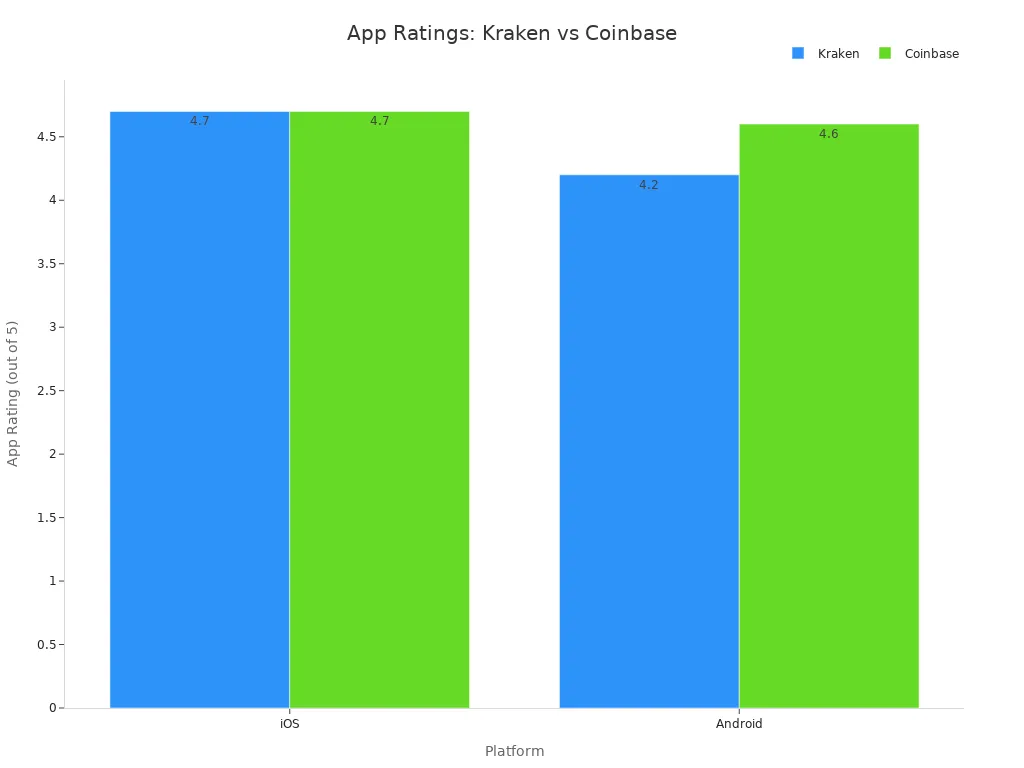
Mobile trading plays a key role for many users. Kraken and Coinbase both have highly rated apps on iOS, each scoring 4.7 out of 5. On Android, Coinbase leads with a 4.6 rating, while Kraken holds a 4.2. Users praise Kraken for security and educational features. Coinbase receives positive feedback for its user-friendly interface and broad cryptocurrency selection. Some users note Kraken’s limited futures trading in the US and Coinbase’s higher fees.
Both apps support biometric authentication and price alerts, making them suitable for trading cryptocurrency on the go.
Fees and Costs
Kraken Fees
Kraken uses a transparent fee structure that appeals to both beginners and advanced traders. The platform operates on a maker-taker model, with trading fees ranging from 0% to 0.26%. Kraken+ subscribers enjoy zero-fee trading on Buy, Sell, Convert, and Recurring purchases up to $10,000 per month in major currencies. However, spreads and card processing fees still apply. Spot, Futures, API, or OTC trades on Kraken Pro do not qualify for the Kraken+ zero-fee benefit.
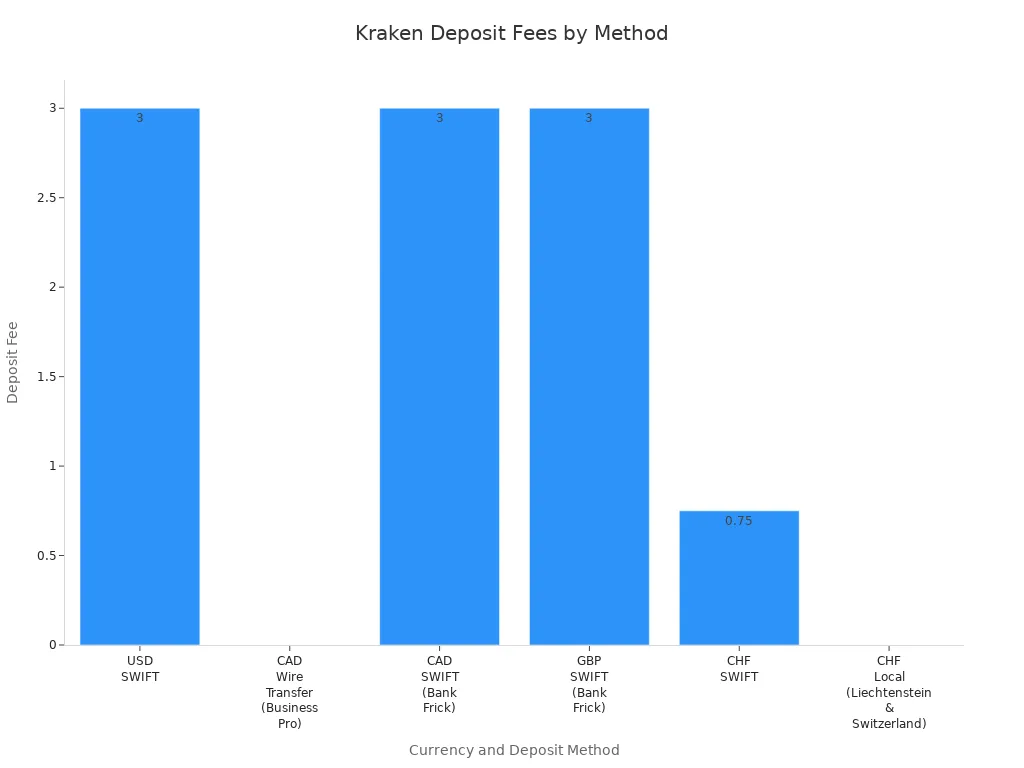
Deposits on Kraken vary by currency and method. Many cryptocurrency deposits are free, while some fiat deposits incur small fees. For example, SWIFT deposits in USD cost $3, and local CHF deposits in Switzerland and Liechtenstein are free. Withdrawal fees depend on the currency and method, with USD withdrawals costing up to $35. Kraken does not charge for account opening, maintenance, or inactivity.
Fee Type | Details |
|---|---|
Trading Fees | Maker-taker model: 0%–0.26%. Kraken+ zero-fee trading up to $10,000/month (spreads/card fees apply). |
Deposit Fees | Vary by method/currency. Crypto often free. SWIFT (USD): $3. Local CHF: free. |
Withdrawal Fees | USD: up to $35. Other currencies vary. |
Account Fees | No fees for opening, maintenance, or inactivity. |
Coinbase Fees
Coinbase uses a tiered maker-taker model for trading fees. For users with monthly trading volumes up to $10,000, the maker fee is 0.40% and the taker fee is 0.60%. As trading volume increases, fees decrease. Stablecoin pairs have even lower fees, starting at 0.00% for makers and 0.10% for takers. Futures trading on Coinbase includes a minimum $0.20 transaction fee and a 0.80% liquidation fee.
Depositing funds on Coinbase is simple. ACH transfers are free, while USD wire deposits cost $10. SEPA deposits in euros cost 0.15 euros. Crypto deposits do not incur fees. Withdrawal fees also depend on the method. ACH and SEPA withdrawals are free, but USD wire withdrawals cost $25 and SWIFT (GBP) withdrawals cost £1. Crypto withdrawal fees depend on the asset and network.
Note: Starting February 2024, Coinbase applies fees to USDC to USD conversions over $75 million per 30 days.
Fee Comparison
Kraken and Coinbase both offer competitive services, but Kraken often provides lower fees for active traders. For small transactions, Coinbase uses fixed fees, such as $0.99 for trades under $10 and $2.99 for trades up to $200. For larger trades, Coinbase charges a 0.50% spread fee. Kraken Instant usually offers lower fees than Coinbase Simple, especially for high-volume users.
Transaction Size (USD) | Coinbase Fee Structure | Kraken Fee Structure |
|---|---|---|
$10 or lower | Fixed fee: $0.99 | Generally lower fees on Kraken Instant |
$10 – $25 | Fixed fee: $1.49 | Kraken Instant generally lower fees |
$25 – $50 | Fixed fee: $1.99 | Not explicitly detailed |
$50 – $200 | Fixed fee: $2.99 | Not explicitly detailed |
Over $200 | 0.50% spread fee | Kraken Pro generally lower fees |
Kraken fees remain attractive for users who value low fees and transparent pricing. Coinbase appeals to those who want simplicity, but its transaction fees can add up for frequent or large trades. Both exchanges provide clear information about their fee structure, helping users make informed decisions.
User Experience
For Beginners
Both kraken and coinbase aim to make cryptocurrency trading accessible for new users. Coinbase stands out with its quick onboarding, simple KYC process, and an intuitive app. Users can buy cryptocurrency soon after signing up. The platform offers a wide range of educational resources, including the ‘Earn’ program, which uses videos and quizzes to teach users about digital assets. Customer support responds quickly and helps beginners navigate the platform.
Kraken also welcomes beginners with a straightforward onboarding process through its main app. The platform provides a demo account for practice trading. While the interface can seem technical, kraken offers a simplified mode for new users. Educational content is available through the kraken blog and crypto guides, though it lacks built-in tutorials. Customer support remains responsive and helpful for those starting out.
Aspect | Coinbase (Beginner Focus) | Kraken (Beginner Focus) |
|---|---|---|
Onboarding | Quick KYC, fast crypto purchases | Simple onboarding, demo account for practice |
App Design | Intuitive, easy buy/sell | Beginner-friendly mode, also offers advanced options |
Educational Resources | ‘Earn’ program, videos, quizzes | Blog, guides, occasional AMAs |
Customer Support | Responsive, guides users | Responsive, assists with onboarding |
Tip: Beginners who want a simple experience may prefer coinbase, while those willing to learn more can explore kraken’s demo and guides.
For Advanced Traders
Kraken appeals strongly to advanced traders. The platform offers margin trading, futures contracts with up to 50x leverage, and access to over 420 cryptocurrencies. Kraken Pro provides customizable charting tools and in-depth market data. The platform charges lower fees, with maker fees starting at 0.25% and taker fees at 0.40%. Advanced users benefit from higher staking rewards and more free deposit methods. Customer support is available 24/7 to resolve complex issues.
Coinbase focuses on simplicity. The platform does not offer margin or futures trading. Advanced users may find the trading interface limited. Coinbase charges higher fees and provides fewer advanced trading tools. However, customer support remains available for all users.
Feature | Kraken (Advanced Trader Focus) | Coinbase (Beginner Focus) |
|---|---|---|
Trading Tools | Margin, futures, advanced charting | Basic trading, simple interface |
Cryptocurrency Choice | Over 420 | Over 200 |
Fees | Lower, volume-based | Higher, less flexible |
Customer Support | 24/7, handles advanced queries | 24/7, focused on general support |
Institutional Users
Kraken serves institutional clients through Kraken Prime. This dedicated platform supports asset managers, hedge funds, and corporations. Kraken Prime offers access to liquidity across more than 20 global venues and covers over 90% of the digital asset market. Institutions receive 24/7 customer support from experienced account managers. Kraken Prime also provides asset-backed lending, T+1 credit facilities, and a smart order routing system. These features meet the standards of traditional finance and help institutions manage large cryptocurrency portfolios securely.
Coinbase offers basic business accounts and custody services. However, the platform does not match kraken’s depth of institutional features or dedicated support for high-volume clients.
Institutions seeking advanced trading tools, deep liquidity, and high-touch customer support often choose kraken.
coinbase vs kraken: Which to Choose?
Pros and Cons
The following table summarizes the main advantages and disadvantages of each platform, based on recent user feedback and expert reviews:
Feature Category | Coinbase (Pros) | Coinbase (Cons) | Kraken (Pros) | Kraken (Cons) |
|---|---|---|---|---|
User Experience | User-friendly interface, educational resources, easy trading | Higher staking fees, fewer trading pairs | Advanced trading features, broad trading pairs, extensive fiat support | Regulatory challenges, lower BBB rating |
Security | Insurance coverage, regulatory compliance, cold storage | MFA via SMS less secure | ISO/IEC certifications, Security Labs, proactive security, lower fees | Regulatory issues |
Trading Features | Simple trading, integrated wallet | Limited advanced tools | Margin and futures trading, advanced order types, NFT transactions | N/A |
Fees | N/A | Generally higher, especially for staking | Lower fees, especially for high-volume traders | N/A |
Staking & Rewards | Educational incentives, staking rewards | Higher fees, limited options | Higher staking rewards, flexible options | N/A |
Geographic & Fiat Support | Available in 100+ countries, fewer fiat currencies | N/A | Multiple fiat currencies supported (USD, EUR, CAD, AUD, GBP, CHF, JPY) | N/A |
Reputation | Strong compliance and transparency | N/A | N/A |
Coinbase stands out as a market-leading choice for beginners, offering a simple interface and strong regulatory compliance. Kraken appeals to advanced traders and institutions with its advanced features, lower fees, and broader asset support.
Final Recommendation
Choosing between coinbase vs kraken depends on individual needs and trading goals.
Users who want an easy-to-use interface and educational tools will find Coinbase the better overall choice.
Advanced traders and institutions often select Kraken for its detailed trading tools, margin and futures trading, and competitive staking rewards.
Kraken supports a wider range of fiat currencies and offers lower fees, making it a significantly better choice for those seeking cost efficiency and advanced features.
Both platforms provide strong security and mobile apps, but Kraken leads in expert evaluation scores and is considered one of the best cryptocurrency exchange options in the US.
There is no one-size-fits-all answer. Each user should consider their experience level, trading needs, and priorities before deciding which platform to use.
The comparative analysis shows that kraken excels in advanced trading tools and lower fees, while coinbase offers a beginner-friendly interface and strong insurance protections.
Feature | kraken | coinbase |
|---|---|---|
Trading Tools | Advanced, diverse | Basic, easy to use |
Security | Cold storage, FDIC insurance | |
Fees | Lower, volume-based | Higher, simple structure |
Beginners may prefer coinbase for its simplicity and educational support.
Advanced traders and institutions often choose kraken for robust features and security.
Users should review their priorities and test both platforms.
Staying informed about security helps protect assets in the fast-changing crypto market.
FAQ
What makes Kraken and Coinbase secure for users?
Both platforms use cold storage, two-factor authentication, and encryption. Kraken adds regular proof-of-reserves audits and holds ISO certifications. Coinbase provides FDIC insurance for USD balances. These security measures help protect user funds and personal information.
Can beginners use Kraken and Coinbase easily?
Coinbase offers a simple interface and educational resources, making it ideal for beginners. Kraken provides a demo account and a beginner-friendly mode. Users can start trading quickly on both platforms, but Coinbase feels more intuitive for new traders.
Which platform offers more cryptocurrencies for trading?
Kraken supports over 350 cryptocurrencies, while Coinbase lists more than 240. Users who want access to a wider range of digital assets may prefer Kraken. Both platforms rank among high liquidity exchanges, ensuring smooth trading for most assets.
How do the fees compare between Kraken and Coinbase?
Kraken uses a maker-taker model with lower trading fees, especially for high-volume users. Coinbase charges higher fees for small transactions but offers a straightforward fee structure. Active traders often save more on Kraken.
Do both platforms support mobile trading?
Yes, both Kraken and Coinbase offer mobile apps for iOS and Android. Users can trade, monitor prices, and manage accounts on the go. The apps include security features like biometric authentication and price alerts.

