

You might feel uncertain about how to cash out bitcoin in 2025. Many people share these concerns. According to a recent report, 40% of cryptocurrency owners do not trust the safety of their assets, and nearly one in five have faced problems withdrawing funds. When cashing out bitcoin, you must avoid common mistakes that can lead to loss or frustration:
Entering the wrong wallet address can cause permanent loss of bitcoin.
Ignoring withdrawal fees might reduce your cash-out amount.
Using untrusted platforms increases your risk of scams.
Choosing the right method for cashing out bitcoin depends on what matters most to you. Some people care about speed, others value privacy, and some want the lowest fees. Always check each option and review your details before you confirm any transaction.
Key Takeaways
Choose the right bitcoin cash-out method based on your needs for speed, privacy, and fees.
Use trusted platforms with strong security and complete KYC to protect your funds.
Always double-check wallet addresses and transaction details to avoid permanent loss.
Be aware of fees and withdrawal times; compare options to keep more of your money.
Stay alert for scams by verifying buyers, using escrow services, and never sharing private info.
How to Cash Out Bitcoin
Main Methods
You have several options when you want to cash out bitcoin in 2025. The most popular methods include using exchanges, peer-to-peer platforms, Bitcoin ATMs, and debit cards. Many people choose Cash App because it has 50 million users and offers simple ways to convert bitcoin to cash or transfer it to a bank account. Cash App’s user-friendly design and new features, like possible Lightning Network support, make it a top choice for cashing out bitcoin.
Here are the main methods you can use:
Centralized Exchanges
You can use exchanges like Coinbase, Kraken, or Bitstamp to sell bitcoin. These platforms let you trade your bitcoin for cash and withdraw it to your bank account. Many people trust these exchanges because they follow strict rules and offer strong security.Peer-to-Peer (P2P) Platforms
P2P platforms connect you directly with buyers. You can choose your payment method and negotiate the price. Some people like this method because it offers more privacy and sometimes lower fees.Bitcoin ATMs
Bitcoin ATMs let you sell bitcoin for cash instantly. You find a machine, send your bitcoin, and get cash right away. This method is fast, but fees can be higher.Bitcoin Debit Cards
Some platforms offer debit cards linked to your bitcoin wallet. You can spend your bitcoin or withdraw cash at ATMs. This method is convenient if you want to use your bitcoin for everyday purchases.
Tip: Always compare the fees, speed, and privacy of each method before you decide how to cash out bitcoin.
The table below shows the key differences in privacy and security among the main cash-out methods:
Method | Privacy (AML/KYC) | Security & Custody | Physical Security & Other Considerations |
|---|---|---|---|
Exchanges | Extensive personal data collection due to AML/KYC (ID, address, source of funds) | Custodial risk: funds held by exchange; risk of hacks, employee fraud, insolvency, censorship | Frequent hacking targets; security features like 2FA; “Not your keys, not your bitcoin” applies |
P2P | Little or no identifying info required; minimal AML/KYC; email/password typical | Escrow services vary: some custodial, some non-custodial; rely on reputation systems; user responsibility | Risk depends on counterparty reliability; mediation can be slow/stressful |
Bitcoin ATMs | Tiered AML/KYC based on transaction size; may use SMS or camera for verification | Immediate self-custody: bitcoin sent directly to user wallet; no intermediaries | Physical security risk at ATM location; users carry cash; choose safe, well-lit areas |
Debit Cards | N/A (only mentioned for buying vouchers, not withdrawal) | N/A | N/A |
You can see that each method has different levels of privacy and security. Exchanges require more personal information, while P2P platforms may offer more privacy. Bitcoin ATMs give you instant cash but require you to be careful with your physical safety.
Choosing a Platform
When you decide how to sell bitcoin, you need to pick the right platform. Not all platforms are the same. Some have better security, some have lower fees, and some are easier to use. You should always check the reputation of the platform before you cash out bitcoin.
Here is a table showing some of the most reputable platforms for cashing out bitcoin in 2025:
Platform | Regulatory Compliance & Certifications | Security Features | KYC Requirements | User Reviews / Ratings |
|---|---|---|---|---|
Gemini | World’s first SOC 1 Type 2 and SOC Type 2 certified; requires valid ID for US residents | Strong security focus; multi-factor authentication | Valid driver’s license or passport required | 13M+ users; positive app store ratings |
Crypto.com | Compliant platform with compliance screening; launched US service in 2022 | Multi-factor authentication including biometrics, email, SMS, OTP | Personal info and valid photo ID required | Good user reviews; app available on iOS and Android |
Bitstamp | One of the first exchanges registered by BitLicense in NY | 2FA, multi-sig hot wallets, email confirmation for withdrawals | Photo ID required for KYC | Popular in NY; positive user feedback |
Kraken | Various KYC levels; known for security and educational resources | Strong security; OTC trading and account management | KYC required with multiple levels | App store ratings: 4.7 iOS / 4.2 Android |
Binance US | Operates with KYC and security tailored for US users | 2FA, secure offline storage, real-time monitoring | Photo ID, address, and personal info required | Well-rated; mobile app available |
Abra | Serves institutional/private clients globally; retail US services discontinued | OTC trading, wealth management services | N/A for retail US users | Apple Store 4.7/5; Google Play 3.4/5 |
Kraken stands out for its strong security, multiple KYC levels, and helpful educational resources. It has high ratings on both iOS and Android app stores. Abra focuses on institutional and private clients and also receives good reviews, but it no longer serves retail users in the US.
When you choose a platform, you must also think about KYC (Know Your Customer) and compliance rules. These rules help keep your money safe and prevent crime. In 2025, all major platforms require you to complete KYC before you can deposit or withdraw bitcoin. Here are the standard KYC steps you will face:
Submit a valid photo ID.
Provide proof of address (not older than 90 days).
Show where your funds come from if you are a high-risk user.
Go through regular KYC updates, which may happen every year or every three years.
Complete video KYC in some countries, which checks your identity with a live video.
Pass checks for sanctions and politically exposed persons.
Let the platform monitor your transactions for suspicious activity.
Note: Some countries now require wallet-level identification and detailed transaction reports. Platforms must also keep enough money in reserve to make sure you can always withdraw your funds.
By 2025, platforms use advanced tools like AI to check for suspicious activity and share information with other countries to stop crime. These steps make it safer for you to cash out bitcoin, but you must always follow the rules and keep your documents ready.
When you look at how to cash out bitcoin, always check the platform’s reputation, security features, and KYC process. This will help you avoid scams and make sure you get your money safely. The most common ways to convert crypto to cash include using trusted exchanges, P2P platforms, and ATMs. Each method has its own pros and cons, so think about what matters most to you before you choose.
Centralized Exchanges
How to Sell Bitcoin
If you want to know how to sell bitcoin, centralized exchanges offer some of the most popular methods for selling bitcoin. You can use platforms like Coinbase, Kraken, or Bitstamp. These exchanges make the process simple and secure. Here is how to sell bitcoin step by step:
Choose a trusted exchange such as Coinbase, Kraken, or Bitstamp.
Create an account and complete the KYC process by submitting your ID and personal information.
Link your bank account to the exchange for easy withdrawals.
Transfer your bitcoin from your wallet to the exchange’s wallet.
Place a sell order for the amount of bitcoin you want to convert to cash.
Confirm the details and complete the sale.
Withdraw the fiat money to your linked bank account.
Many people ask, “how do you sell bitcoin?” The answer is to follow these steps and always check the platform’s rules. If you are selling from a brokerage account, the process is similar. You can also use methods for selling bitcoin like market or limit orders to get the best price.
Security
When you use online cryptocurrency exchanges, you must think about security. Centralized exchanges hold your bitcoin in their wallets, so you do not control your private keys. This creates custodial risk. Hacks, phishing scams, and insider threats can lead to loss of funds. Always use two-factor authentication and set up withdrawal whitelists. Remember, withdrawal delays can happen if the exchange faces regulatory issues. To stay safe, never share your login details and always check for official websites.
Tip: Use exchanges with strong security features and a good reputation to reduce risks when you withdraw bitcoin.
Fees and Speed
You should always check the fees before you start selling bitcoin with a bank account. Trading fees on major exchanges usually range from 0.1% to 0.5%. Bitcoin withdrawal fees and other costs can add up, so review them before you confirm your transaction. Bank transfers for fiat withdrawals often take 1 to 3 business days. E-wallet withdrawals can be faster but may have extra charges. Each exchange offers different withdrawal options, so compare them to find the best fit for your needs. Cash app bitcoin withdrawal is also popular for its speed and ease of use.
The table below shows common fee and speed details:
Aspect | Details |
|---|---|
Trading Fees | 0.1% – 0.5% |
Withdrawal Fees | Varies by exchange and method |
Withdrawal Times | Bank: 1–3 days; E-wallet: near-instant |
If you want to know how do you sell bitcoin quickly, choose methods for selling bitcoin that match your speed and cost needs. Cash app bitcoin withdrawal is a fast option, but always check the latest fees.
Peer-to-Peer Platforms
Convert Crypto to Cash
Peer-to-peer platforms let you convert crypto to cash by connecting you directly with other users. You can choose who you want to trade with and pick your payment method. Many people use these platforms because they offer more control and privacy when you want to convert crypto to cash. The process is simple and gives you the chance to negotiate your own price.
Here is how you can convert crypto to cash using a peer-to-peer platform:
Register and verify your identity on a trusted platform.
Find a buyer by browsing listings or creating your own offer.
Agree on the amount, price, and payment method. Common payment methods include bank transfers, PayPal, and cash payments.
Transfer your bitcoin to the platform’s escrow account.
Wait for the buyer to send the payment.
Confirm you have received the money, then release your bitcoin from escrow.
You can use these platforms to convert bitcoin to cash or for selling bitcoin for cash. Most platforms support payment methods like cash deposits and bank transfers. You get lower fees and more flexibility, but sometimes it takes longer to find a buyer.
Safety Tips
Staying safe is very important when you use peer-to-peer platforms. You must always confirm that you have received the money in your account before you release your bitcoin. Do not trust screenshots or payment proofs because scammers can fake them. Always check that the buyer’s payment details match their platform identity. Use the platform’s chat system for all communication. Never move the conversation to another app.
Follow these tips to avoid scams:
Only trade with verified users who have good ratings.
Avoid payment methods that allow chargebacks, like PayPal, unless you trust the buyer.
Meet in public places if you choose cash payments, and check the money carefully.
Never share your verification codes or personal details.
If you see anything suspicious, contact the platform’s support right away.
Tip: Platforms like Binance P2P use AI and user verification to help keep your trades safe.
Fees and Verification
Peer-to-peer platforms usually charge low or competitive fees. Some even offer zero trading fees for certain transactions. Each platform has its own rules for verification. Some only need your email, while others ask for ID to follow local laws. Security features like escrow, two-factor authentication, and user ratings help protect your trades.
Here is a table showing how some popular platforms compare:
Platform | Fees | Verification Process | Security Features | Payment Methods |
|---|---|---|---|---|
LocalBitcoins | Low fees, escrow | Email; optional 2FA | Escrow, 2FA, user ratings | Bank transfer, PayPal, cash |
Paxful | Competitive | May require ID | Escrow, 2FA, 24/7 support | Bank, gift cards, wallets |
Binance P2P | Minimal | Minimal at first | Smart contracts, escrow, reputation | Many options |
WazirX P2P | Competitive | Advanced verification | Escrow, 2FA | Bank, mobile wallets |
Remitano | Competitive | May require ID | Escrow, smart contracts, 2FA | Many methods |
HodlHodl | Low, no escrow fees | Minimal, privacy-focused | Multi-signature smart contracts | Wide range |
You can use these platforms to convert crypto to cash in a way that fits your needs. Always check the fees and what kind of verification is needed before you start.
Bitcoin ATMs

Withdraw Bitcoin
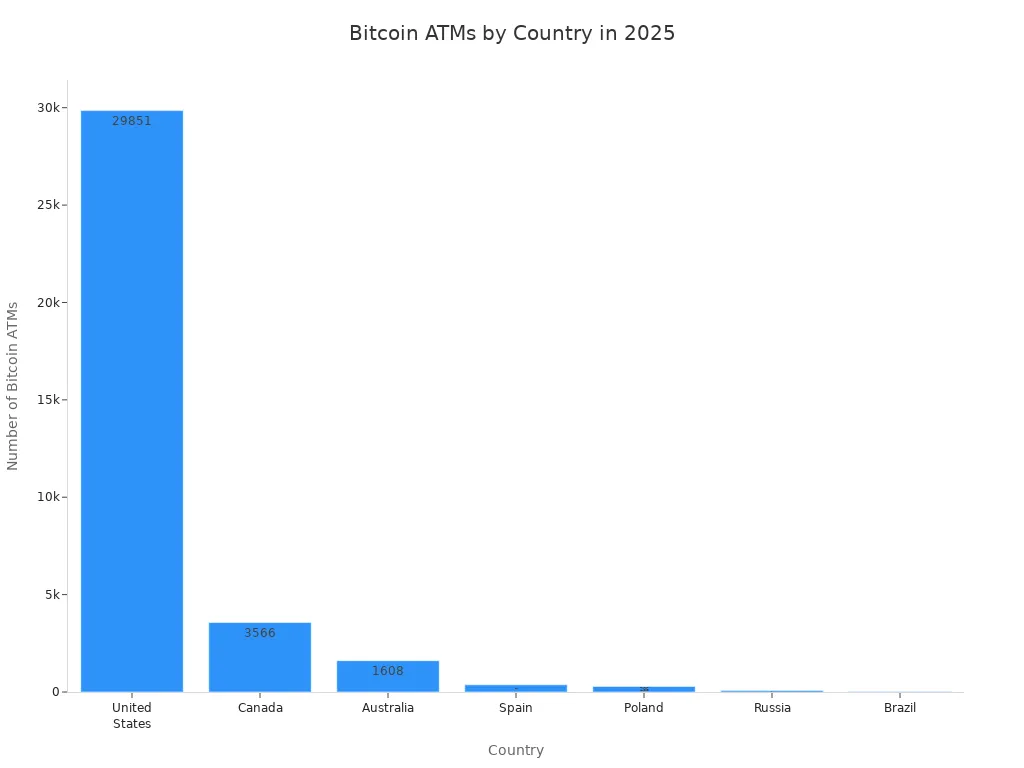
You can withdraw bitcoin as cash quickly by using bitcoin ATMs. These machines let you turn your bitcoin into cash in just a few steps. First, find a bitcoin ATM near you. Many online maps and apps help you locate one. The United States has the most bitcoin ATMs, with almost 30,000 machines. Canada and Australia also have many. Here is a table showing the number of bitcoin ATMs in different countries:
Country | Number of Bitcoin ATMs (2025) | Regions/States with Highest Concentration |
|---|---|---|
United States | ~29,851 | California ( |
Canada | ~3,566 | Ontario ( |
Australia | ~1,608 | New South Wales ( |
Spain | 369 | Madrid (86), Barcelona (80), Malaga (17) |
Poland | 285 | Warsaw (84), Kraków (51), Gdańsk (20), Wrocław (15) |
Brazil | 22 | São Paulo, Rio de Janeiro, Brasília |
Russia | 74 | Moscow, St. Petersburg, Novosibirsk |
To withdraw bitcoin, follow these steps:
Find a bitcoin ATM that supports cash withdrawals.
Verify your identity. The ATM may ask for your phone number or scan your ID.
Choose “Withdraw Cash” and enter the amount you want.
Scan the QR code on the ATM with your bitcoin wallet app.
Send the bitcoin to the ATM’s address.
Wait for the transaction to confirm.
Collect your cash from the machine.
Security Tips
When withdrawing bitcoin as cash, always use ATMs in safe, well-lit places. Never share your wallet details with anyone nearby. Keep your transaction receipt. Some ATMs require more ID for higher withdrawal limits. Stay at the ATM until you get your cash. If you have any problems, contact the ATM operator right away.
Tip: Plan your withdrawal during less busy hours to avoid waiting. Always check the bitcoin price before you start.
Fees and Limits
Fees for using bitcoin ATMs can be high. Most operators charge between 5% and 25% for each withdrawal. Some machines add a small network fee of $1 to $3. Daily withdrawal limits usually range from $3,000 to $50,000, depending on the operator and your ID level. Here is a table with common fees and limits:
Operator | Buy Fee Range | Withdrawal Limits (Daily) |
|---|---|---|
General Bitcoin ATMs | 5% to 25% | $3,000 to $50,000 |
CoinTime | 17.5% to 25% | Up to $50,000 |
CoinFlip | $3 + 7.1% to 17.6% | N/A |
Bitcoin Depot | 20% | N/A |
RockItCoin | $1 + 18.7% | N/A |
Always check the fees and limits before you withdraw. Using bitcoin ATMs gives you fast access to cash, but you pay more for the speed and privacy.
Bitcoin Debit Cards
Cash Out Bitcoin
Bitcoin debit cards give you a simple way to cash out bitcoin for everyday use. You can spend your bitcoin at stores or withdraw cash from ATMs. To get started, you pick a provider, download their app, and complete a quick setup. Most cards need you to finish a KYC check with your government ID. After approval, you link your bitcoin wallet to the card. When you want to cash out bitcoin, you load your card with bitcoin and use it like a regular debit card. You can pay for groceries, shop online, or make a withdrawal at an ATM.
Here is a table showing top bitcoin debit card providers in 2025:
Provider | Card Type | Rewards | Fees and Charges | Supported Cryptocurrencies | Setup Requirements |
|---|---|---|---|---|---|
Bitget Wallet Card | Debit | Up to 0.4% cashback | No issuance/annual fees; low transaction | 27+ blockchains including bitcoin | KYC, app, online application |
Bybit Card | Debit | Up to 10% cashback | No annual fee; 0.9% conversion fee | BTC, ETH, USDT, USDC, AVAX | KYC, app, global |
Crypto.com Visa | Prepaid | Up to 5% CRO rewards | No annual fee; 1% top-up fee | 100+ cryptocurrencies including bitcoin | KYC, app, staking for best rewards |
Coinbase Card | Debit | 1%-4% rewards | No annual fee (US); 2.49% liquidation fee | 40+ cryptocurrencies | KYC, app, US/EU/UK/EEA |
Tip: Always check if your provider supports cash out bitcoin in your country before you apply.
Security and Privacy
You must protect your bitcoin when you cash out bitcoin with a debit card. Most cards require KYC, which means you share your ID and address. This helps keep your withdrawal safe and follows local laws. Some cards offer extra privacy by not linking your bank account or by using non-custodial wallets. If you want more privacy, use small withdrawal amounts, burner emails, or a VPN. Remember, anonymous cards may not help you if you lose money or face a dispute. Always keep your card and app secure with strong passwords and two-factor authentication.
Fees and Supported Regions
Bitcoin debit cards have different fees and work in different places. You may pay a conversion fee when you cash out bitcoin or make a withdrawal. Some cards charge ATM fees or foreign exchange fees. For example, Bybit Card has a 0.9% conversion fee, while Crypto.com Visa charges a 1% top-up fee. Most cards do not have annual fees. You can use these cards in many regions, but some, like Coinbase Card, only work in the US or Europe. Others, like Bitget Wallet Card, support Asia and Latin America but not the US.
Feature | Details |
|---|---|
Coinbase Card: US only; Crypto.com, Wirex: UK, EEA, Asia-Pacific, LATAM; Bitget: EEA, Asia, LATAM (no US) | |
KYC Requirements | Most cards need government ID and proof of address; minimum age 18 |
Local Regulations | Rules affect withdrawal limits, ATM access, and staking rewards |
Note: Always read the terms before you cash out bitcoin to avoid surprise withdrawal fees or limits.
Comparison of Methods
Security and Fees
When you look at different methods for cashing out bitcoin, you need to think about security and fees. Each method has its own way to protect your bitcoin and your money. Centralized exchanges like Coinbase, Kraken, and Gemini use strong security features. For example, Coinbase offers insurance protection and FDIC-insured balances. Kraken is known for its strong security and low fees. Binance has high liquidity but has faced security breaches in the past. Gemini focuses on security and has special certifications. Crypto.com uses multi-factor authentication and protects your account with strong mobile app security.
Peer-to-peer platforms use escrow services. These hold your bitcoin until both sides finish the trade. This helps keep your money safe without a central company. Bitcoin ATMs give you fast access to cash, but they do not always have detailed security features. Debit cards let you spend your bitcoin, but you must trust the card provider to keep your funds safe.
Platform/Method | Security Features | Notes on Security Context |
|---|---|---|
Coinbase | Insurance, FDIC-insured USD, strong security | User protection, regulatory compliance |
Kraken | Comprehensive security, strong focus | Low fees, robust security |
Binance | Robust security, some past breaches | High liquidity, some security incidents |
Gemini | SOC 2 certification, strong compliance | Security-conscious users |
Crypto.com | Multi-factor authentication, strong mobile app security | Crypto card services |
Peer-to-Peer | Escrow or mediation services | No central custody, user responsibility |
Bitcoin ATMs | Basic security, varies by operator | Fast, but less detailed security |
Debit Cards | Depends on provider | Trust in card provider needed |
Fees also change with each method. Centralized exchanges usually charge trading and withdrawal fees. Peer-to-peer platforms often have lower fees, but you must watch out for hidden costs. Bitcoin ATMs charge higher fees for quick cash. Debit cards may have conversion or ATM fees.
Tip: Always check the fee schedule before cashing out bitcoin. This helps you keep more of your money.
Speed and Convenience
You want to cash out bitcoin quickly and easily. Each method offers different speeds and levels of convenience. On-chain bitcoin transactions can take about an hour, especially if the network is busy. Bitcoin ATMs give you near-instant cash, but you need to find a machine. The Lightning Network lets you move bitcoin almost instantly, but you need a special wallet and some technical skill.
Traditional methods like bank transfers or debit cards can take from one day to several days. These methods give you more consumer protection, but you wait longer for your money. Crypto withdrawals usually finish in under an hour if the network is not busy.
Withdrawal Method | Average Transaction Speed | Convenience Rating |
|---|---|---|
On-Chain Bitcoin | ~1 hour (can be longer if busy) | Moderate; user control, slower if congested |
Bitcoin ATMs | Near-instant | High; fast, easy, but not everywhere |
Lightning Network | Near-instant | High; very fast, needs special wallet |
Bank/Debit/E-wallet | 24 hours to several days | Lower; slower, more protection |
Crypto Withdrawals | Under an hour (normal conditions) | High; fast, but you handle your own security |
You should choose the method that matches your needs. If you want speed, bitcoin ATMs or the Lightning Network work best. If you want more protection, use a bank transfer or debit card. Centralized exchanges offer high liquidity, which helps you cash out bitcoin even in large amounts.
Note: Think about your priorities—speed, security, fees, and convenience—before picking a method for cashing out bitcoin.
Avoiding Scams
Red Flags
You face many risks when you cash out bitcoin. Scammers use new tricks every year. Some of the most common scams target people who want to withdraw bitcoin quickly. For example, criminals often call or message seniors and pretend to be from the police or a trusted company. They pressure victims to send bitcoin through ATMs. Once you send bitcoin this way, you cannot get it back. This scam works because many people do not know how bitcoin works.
Here is a table showing the most common bitcoin scams and how much money people lose:
Scam Type | Description | Financial Impact / Frequency Data |
|---|---|---|
Phishing techniques | Use of malicious links and fake social media to steal wallet info. | Victims lost $47 million in February alone. |
Celebrity impersonation | Scammers pretend to be famous people to promote fake giveaways or investments. | Very common, no exact numbers. |
Romance fraud | Scammers build trust on dating sites, then ask for bitcoin. | Over $652 million lost last year. |
Investment scams | Fake apps or sites promise high returns to trick you. | Over $4.5 billion lost in 2023. |
Pig butchering | Mix of romance and investment fraud, luring victims into fake bitcoin schemes. | $112 million seized by US DOJ last year. |
Pump-and-dump schemes | Scammers hype up tokens, then sell, leaving you with worthless bitcoin. | $240 million lost last year. |
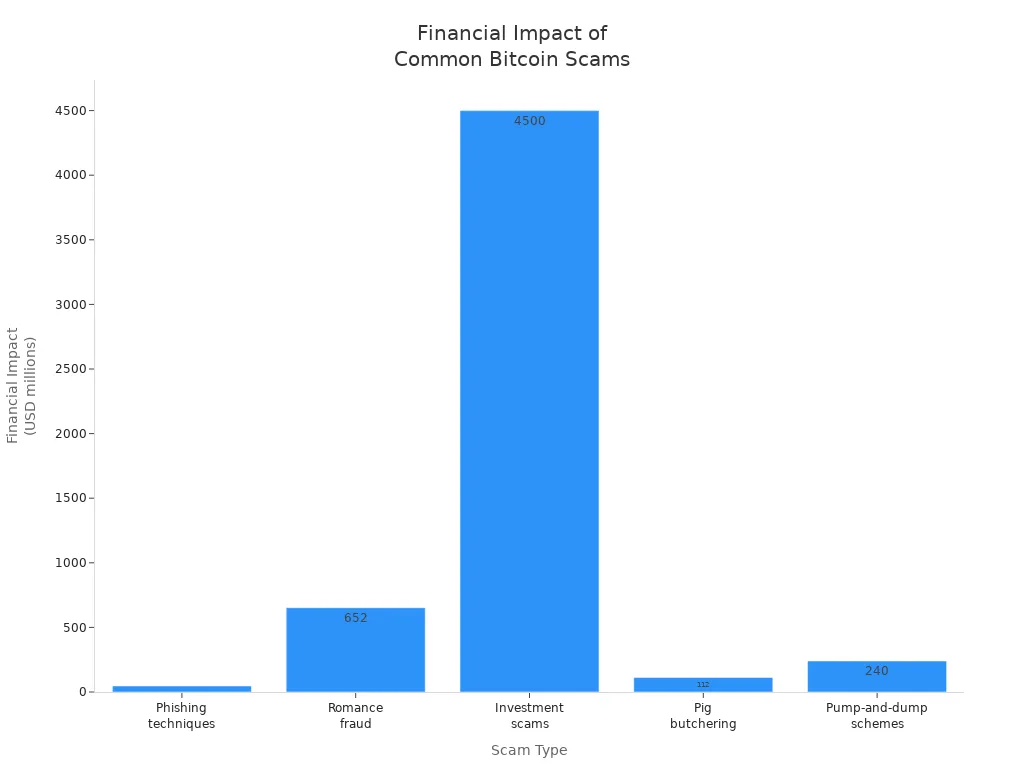
You should always watch for these red flags. If someone promises easy money or asks you to send bitcoin fast, stop and check if it is a scam.
Safe Practices
You can protect your bitcoin by following smart practices. Security experts recommend these steps:
Research every exchange, wallet, or project before you use it for bitcoin withdrawals.
Use hardware wallets or cold storage for large amounts of bitcoin.
Never share your private keys or sensitive information with anyone.
Always verify the recipient’s bitcoin address before sending funds.
Enable two-factor authentication on all your bitcoin accounts.
Stay away from offers that sound too good to be true.
Keep records of all your bitcoin transactions and interactions.
Educate yourself about new bitcoin scams and share what you learn with others.
Report any suspicious activity to the platform and local authorities.
Tip: Use only well-known platforms and update your passwords often. These practices help keep your bitcoin safe.
By using these practices, you lower your risk and make it harder for scammers to steal your bitcoin. Stay alert and always double-check before you send or withdraw bitcoin.
Compliance and Taxes
Reporting Requirements
You must follow strict rules when you sell or withdraw bitcoin. Tax agencies in the United States, European Union, Canada, and Japan all treat bitcoin as property or a commodity. This means you must report every sale, trade, or use of bitcoin on your tax return. In the United States, you need to report bitcoin sales using Form 1099-DA. Starting in 2025, brokers must send these forms to the IRS. You must also keep records of your cost basis and gains. The European Union uses the DAC8 directive. This rule requires all crypto platforms, even those outside the EU, to report bitcoin transactions for EU taxpayers. In Canada, you must keep detailed records of every bitcoin trade, even if you only swap one crypto for another. Japan taxes bitcoin as income, and you must report every transaction.
Here is a table showing how different places handle bitcoin taxes:
Jurisdiction | Tax Type | Reporting Rules | Special Notes |
|---|---|---|---|
United States | Capital gains, income | Form 1099-DA, cost basis, IRS enforcement | DeFi/self-custody not reported by platforms |
European Union | Varies by country | DAC8: all platforms report user transactions | GDPR notifications, penalties for noncompliance |
Canada | Capital gains, income | Detailed records, all trades reported | Frequent trading taxed as business income |
Japan | Income tax | All transactions reported, no capital gains category | High progressive tax rates |
Note: You must answer digital asset questions on your tax return honestly. Keep all your bitcoin records safe.
Staying Legal
You need to stay up to date with bitcoin tax laws. If you do not report your bitcoin transactions, you risk heavy penalties. Starting in 2025, the IRS can fine you up to $100,000 for not reporting bitcoin sales. You could even face up to five years in prison for serious violations. The IRS and DOJ have started to charge people who hide bitcoin income. One case involved a person who failed to report almost $4 million in bitcoin gains. To avoid trouble, always report your bitcoin activity and consider voluntary disclosure if you missed something in the past.
Here are some tips to help you stay legal with bitcoin:
Check for new tax rules every year.
Use trusted tax software that supports bitcoin.
Save all receipts and transaction records.
Ask a tax professional if you feel unsure.
Never ignore letters from tax agencies about bitcoin.
Tip: Tax laws change often. Make sure you know the latest rules before you cash out bitcoin.
Secure Withdrawal Checklist

Final Steps
Before you cash out bitcoin, you should follow a clear checklist to keep your funds safe. Each step helps you avoid mistakes and protect your money.
Choose a reputable and regulated platform for your bitcoin transaction.
Update your wallet or app to the latest version to fix any security issues.
Set a strong password and enable two-factor authentication on your account.
Prepare your ID, proof of address, and any other documents for verification.
Double-check the recipient’s address before sending bitcoin.
Start the withdrawal and use the transaction ID (TxID) to track your bitcoin on a blockchain explorer.
Wait for enough confirmations. For small amounts, one confirmation is enough. For larger amounts, wait for three to six confirmations.
Review all fees, including trading, withdrawal, and network fees, before you finish the transaction.
After you receive your cash or funds, log out of your account and store your records safely.
Tip: Always use good lighting and clear images when submitting ID or selfies for verification. This helps avoid delays.
Ongoing Security
You need to keep your bitcoin safe even after you finish a withdrawal. Good habits protect your funds from theft or loss.
Protect your private keys with encryption and store them in a secure place, such as a hardware wallet.
Regularly back up your bitcoin wallet and keep copies in different safe locations.
Update your wallet software and device systems to guard against new threats.
Use multi-signature wallets for extra protection. This means more than one person must approve a bitcoin transaction.
Always check the recipient’s address before sending bitcoin to avoid mistakes.
Monitor your accounts for any strange activity and set up alerts if possible.
Learn about new scams and teach others how to stay safe with bitcoin.
Note: Cold wallets keep your bitcoin offline and safe from hackers. Only connect them when you need to move funds.
You have many secure ways to cash out bitcoin in 2025. Choose your withdrawal method based on your needs—exchanges offer security, peer-to-peer platforms give flexibility, and ATMs provide instant cash. Always enable two-factor authentication and use cold wallets to keep your bitcoin safe. Stay alert for phishing and double-check all withdrawal details. Regulatory agencies now enforce strict compliance, so follow KYC rules and keep your records. Use the checklist to protect your bitcoin and stay informed about new platforms and regulations.
FAQ
How long does it take to withdraw Bitcoin to my bank account?
Most withdrawals take 1 to 3 business days. Some platforms offer instant transfers, but you may pay higher fees. Always check the withdrawal time before you start.
What should you do if your withdrawal is delayed?
First, check your transaction status on the platform. Look for any emails or alerts. If you see no updates, contact customer support. Keep your transaction ID ready.
Are there limits on how much Bitcoin you can withdraw?
Yes, every platform sets daily and monthly limits. These limits depend on your account level and verification. You can find the exact numbers in your account settings or the platform’s help center.
Can you withdraw Bitcoin without completing KYC?
Most trusted platforms require KYC for withdrawals. Some peer-to-peer services allow small trades without full verification. You risk losing access or facing delays if you skip KYC.
What fees should you expect when cashing out Bitcoin?
You may pay trading fees, withdrawal fees, and network fees.
Fee Type
Typical Range
Trading Fee
0.1% – 0.5%
Withdrawal Fee
Varies by method
ATM Fee
5% – 25%

