
You need to decide which crypto exchange fits your needs. Look at security, how easy it is to use, fees, and how much crypto you can actually trade. Most global crypto trading happens on centralized exchanges. For example, Binance alone handles almost 40% of the market, while decentralized exchanges only make up about 7.6% of trading volume. When you compare dex vs cex, think about your experience with crypto, how much privacy you want, and your trading goals. Each exchange offers different benefits, so focus on what matters most to you when picking a crypto exchange.
Key Takeaways
Centralized exchanges (CEX) offer easy-to-use platforms, fast trades, strong security, and customer support, making them ideal for beginners and high-volume traders.
Decentralized exchanges (DEX) give you full control of your crypto, more privacy, and access to new tokens, but require managing your own wallet and understanding blockchain fees.
CEXs have higher liquidity and legal protections but need identity verification, while DEXs provide anonymity and transparency with less regulation and support.
Fees vary: CEXs charge trading fees but often have lower costs for deposits and withdrawals; DEXs have no trading fees but require paying blockchain gas fees that can be high during busy times.
Choose your exchange based on your priorities: use CEX for ease, support, and compliance; pick DEX for privacy, control, and early access to new coins.
CEX
What Is a CEX
A cex, or centralized exchange, is a platform where you can buy, sell, and trade crypto. You create an account, complete identity checks, and then start trading. Centralized exchanges use a central authority to manage trades and keep your funds safe. These exchanges offer user-friendly dashboards, mobile apps, and simple registration. You can access many cryptocurrencies and use advanced trading tools. Most cex platforms support fiat money, so you can deposit or withdraw using your bank account or card.
Here are the main features of a centralized exchange:
User-friendly interface with easy account setup and mobile access.
High liquidity for fast trades and stable prices.
Strong security, including two-factor authentication and cold wallet storage.
Advanced trading tools for both beginners and pros.
Support for many cryptocurrencies and fiat currencies.
CEX Pros
Centralized exchanges offer many benefits that make trading easier and safer for you.
Tip: If you want fast trades and easy access to your funds, a cex is a strong choice.
Advantage | Description | Example/Supporting Data |
|---|---|---|
High Liquidity | Fast, stable trades with little price change. | |
User-Friendly Interface | Simple for beginners and pros, with mobile apps and quick setup. | One-click trading and real-time dashboards. |
Security and Trust | Strong protection for your funds and data. | Over 60% of cex platforms use cold storage. |
Access to Fiat Currencies | Deposit and withdraw in your local money. | Supports cards, bank transfers, and PayPal. |
Regulatory Compliance | Follows laws to keep your trading safe. | Over 90% of top centralized exchanges require KYC. |
Customer Support | 24/7 help with account or trading issues. | Live chat and email support. |
Advanced Trading Features | Tools like margin trading and stop-loss orders for experienced users. | Helps manage risk and use leverage. |
Centralized exchanges also offer extra services like staking, lending, and copy-trading. You get access to a wide range of financial tools and support.
CEX Cons
Centralized exchanges have some drawbacks you should know about:
You must trust the exchange to keep your funds safe. Hacks and data breaches can happen.
Registration can be complex, with strict identity checks.
Some cex platforms charge high fees, which can lower your returns.
Limited transparency makes it hard to see how the exchange operates.
Market manipulation and wash trading can affect prices.
Regulatory changes may impact your ability to trade or withdraw funds.
If you value privacy or want full control of your assets, a cex may not fit your needs. Always check the security and reputation of any centralized exchange before you trade.
DEX
What Is a DEX
A dex, or decentralized exchange, lets you trade crypto directly with other users. You do not need to trust a central authority. Instead, you keep control of your funds at all times. Decentralized exchanges use smart contracts to automate trades and make sure only you can access your assets. You connect your wallet, like MetaMask or Ledger, and start trading from there. This setup gives you user control over funds and keeps your private keys safe.
Blockchain experts say decentralized exchanges have several defining features:
Non-custodial trading, so you always control your private keys.
Secure smart contracts that automate and protect trades.
Integration with non-custodial wallets for easy access.
Advanced privacy protocols to keep your data safe.
Security for liquidity pools to prevent attacks.
Transparent governance through DAOs, giving you a voice in decisions. 7. Open-source code and cross-chain compatibility for more trading options.
Decentralization is the core idea behind a dex. You get to trade crypto without giving up control or privacy.
DEX Pros
Decentralized exchanges offer many benefits for crypto users:
You keep your assets in your own wallet, which lowers the risk of hacks and theft.
DEXs use a decentralized network, making them hard to attack.
You trade directly with others, so there is less chance of fraud or manipulation.
All trades are recorded on the blockchain, so you can check every transaction.
DEXs support peer-to-peer trades, giving you more flexibility.
Many decentralized exchanges use automated market makers and liquidity pools, so you can trade any time.
Tip: If you want privacy, user control, and transparency, a dex fits your needs.
Decentralized exchanges also support defi projects and new tokens. You can often find coins here before they appear on other exchanges. The decentralized nature of these platforms helps you avoid many limits found on centralized exchanges.
DEX Cons
You should know the downsides of using a dex:
Some decentralized exchanges have lower liquidity, so big trades can move prices a lot.
The user interface can be hard for beginners to understand.
You must manage your own wallet and private keys. If you lose them, you lose your crypto.
DEXs may have higher fees for certain trades, especially when the blockchain is busy.
Not all decentralized exchanges support fiat money, so you cannot always use dollars or euros.
The decentralized nature means there is no customer support if you make a mistake.
Decentralized exchanges give you more freedom, but you must take more responsibility. If you value decentralization and defi, you may find a dex is the best choice for your cryptocurrency trades.
DEX vs CEX
Key Differences Between CEX and DEX
You need to know the key differences between cex and dex before you choose an exchange. The table below gives you a clear, side-by-side comparison of how these two types of crypto exchanges work:
Aspect | CEX (Centralized Exchange) | DEX (Decentralized Exchange) |
|---|---|---|
Supervision | Third-party authority manages and supervises | No central authority; trades run on smart contracts |
Convenience | User-friendly, easy for beginners | More complex, needs knowledge of wallets and gas fees |
Liquidity | Deep liquidity, fast trades, stable prices | Liquidity depends on user pools, can be lower |
Trading Features | Advanced tools, analytics, many trading options | Basic trading pairs, fewer advanced features |
Anonymity | Requires KYC, less privacy | No KYC, more privacy and anonymity |
Security Risks | Risk of hacks, fraud, and regulatory shutdowns | Users control funds, but must protect their own keys |
Regulatory Compliance | Follows laws, offers user protection | Largely unregulated, more freedom but higher risk |
Examples | Binance, Coinbase, Kraken | Uniswap, PancakeSwap |
Tip: When you compare dex vs cex, look at how much control, privacy, and support you want from your exchange.
Security
Security is one of the most important things to consider in the dex vs cex debate. On a cex, you trust the exchange to keep your crypto safe. This means you face risks like hacks, phishing, and even scams. For example, hackers have targeted exchanges like WazirX by finding weaknesses in smart contracts. Phishing attacks and malware can also steal your login details or private keys. If the exchange gets hacked, you could lose your funds.
Cex platforms try to protect you with two-factor authentication, cold storage, and regular audits. They also follow rules like AML and KYC to keep your account safe. Still, because they hold your assets, they remain big targets for hackers.
A dex works differently. You keep your crypto in your own wallet and trade directly with others. This means you control your private keys and do not need to trust a third party. DEXs use smart contracts to handle trades, so all transactions are recorded on the blockchain. This setup makes it harder for hackers to steal large amounts at once. However, you must protect your own wallet and keys. If you lose them, you lose your crypto. DEXs do not require KYC, so you get more privacy, but you also take on more responsibility.
Liquidity
Liquidity means how easily you can buy or sell crypto without changing the price too much. In the dex vs cex comparison, cex platforms usually win here. Cex exchanges like Binance have huge liquidity pools and handle billions of dollars every day. This lets you trade quickly and at stable prices. For example, the top five cex platforms can see over $200 billion in daily trading volume.
A dex depends on users to provide liquidity through pools. These pools are often smaller, so big trades can move prices a lot. The top five dex platforms only reach about $3 to $4 billion in daily volume. This means you might face higher slippage or wait longer for trades to finish. DEXs use automated market makers to set prices, but these systems can struggle with very large trades.
Note: If you plan to trade large amounts or need fast execution, a cex gives you deeper liquidity and more stable prices.
User Experience
User experience is another big factor in the dex vs cex decision. A cex usually offers a simple, guided process. You sign up, verify your identity, and start trading with easy-to-use dashboards and customer support. This makes cex platforms great for beginners.
A dex asks you to connect your own wallet and manage your private keys. You do not need to create an account or share personal information. However, you must understand how wallets, gas fees, and smart contracts work. Many users find dex platforms confusing at first. There is no customer support if you make a mistake. You must also watch out for network congestion, which can slow down your trades.
Tip: If you want a smooth start and help when you need it, a cex is easier. If you value privacy and control, a dex gives you more freedom but needs more learning.
Regulation
Regulation shapes how each exchange works and protects you as a user. Cex platforms must follow strict rules in most countries. They require you to complete KYC checks and follow anti-money laundering laws. This helps prevent crime and protects your funds. For example, in the United States, cex exchanges must register with agencies like FinCEN and follow the Bank Secrecy Act. In the EU, new rules like MiCA set clear standards for crypto exchanges.
A dex does not have a central authority, so it does not enforce KYC or AML rules. You can trade without sharing your identity. This gives you more privacy, but it also means less protection if something goes wrong. Some new laws in Europe and other places are starting to push dex platforms to add more compliance tools, like on-chain KYC or transaction monitoring. Still, most dex platforms remain less regulated than cex exchanges.
Note: If you need strong legal protection or want to follow all rules, a cex is the safer choice. If you want more privacy and fewer limits, a dex may suit you better.
Fees and Costs
Is It Cheaper to Buy on a DEX or CEX
When you compare costs, you need to look at more than just trading fees. Centralized exchanges (CEXs) and decentralized exchanges (DEXs) have different fee structures. CEXs usually charge a small percentage for each trade. Many offer discounts if you trade large amounts or use their native tokens. DEXs do not charge traditional trading fees, but you pay blockchain network fees, also called gas fees, for every transaction.
Here is a table showing the trading fees for some of the top centralized exchanges:
Exchange | Maker Fee Range | Taker Fee Range | Discounts / Notes |
|---|---|---|---|
Binance.US | Around 0.10%, down to 0.02% for ≥ $1B volume | Around 0.10% | 25% off with BNB; zero-fee BTC pairs |
Robinhood | 0% | 0% | Commission-free trades; spreads ~0.3%-0.4% |
Kraken Pro | 0% to 0.16% (maker) | 0.10% to 0.26% (taker) | Discounts for ≥ $10M monthly volume |
Coinbase Adv. | 0% to 0.40% (maker) | 0.05% to 0.60% (taker) | Rebates scale with volume, down to 0%/0.05% |
BYDFi | 0.10% | 0.02% to 0.10% | Spot and futures fees; platform vouchers |
Bitstamp | 0% to 0.30% | 0% to 0.30% | Fees drop to 0% over $20M volume |
KuCoin | 0.10% | 0.10% | 20% off paying fees in KCS; VIP rebates |
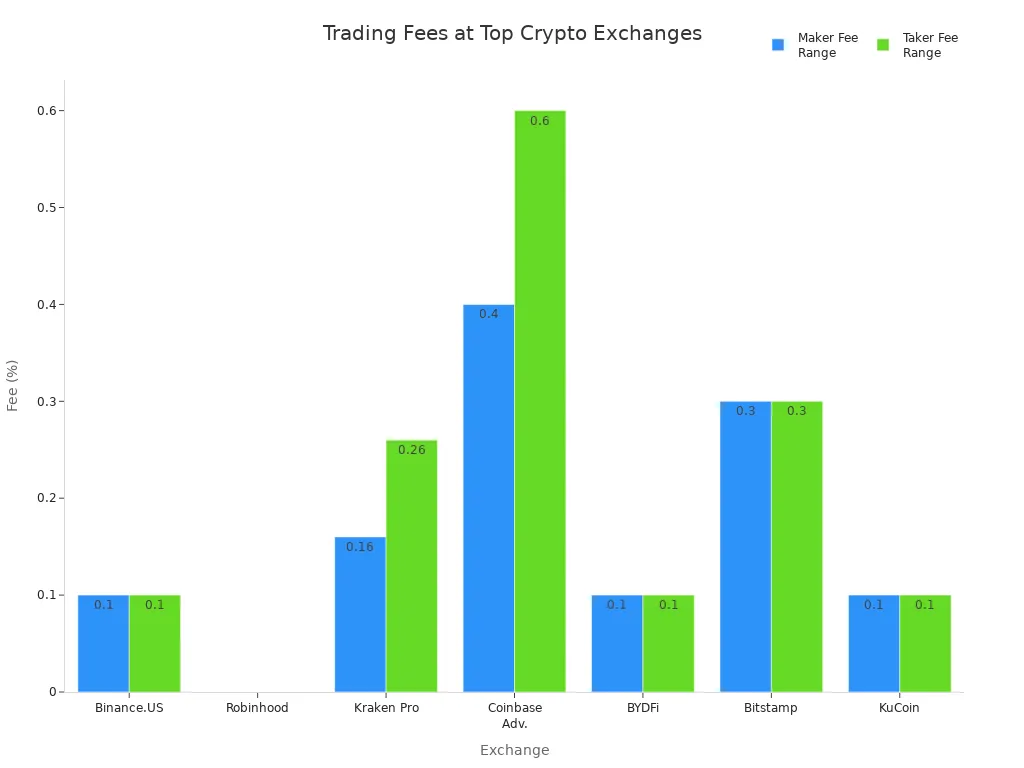
You might wonder, is it cheaper to buy on a dex or cex? The answer depends on your trading style and the network you use. On a CEX, you pay trading fees that range from 0% to about 0.40%. Some platforms offer zero-fee trades or lower fees for high-volume users. On a DEX, you do not pay a trading fee to the platform, but you must pay gas fees. These can change based on how busy the blockchain is. Sometimes, gas fees are very low, but during busy times, they can be much higher than CEX trading fees.
When you deposit or withdraw funds, CEXs and DEXs also differ:
CEXs usually do not charge for crypto deposits. They may charge for fiat deposits, depending on your payment method.
Crypto withdrawals on CEXs often have a flat fee plus a network fee. Fiat withdrawals have variable fees.
DEXs do not charge deposit or withdrawal fees because you trade directly from your wallet. You only pay network fees for each transaction.
Tip: If you trade small amounts or want to avoid high gas fees, a CEX may be cheaper. If you value privacy and control, a DEX gives you direct access, but watch out for network costs.
Choosing an Exchange
For Beginners
You want a simple start in crypto. Look for exchanges with easy interfaces, strong security, and helpful support. Many platforms offer tutorials and demo trading. Here are the top factors to consider:
User-friendly design and clear instructions.
Wide selection of coins, including popular altcoins.
Transparent fees and charges.
High liquidity for smooth trades.
Extra features like mobile apps and staking.
Avoid focusing only on low fees or ignoring support.
Key Beginner-Friendly Features | Notable Advantages | |
|---|---|---|
Coinbase | Simple interface, educational resources, easy fiat-to-crypto purchases | Top recommended for new users |
Binance.US | Low fees, beginner-friendly features | Runner-up despite regulatory challenges |
Kraken | Strong security, beginner-friendly | Highly praised for safety |
Bitget | Demo trading, copy trading features | Recommended for beginners |
Gemini | Intuitive UI, regulatory compliance | Recognized for ease of use |
Tip: Start with a centralized exchange if you want guidance and support. Try a dex when you feel ready to manage your own wallet.
For Privacy
You value privacy and control over your data. Centralized exchanges require identity checks and store your information. Decentralized exchanges let you trade directly from your wallet without sharing personal details.
Centralized exchanges collect and protect your data using encryption and audits.
Decentralized exchanges do not ask for personal info. You keep control of your private keys and funds.
DEXs offer transparency and anonymity, but you must secure your wallet yourself.
Note: Choose a dex if you want maximum privacy and control. Use a centralized exchange if you need customer support and insurance.
For High-Volume Traders
You trade large amounts of crypto and need speed, reliability, and low fees. Look for exchanges with strong infrastructure, deep liquidity, and advanced security.
Efficient order matching engines and APIs support frequent trading.
Security features like two-factor authentication and cold storage protect your assets.
Real-time monitoring tools track system health.
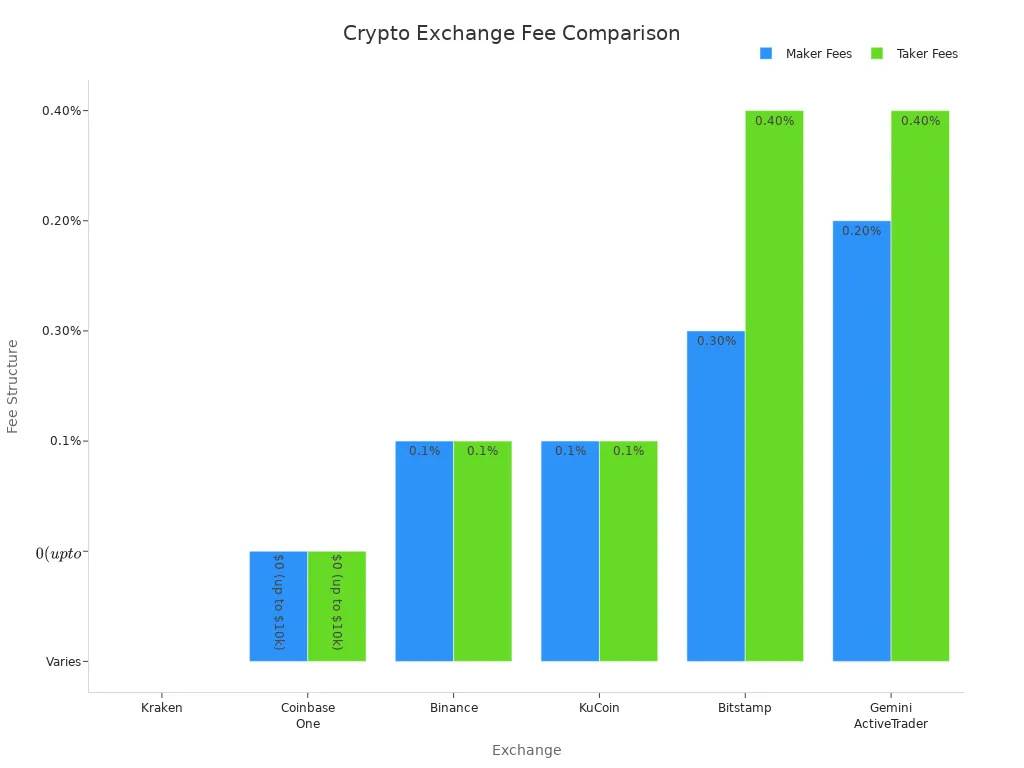
Exchange | Fee Structure Highlights | Maker Fees | Taker Fees | Withdrawal Fees | Additional Notes |
|---|---|---|---|---|---|
Kraken | Tiered fees decrease with higher trading volumes | Varies | Varies | Varies | Lower fees for higher volume traders |
Binance | Low fees (~0.1%) with discounts for using native token (BNB) | ~0.1% | ~0.1% | Varies | Fee discounts when paying with BNB |
KuCoin | Low fees (~0.1%) with discounts for holding native token (KCS) | ~0.1% | ~0.1% | Varies | Fee discounts available |
Tip: Pick exchanges with deep liquidity and low fees. Use OTC platforms for very large trades to avoid market impact.
For Altcoin Trading
You want access to new and diverse crypto coins. Centralized exchanges list coins after strict checks. Decentralized exchanges let anyone list tokens, so you find new projects faster.
Factor | Centralized Exchange (CEX) | Decentralized Exchange (DEX) |
|---|---|---|
Strict rules and due diligence, limited token listings | Permissionless, anyone can list tokens, enabling more new tokens | |
Supported Coins | Many popular coins, fewer new tokens | Wide range, including new and niche tokens |
Tip: Use a dex to discover new altcoins early. Choose a centralized exchange for established coins and safer trading.
For Compliance
You need to follow laws and protect your assets. Centralized exchanges offer strong compliance features:
Anti-Money Laundering (AML) and Know Your Customer (KYC) checks.
Secure custody and asset segregation.
Recordkeeping and data retention for audits.
Regulated custody partnerships.
Note: Select a centralized exchange if you need legal protection and compliance. Use a dex only if your region allows it and you accept higher risk.
Safety Tips
Protecting Funds
You want to keep your crypto safe. Security experts share several strategies that help protect your funds on exchanges:
Enable Multi-Factor Authentication (MFA). Use apps like Google Authenticator for extra account security. MFA blocks most identity attacks.
Store crypto in cold wallets. Cold storage keeps your assets offline, away from hackers. Hardware wallets like Ledger offer strong protection.
Check for regular security audits. Choose exchanges that test their systems often. Audits find and fix security gaps.
Use strong data encryption. Exchanges that encrypt your information keep it safe from theft.
Manage API keys carefully. Treat API keys like passwords. Limit their permissions and rotate them often.
Train yourself and staff. Learn about phishing and password safety. Most breaches happen because of human mistakes.
Have an incident response plan. Know what to do if something goes wrong. Quick action can limit damage.
Follow compliance rules. Pick exchanges that use KYC and AML checks. These rules help keep your assets legal and secure.
Look for AI-powered threat detection. Some exchanges use smart tools to spot fraud fast. 10. Practice safe wallet management. Use strong passwords, multi-signature wallets, and monitor your accounts often.
Tip: Always double-check your security settings and keep your wallet recovery phrases in a safe place. 🛡️
Avoiding Scams
Scammers target crypto users in many ways. You need to know the common scams and how to avoid them.
Scam Type | Description | How to Avoid |
|---|---|---|
Phishing | Fake emails or websites steal your passwords and keys. | Check URLs, never click unknown links, use anti-phishing tools. |
Social Engineering | Scammers pretend to be support or influencers to trick you. | Verify sources, never share private keys, delay actions to think. |
Malware | Bad software steals your wallet info or changes addresses. | Use hardware wallets, download only from official sites, update anti-malware software. |
Address Poisoning | Attackers send fake transactions to trick you into copying wrong addresses. | Use verified contacts, try human-readable address services. |
Scammers build fake relationships or promise big returns to steal your crypto. | Be careful with fast relationships, check identities, never pay fees upfront. | |
Fraudsters pose as authorities demanding crypto payments for fake debts. | Confirm debts with official agencies, never pay with crypto kiosks. | |
Fake Exchanges/Wallets | Scammers create fake platforms to steal deposits. | Use only well-known exchanges and wallets, check reviews. |
Stay alert for fake ICOs and pyramid schemes. If something sounds too good to be true, it probably is. Report scams to authorities and always verify before sending money or sharing information.
Note: Protect yourself by staying informed and never sharing your private keys or passwords with anyone. 🚨
You have learned the key points in the wrap up on cexs vs dexs. If you want easy access, strong support, and legal protection, a centralized exchange fits your needs. If you value privacy, control, and new coins, a decentralized exchange works better. Make a list of your priorities before you choose. Try both types if you feel unsure. You will find the best crypto exchange for your goals.
FAQ
What is the safest way to store your crypto after buying on an exchange?
You should move your crypto to a hardware wallet or a secure software wallet. This keeps your assets offline and away from hackers. Exchanges offer some protection, but you control your security with your own wallet.
Can you trade without verifying your identity?
You can trade on most DEXs without sharing your identity. CEXs require you to complete KYC checks for security and legal reasons. If you want privacy, choose a DEX and connect your wallet directly.
How do you avoid high fees when trading crypto?
You can compare fee tables before you trade. Choose exchanges with low trading fees or trade during times when network gas fees are low. Some platforms offer discounts if you use their native tokens.
What should you do if you lose access to your wallet?
You must use your recovery phrase to restore your wallet. Write down your phrase and keep it in a safe place. If you lose your phrase, you cannot recover your crypto.

