
You may feel concerned about keeping your digital assets safe on Coinbase in 2025. Many users want a coinbase alternative because new rules and threats make security more important than ever. Today, exchanges must use strong protection like multi-factor authentication, cold storage, and real-time monitoring to stop hacks and fraud. They also follow strict rules such as KYC, AML, and data privacy laws. By choosing the right coinbase alternative, you can reduce risks and protect your crypto from loss or theft. You have many alternatives that focus on both safety and trust.
Key Takeaways
Choose Coinbase alternatives that offer strong security like cold storage, two-factor authentication, and insurance to protect your crypto assets.
Top alternatives such as Kraken, Gemini, Binance.US, and Crypto.com provide unique safety features and regulatory compliance to reduce risks.
Look for exchanges with clear security records, regular audits, and transparent practices to ensure your funds stay safe.
Follow best practices when switching platforms: double-check addresses, match network types, enable two-factor authentication, and start with small test transfers.
Consider privacy needs by using decentralized wallets or KYC-free platforms if you want to trade without sharing personal information.
Top Coinbase Alternatives for Security
Best Coinbase Alternatives in 2025
You have many choices when searching for the best coinbase alternative. Some of the top coinbase alternatives include Kraken, Gemini, Binance.US, Crypto.com, eToro, Bitstamp, BitMart, Kyrrex, Tangem, and Best Wallet. These platforms stand out because they focus on good security and user protection. You can find trusted alternatives that offer strong safety features and easy-to-use designs. Many users consider these the best coinbase alternatives because they combine advanced technology with simple interfaces.
Here is a quick look at what makes some of the top coinbase alternatives unique:
Exchange | Unique Security Features Compared to Coinbase |
|---|---|
Kraken | 95%+ cold storage, proof-of-reserves audits, 24/7 surveillance, mandatory 2FA, no major breaches in 11+ years |
Gemini | SOC 1 & SOC 2 certifications, insurance for hot wallets, hardware security keys, multi-approval cold storage withdrawals |
Binance.US | Cold/hot wallets, SAFU emergency fund, 2FA, biometric verification, history of security incidents |
Crypto.com | SOC 2 Type II audits, hardware-token authentication, biometric 2FA, proof-of-reserves, $750 million insurance |
eToro | No unique security features detailed |
Bitstamp | Not specifically detailed |
BitMart | Not specifically detailed |
Kyrrex | Not specifically detailed |
Tangem | Not specifically detailed |
Best Wallet | Not specifically detailed |
You can see that the best coinbase alternative for you may depend on your needs. For example, Kraken has never had a major hack and uses strict cold storage. Gemini offers rare security certifications and insurance. Crypto.com stands out with biometric 2FA and a large insurance fund. These features help you keep your assets safe.
Why Choose a Coinbase Alternative
You might want to explore coinbase alternatives if you value extra safety, privacy, or different features. Some users look for user-friendly exchanges that offer more control or lower fees. Others want platforms with a better security record or more global licenses. Choosing the best coinbase alternative can help you avoid risks linked to past security incidents or changing regulations at coinbase. By comparing top coinbase alternatives, you can find a platform that matches your needs and keeps your crypto secure.
Security Comparison of Top Coinbase Alternatives
Security Features Overview
You want to know how each exchange protects your crypto. Many top Coinbase alternatives use strong security features like cold storage, two-factor authentication, and regular audits. Some, such as Kraken, have never suffered a major hack involving user funds. Gemini also has a clean record and follows strict U.S. regulations. Binance uses the SAFU emergency fund to protect users if a breach happens. Coinbase and Gemini both offer insurance for hot wallets, while Binance relies on its emergency fund.
Here is a quick look at the security records of leading platforms:
Exchange | Security Record Summary | Past Hacks or Breaches |
|---|---|---|
Coinbase | Strong, cold wallets, 2FA | None reported |
Kraken | Cold storage, audits, licensed | Never suffered a major hack |
Gemini | U.S. compliance, strong security | No explicit breaches |
Binance | SAFU fund, 2FA, cold/hot wallets | Covered losses in 2019 hack |
Bitstamp | Cold storage, compliance | No major breaches |
Some platforms also focus on privacy. For example, MEXC and Best Wallet let you trade without KYC, which means you do not have to share your identity for basic use. This gives you more control over your privacy and security and availability.
Tip: If you want extra privacy, look for platforms that offer KYC-free trading or non-custodial wallets.
Fees and Unique Advantages
You also care about costs and best features. Most Coinbase alternatives charge lower trading fees than Coinbase. For example, Binance charges a 0.1% trading fee, and Kraken’s fees start at 0% for makers. Bitstamp offers low fees for high-volume traders. Many exchanges do not charge for crypto withdrawals, but fiat withdrawal fees can vary.
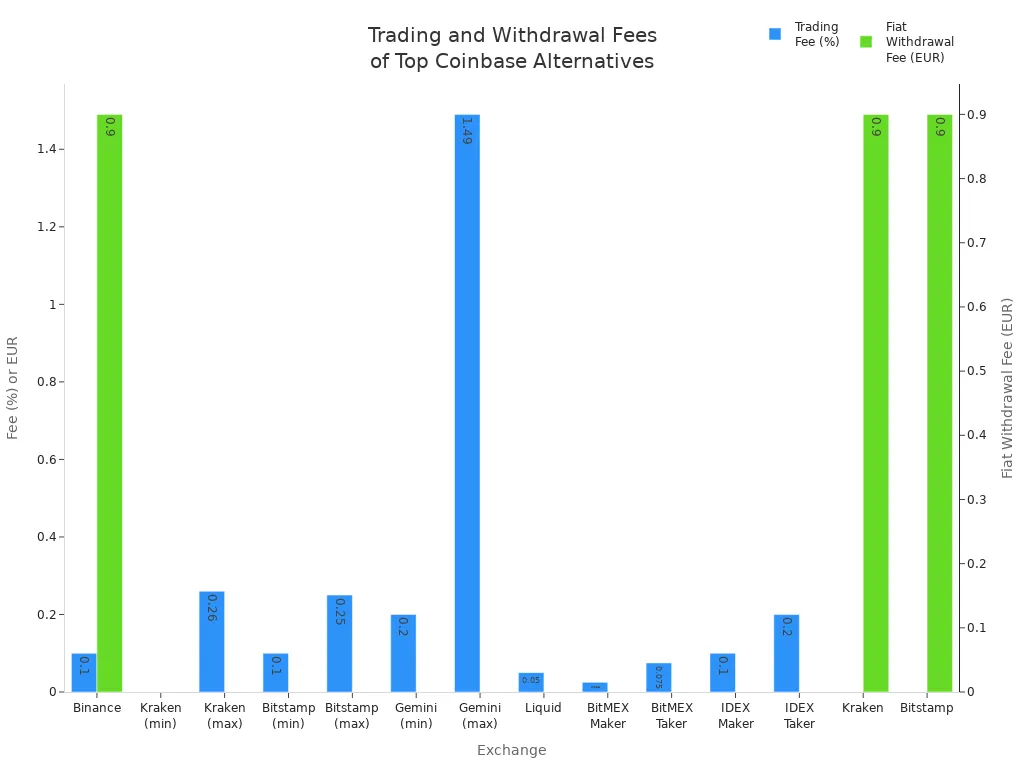
Some platforms stand out with unique features. Binance’s SAFU fund is one of the best features for user protection. Best Wallet offers a non-custodial, KYC-free experience for privacy-focused users. You can choose the platform that matches your needs for safety, privacy, and cost.
Deep Dive: Best Coinbase Alternatives
Kraken
Kraken stands out as one of the best coinbase alternatives for security-focused users. You benefit from a platform that puts your safety first. Kraken uses several strong protocols to protect your funds and data:
Withdrawal whitelists to limit transactions to approved addresses
Cold wallets for most customer funds, keeping them offline
Regular security audits to find and fix weaknesses
Compliance with international data protection rules like GDPR
Advanced encryption for sensitive data
Strict KYC checks for identity verification
Ongoing transaction monitoring for suspicious activity
Employee training on security and compliance
Filing suspicious activity reports with authorities
You get peace of mind because Kraken has never suffered a major hack. The platform also offers a user-friendly interface and an easy-to-use platform for both beginners and advanced traders. Kraken’s strong regulatory compliance and transparent operations make it a top coinbase alternative.
Pros:
Excellent security record
Advanced protection features
Strong regulatory compliance
Cons:
KYC process can take time
Some features may feel complex for new users
Gemini
Gemini is another best coinbase alternative, especially if you want strong compliance and advanced security. Gemini follows many industry standards and regulations, including ISO/IEC certifications, SOC1, SOC2, GDPR, CCPA, HIPAA, and PCI DSS. You can trust Gemini’s security because it uses:
Data encryption at rest and in transit
Data loss prevention (DLP) policies
Audit logging of user activity
Role-based access control (RBAC)
Secure Google Cloud infrastructure
Responsible AI principles for fairness and safety
Gemini’s insurance for hot wallets and hardware security keys add extra layers of protection. The platform’s easy-to-use platform and clear design help you manage your assets with confidence. Gemini’s regulatory compliance and security features make it a strong coinbase alternative for users who value trust and transparency.
Pros:
High-level security certifications
Insurance for hot wallets
Strong regulatory compliance
Cons:
Some advanced features may not suit all users
Binance.US
Binance.US is a best coinbase alternative for active traders who want low fees and strong security. You get:
Mandatory 2FA (Google Authenticator recommended)
Most funds in cold storage
Multisignature and threshold signature schemes
Advanced data encryption
No major security breaches on Binance.US
You can enjoy a feature-rich trading interface, high-speed trade execution, and a mobile app for trading anywhere. Binance.US offers lower fees and more crypto choices than coinbase. However, customer support can be slow, and the verification process may frustrate some users. The platform lacks some products like futures and margin trading due to US rules.
Pros:
Strong security measures
Low fees and wide crypto selection
Advanced trading tools
Cons:
Weaker customer support
Fewer product options than coinbase
Crypto.com
Crypto.com is a best coinbase alternative if you want a mix of security and convenience. The platform protects your assets with:
Two-factor authentication (2FA) for withdrawals and sensitive actions
Withdrawal limits and address whitelisting
Cold storage for most assets
Continuous monitoring for suspicious activity
Anti-phishing code to verify official messages
24/7 customer support
Insurance coverage for user funds
Crypto.com responded quickly to a 2022 breach by suspending withdrawals, reimbursing users, and improving security. The platform uses physical, electronic, and procedural safeguards to protect your information. You can rely on Crypto.com’s easy-to-use platform and strong compliance with global regulations.
Pros:
Strong security and insurance
Fast response to incidents
User-friendly interface
Cons:
Past breach may concern some users
Some features may require extra verification
eToro
eToro is one of the best coinbase alternatives for users who want social trading and strong client protection. You benefit from:
Private on-chain addresses
Machine learning-assisted security
Transport layer security (TLS) encryption
Segregation of client funds
Negative balance protection
Regulatory licenses in Australia, Cyprus, UK, and Seychelles
$1,000,000 third-party insurance underwritten by Lloyd’s of London
eToro’s user experience stands out with its social trading community, CopyTrader, and educational resources. The platform’s easy-to-use platform helps you learn and trade with confidence. eToro’s broad regulatory coverage and insurance make it a best coinbase alternative for different user types.
Pros:
Strong client protection and insurance
Social trading features
Wide regulatory coverage
Cons:
Not all features available in every country
Some users may find the social focus distracting
Bitstamp
Bitstamp is a best coinbase alternative for users who value stability and compliance. The platform uses:
Strict KYC/AML protocols
Regular financial audits
Registered with FinCEN in the US
Bitstamp’s long history and operational stability give you confidence in its reliability. The platform’s user-friendly interface makes it easy for you to trade and manage assets. Bitstamp’s strong regulatory compliance and security features make it a trusted coinbase alternative.
Pros:
Long-standing reputation
Strong regulatory compliance
Stable operations
Cons:
Fewer advanced features than some competitors
Limited crypto selection
BitMart
BitMart offers a mix of security features but has faced challenges. You get:
Data encryption and strict access controls
Multi-factor authentication (MFA)
Cold storage and multi-signature technology
Regular security audits and bug bounty programs
BitMart suffered a $200 million theft in 2021 due to compromised hot wallets. The platform reimbursed users and moved most assets to cold storage. However, BitMart lacks transparent proof-of-reserves and does not insure crypto deposits. The platform has not obtained top compliance certifications. BitMart’s user experience is improving, but it does not match the best coinbase alternatives for security.
Pros:
Multiple security layers
Regular audits and risk controls
Cons:
Past major breach
No insurance for crypto deposits
Lower compliance standards
Kyrrex
Kyrrex is a best coinbase alternative for users who want strong compliance and security. You benefit from:
Registration with FinCEN as a Money Services Business
Ongoing pursuit of Money Transmitter Licensing in the US
Annual independent audits, penetration testing, and code reviews
Top-tier security for user funds
Custom transaction monitoring and threshold management
Kyrrex’s regulatory oversight and security focus help protect your assets. The platform’s easy-to-use platform and admin panel make it simple for you to manage your account. Kyrrex stands out among coinbase alternatives for its commitment to compliance and user protection.
Pros:
Strong regulatory compliance
Advanced security protocols
User-friendly interface
Cons:
Still expanding in the US
Some features may be limited by region
Tangem (Hardware Wallet)
Tangem is a best coinbase alternative if you want maximum security and privacy. As a hardware wallet, Tangem offers:
Security Feature | Description |
|---|---|
Highest security level, same as used in passports | |
Private Key Storage | Keys generated and stored offline, never leave the chip |
Air-Gapped Design | No internet or server dependency, immune to online hacks |
Physical Durability | IP68 protection, works in extreme conditions |
Immutable Firmware | Cannot be updated after installation, no risk of malicious updates |
Multi-Signature Support | Supports secure backup and multi-signature |
Privacy | No user registration or KYC, full anonymity |
Open Source App | App can be reviewed by anyone for security |
Tangem’s hardware wallet has passed independent security audits. You do not need to register or provide KYC, so your privacy stays protected. The wallet works even if Tangem’s servers go offline. Tangem is a top choice for users who want to control their crypto without relying on exchanges.
Pros:
Maximum security and privacy
No KYC or registration
Works offline and in harsh conditions
Cons:
Not an exchange, so you manage your own trades
Physical card must be kept safe
Best Wallet (KYC-Free DEX)
Best Wallet is a best coinbase alternative for privacy-focused users who want a decentralized, KYC-free experience. You get:
No personal information or KYC required
Trades executed through smart contract-based liquidity pools
Private keys encrypted and stored only on your device
Two-factor authentication and biometric access
Unique backup passphrase for recovery
Never holds client funds, so no counterparty risk
Aggregates liquidity for competitive rates and cross-chain swaps
Fiat on-ramps without losing anonymity
You keep full control of your assets and privacy. Best Wallet’s user-friendly interface makes it easy for you to trade and manage crypto without giving up your identity. This platform stands out among the best coinbase alternatives for users who want privacy and security.
Pros:
Full privacy and control
No KYC or registration
Decentralized and non-custodial
Cons:
No customer support like centralized exchanges
You are responsible for your own security
Tip: Choose the best coinbase alternative that matches your needs for security, privacy, and ease of use. Each platform offers unique strengths for different user types.
Evaluating a Coinbase Alternative for Security
What to Look For
When you start choosing the right coinbase alternative, focus on platforms that offer robust protective measures. These features help you keep your assets safe and give you more security and control over your funds. Look for exchanges that provide:
A high percentage of assets stored in cold storage. This keeps most funds offline and away from hackers.
Mandatory two-factor authentication for every account. This adds another layer of protection when you log in.
Biometric authentication options, such as fingerprint or face ID, for extra account safety.
Withdrawal address whitelisting. This feature lets you approve only trusted addresses for withdrawals.
Insurance coverage for digital assets. Some exchanges offer insurance for hot wallets or have emergency funds.
Regular security audits and bug bounty programs. These help find and fix problems before hackers can exploit them.
Hardware security modules and multi-signature wallets. These tools protect private keys and require more than one person to approve withdrawals.
Transparent security practices and clear regulatory compliance. This builds trust and shows the exchange follows the law.
Tip: Always enable strong two-factor authentication and use cold wallets for long-term storage. Update your passwords often and watch out for phishing attempts.
Red Flags to Avoid
You need to spot warning signs that show an exchange may not be safe. Some platforms promise guaranteed high returns in a short time. This is a common sign of a scam. If you see an anonymous team with no real names or faces, you should be careful. Lack of customer support or slow replies can also mean trouble.
No information about the team or company.
Poor or missing customer support.
No clear regulatory status or licenses.
No regular security audits or public security reports.
History of major hacks with no clear response or compensation.
Unusual withdrawal limits or delays.
Many unregulated exchanges have lost user funds in the past. Some even use customer assets as collateral without telling you. If an exchange does not follow the rules or hides important details, you risk losing your crypto. Always check for these red flags before you trust a new platform.
How to Switch from Coinbase Safely
Step-by-Step Guide
Switching your crypto from Coinbase to another platform can feel stressful, but you can make it safe and simple by following these steps:
Create an account on your new exchange or set up your new wallet. Complete any required identity checks.
Find the correct receiving address on your new platform. Always copy and paste or scan the QR code to avoid mistakes.
Check that the network type matches on both Coinbase and your new platform. For example, if you send USDT, make sure both use the same blockchain (like ERC-20 or BSC).
In Coinbase, select ‘Transfer’ and then ‘Send’. Paste the receiving address and double-check it.
Enter the amount you want to send. Coinbase will show you the network fee.
Enable two-factor authentication on your Coinbase account before sending. This adds extra security.
Confirm the transaction. Track its progress in Coinbase’s Transaction History.
If your new platform asks for wallet ownership proof, complete a small test transfer first.
Add trusted addresses to your Coinbase whitelist early. This step can take up to two days.
If you face delays or issues, contact customer support right away.
Tip: Always double-check the address and network before sending. Sending to the wrong address or network can cause permanent loss.
Best Practices for Asset Protection
You can protect your crypto during the move by following these best practices:
Spread your assets across several wallets or exchanges. This reduces risk if one gets hacked.
Use both cold wallets (offline) and hot wallets (online) to balance safety and easy access.
Set up dual control for large transfers. This means more than one person must approve big moves.
Keep your private keys safe. Never share them with anyone.
Stay updated on security news and rules for your region.
Use strong passwords and change them often.
Review your transaction history to spot any strange activity.
Avoid moving funds during busy network times to prevent delays.
Choose exchanges that follow local laws to avoid account blocks.
Note: Many users lose funds by sending to the wrong address or using the wrong network. Always check details before you confirm.
If you want to know how to safely transition away from coinbase, careful planning and attention to detail will help you avoid mistakes and keep your assets secure.
You have many secure options if you want to move away from coinbase. Kraken and Gemini lead in user satisfaction for security and ease of use, offering cold storage, two-factor authentication, and strong compliance. In 2025, crypto thefts have reached record highs, so you must stay alert.
Always review your coinbase account and consider switching if you see risks. Use multi-factor authentication, monitor your accounts, and keep learning about new threats. Stay updated with trusted resources to protect your assets on coinbase or any alternative.
FAQ
What is the safest way to move my crypto from Coinbase?
You should use the withdrawal feature on Coinbase. Always double-check the receiving address. Start with a small test transfer. Enable two-factor authentication. Never share your private keys.
Tip: Always confirm the network type matches on both platforms before sending.
Do I need to complete KYC on every exchange?
Most centralized exchanges require you to complete KYC for full access. Some decentralized platforms and wallets, like Best Wallet, let you trade without KYC. You should check each platform’s rules before signing up.
How can I lower my trading fees when switching exchanges?
You can compare fee tables on each exchange. Choose platforms with lower maker and taker fees. Some exchanges offer discounts if you use their native token or trade higher volumes.
Binance and Kraken often have lower fees than Coinbase.
Watch for hidden withdrawal costs.
Are hardware wallets safer than exchanges?
Yes, hardware wallets like Tangem keep your crypto offline. You control your private keys. Hackers cannot reach your funds unless they get your device and PIN. You must keep your wallet safe from loss or damage.
Can I keep my identity private when trading crypto?
You can use decentralized exchanges or non-custodial wallets that do not require KYC. These platforms let you trade without sharing personal information. Always check local laws before using privacy-focused tools.
Note: Privacy options may limit your access to some features or coins.

