

You can no longer mine Ethereum after the Merge. The Ethereum network now uses proof-of-stake, which means you earn rewards by staking coins instead of solving complex puzzles. This change cut energy use by over 99.99%, dropping from nearly 23 million megawatt-hours a year to just over 2,600. Before the switch, miners worldwide powered the network with a hashrate near one petahash per second. Now, staking makes Ethereum much more eco-friendly, reducing emissions to a fraction of past levels.
Can you mine Ethereum today? No, but you can still earn with Ethereum by learning about staking or exploring other coins to mine.
Key Takeaways
You cannot mine Ethereum anymore because the network switched to proof-of-stake after the Merge.
Staking Ethereum lets you earn rewards by locking up coins instead of using expensive mining hardware.
Many miners now use their old equipment to mine other coins like Ethereum Classic or Ravencoin.
Staking is easier and more eco-friendly than mining, with options for both beginners and experts.
Before staking or mining, check your budget, skills, and local electricity costs to choose the best path.
Can You Mine Ethereum?
The Merge Explained
You might wonder, can you mine Ethereum after the big upgrade? The answer is no. The Ethereum Merge changed everything about how the network works. Before the Merge, ethereum mining used proof-of-work. Miners solved complex puzzles with powerful computers. This process used a lot of electricity and created competition for block rewards.
The Merge was a huge technical change. Developers combined the Beacon Chain, which used proof-of-stake, with the old Ethereum Mainnet that ran on proof-of-work. Now, validators secure the network by staking ETH instead of using mining hardware. You do not need to learn how to mine Ethereum anymore because mining ETH is no longer possible on the main Ethereum chain.
The new system picks validators randomly to create blocks and check transactions. You earn rewards by staking coins, not by mining. The Merge made Ethereum much more eco-friendly. Energy use dropped by over 99%. The network now processes blocks every 12 seconds in slots and groups them into epochs. This upgrade also keeps all past transactions safe and sets the stage for future improvements.
The Ethereum Merge did not just end mining. It made the network safer, more decentralized, and ready for growth.
Why Mining Ended
Can you still mine Ethereum? No, and here is why. Ethereum developers decided to end proof-of-work mining for several important reasons:
Proof-of-work used as much energy as a small country, about 70 terawatt-hours each year.
The environmental impact was too high and not sustainable.
Mining required expensive machines, making it hard for regular people to join.
Mining pools could control large parts of the network, risking centralization.
Proof-of-stake achieves security and decentralization with much less energy.
Validators now stake ETH instead of using computers to solve puzzles.
The new system gives clearer finality and better protection against attacks.
After the Ethereum Merge, the network stopped giving mining rewards. The block structure changed, removing fields like difficulty and nonce that miners needed. The execution engine now only handles transactions, not mining. Vitalik Buterin, one of Ethereum’s founders, said that mining on Ethereum is finished and will not come back.
You cannot use your mining hardware for Ethereum anymore. Mining ETH is not possible, and the network now relies on staking. If you want to earn ETH, you need to learn about staking or look for other coins to mine.
Can you mine Ethereum today? The answer is no. The Merge ended proof-of-work and made mining obsolete.
Ethereum Mining Alternatives

Other Mineable Coins
When ethereum mining ended, many miners looked for new coins to mine. You can use your old hardware for several other cryptocurrencies. Here is a table showing some of the most popular options:
Cryptocurrency | Mining Algorithm | Hardware Compatibility | Mining Rewards (approx.) | ASIC Resistance |
|---|---|---|---|---|
Ethereum Classic (ETC) | Etchash | GPU/ASIC recommended | ~2.048 ETC/block | No |
Ravencoin (RVN) | KAWPOW | GPU/CPU (ASIC-resistant) | 2,500 RVN/block | Yes |
Vertcoin (VTC) | ASIC-resistant | GPU/CPU (ASIC-resistant) | 12.5 VTC/block | Yes |
Most former ethereum miners now choose Ethereum Classic, Ravencoin, or Vertcoin. These coins work well with GPUs and do not always need expensive ASICs. Some miners also try Monero or Zcash, but Monero favors CPUs and Zcash often needs ASICs. If you want to know how to mine ethereum alternatives, start by checking if your hardware matches the coin’s algorithm.
Tip: Cloud mining services let you rent mining power for these coins without buying hardware. This can lower your risk and help you test different coins.
Profitability Factors
Mining profits depend on more than just the coin you pick. Electricity costs play a huge role. In places like Iran or Paraguay, cheap power keeps mining profitable. In Western Europe, high rates make mining hard unless you use renewables. You should always check your local electricity price before starting.
Factor | Details and Impact on Mining Profitability |
|---|---|
Profitable mining typically requires rates under $0.10/kWh | |
Industrial vs Residential Rates | Industrial rates are often lower, improving profitability |
Special Mining Tariffs | Some regions offer reduced rates specifically for mining |
Time-of-Use Pricing | Mining during off-peak hours can reduce costs |
Grid Stability and Reliability | Affects uptime and hardware longevity, impacting profitability |
Favorable Regions | North America and others with low electricity costs and stable grids |
Hardware efficiency also matters. Newer GPUs and ASICs use less power for more hashrate. Here is a chart comparing energy efficiency for popular mining hardware:
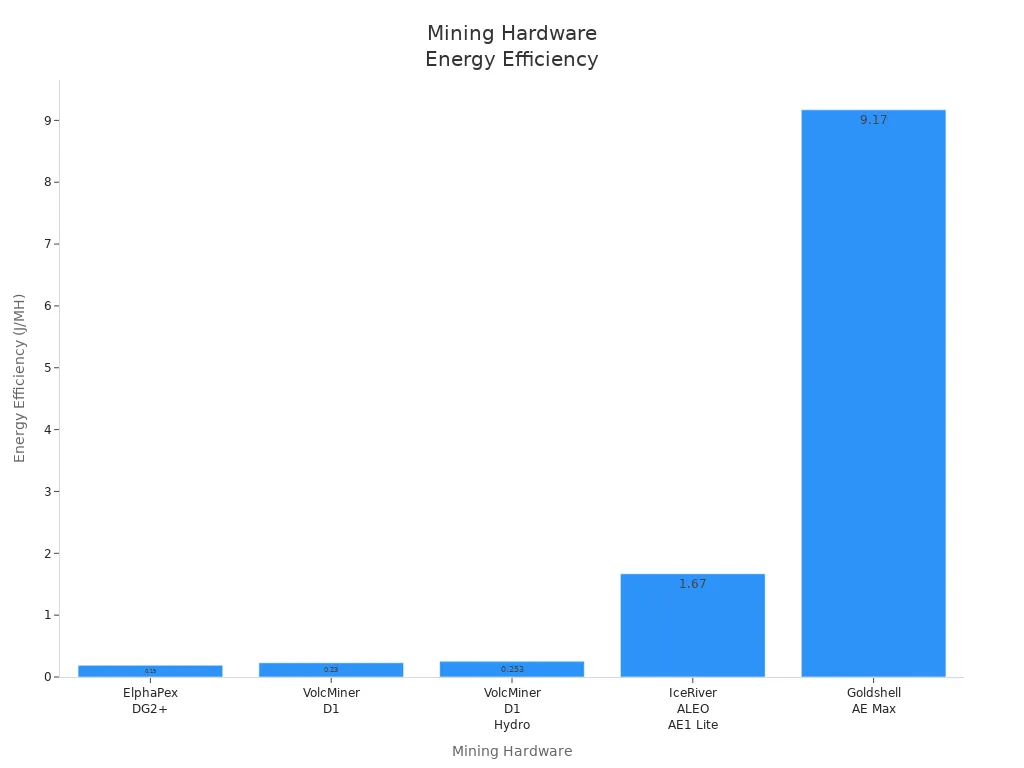
If your hardware uses too much power, your profits may drop or even turn negative. Many miners now use cloud mining to avoid high electricity bills and hardware upgrades. Cloud mining can also help you earn ethereum-based profits without running your own machines. When you look at ethereum mining in 2025, always consider both hardware and energy costs. Picking the right coin and setup can make a big difference in your mining results.
Staking Ethereum

What Is Staking?
Staking is the new way you help secure the ethereum network and earn rewards. Instead of using computers to solve puzzles, you lock up your coins to support the system. This process is called proof-of-stake. You do not need to mine anymore. You become a validator by staking your ethereum. Validators check transactions and propose new blocks. The network picks validators at random, so everyone gets a fair chance.
Here is how staking works on a technical level:
You deposit 32 ETH and a signed message with your withdrawal address.
You wait in an activation queue until your turn comes.
When active, you propose blocks and check others’ blocks.
You earn rewards automatically for doing your job.
If you want to stop, you submit an exit request and wait in a queue.
The network sends your staked ETH and rewards to your withdrawal address.
Your validator status ends, and your balance resets to zero.
You can let someone else run your validator, but you keep control of your coins.
You can also stake smaller amounts through pools or services. Staking rewards depend on how much you stake and how well you follow the rules. If you break the rules or go offline, you can lose some of your coins. This is called slashing.
Staking is now the main way to earn ETH because proof-of-stake uses less energy and keeps ethereum secure.
Solo vs. Pooled Staking
You have two main choices for staking: solo staking and pooled staking. Each has its own benefits and challenges.
Solo Staking
You run your own validator. You need 32 ETH and a computer that stays online all the time. You control your coins and get all the rewards. You also take on all the risks. If your validator goes offline or acts badly, you can lose some ETH. Solo staking gives you more control, but it is harder and needs more money and technical skill.
Pooled Staking
You join a group with other people. You can stake much less than 32 ETH. The pool runs the validator for you. You share the rewards with others in the pool. Pooled staking is easier and safer for beginners. You do not need special hardware or deep knowledge. Many platforms offer pooled staking, including liquid staking and centralized exchanges.
Here is a table comparing solo and pooled staking:
Staking Method | Minimum ETH Required | Control Level | Technical Skill Needed | Risk Level | Accessibility |
|---|---|---|---|---|---|
Solo Staking | 32 ETH | Full | High | Higher | Low |
Pooled Staking | Shared | Low | Lower | High |
Tip: If you have less than 32 ETH, pooled staking lets you start with as little as 0.01 ETH on some platforms.
Staking Requirements
You need to meet certain requirements to stake ethereum. These depend on the method you choose.
Solo Staking
Minimum ETH: 32 ETH
Hardware: Computer with 4-core CPU, 16GB RAM, and 2TB SSD
Internet: Reliable connection, always online
Skill: You must know how to run a validator node
Pooled and Liquid Staking
Minimum ETH: As low as 0.01 ETH (sometimes even less)
Hardware: None needed; the pool or platform handles everything
Skill: No technical knowledge required
Platforms: Lido, Rocket Pool, Binance, Kraken, and others
Here is a table showing minimum requirements for popular staking options:
Staking Method | Minimum ETH Required | Additional Requirements | Notes |
|---|---|---|---|
Solo Staking | 32 ETH | Dedicated hardware, technical skill | Full control, higher rewards, higher risk |
Rocket Pool Mini Pool | RPL token collateral, node management | Lower ETH needed, but you must run a node | |
Liquid/Pooled Staking | 0.01 ETH or less | None | Easy for beginners, rewards shared, less control |
0.025 ETH | None | Very low minimum, no setup needed |
Many platforms make staking easy for small holders. For example, Lido and Rocket Pool let you stake with no minimum or as little as 0.01 ETH. Kraken and Binance also allow small deposits. You should check each platform’s fees and features before you start.
Here is a table of current APY (annual percentage yield) for staking ethereum on major platforms:
Platform | Type | APY Range | Fees | Notes |
|---|---|---|---|---|
Bybit | Centralized Exchange | Up to 7% | No staking fees | Bonus APRs, restaking with cmETH token |
Lido | Liquid Staking | ~2.78% | 10% on rewards | stETH usable in DeFi, can boost APY |
Frax | Liquid Staking | ~3.38% | 10% on rewards | sfrxETH can be lent for stablecoins |
Binance | Centralized Exchange | 2.75% | ~10% on rewards | Stake ETH for WBETH, usable on/off platform |
Rocket Pool | Liquid Staking | ~2.95% | 5% node commission | rETH usable as DeFi collateral |
Coinbase | Centralized Exchange | ~2.08% | 35% commission | cbETH token provides liquidity, high fees |
Kraken | Centralized Exchange | 2.5%–7% | Starts at 20% | Restaking via EigenLayer for higher yields |

Note: Staking rewards can change. They depend on how much ETH is staked, network activity, and platform fees. Most platforms offer between 2% and 7% APY.
You should also know about legal and tax rules. In the United States, some staking services may count as securities and need registration. Other countries have their own rules. You may need to pay taxes on your staking rewards. Always check the laws in your country before you start.
Staking ethereum is open to almost everyone. You can choose solo staking for full control or pooled staking for easy access. Proof-of-stake makes the network safer and greener, and you can earn rewards by helping secure ethereum.
Staking vs. Mining
Risks and Rewards
When you compare staking and mining on the ethereum network, you see different risks and rewards for each method. Mining once offered high rewards, but it required expensive hardware and high electricity costs. Staking now gives you a way to earn rewards by locking up your coins, but it comes with its own set of risks.
Here are the main risks you face with staking:
Slashing: If your validator misbehaves or goes offline, you can lose part or all of your staked ethereum.
Lock-up periods: You cannot withdraw your staked coins right away. This can cause problems if you need quick access during a market drop.
Market volatility: The value of your staked ethereum can fall, even if you earn rewards.
Technology risks: Bugs, downtime, or lost keys can lead to lost funds.
Counterparty risks: Using third-party platforms means you trust them not to lose or steal your coins.
You can lower these risks by choosing reliable validators, spreading your stake across several validators, or using liquid staking options. Each method has its own trade-offs.
Mining rewards in the past were higher in total, with ethereum miners earning about 50 million ETH over seven years. Staking rewards now average around 4% APY. These rewards come from new coin issuance, transaction tips, and MEV (extra value from block production). Staking does not need expensive machines, so your costs are lower. As more people stake, the rewards per person go down, but the system stays more stable.
Staking offers more predictable returns and lower costs, but you must understand the risks before you start.
Accessibility
Staking has become much easier for most users since the ethereum Merge. You no longer need to buy and run special mining hardware. You can start staking with as little as 0.1 ETH using liquid staking or pools. These options do not require deep technical skills.
Here is a table comparing barriers for mining and staking:
Aspect | Mining Ethereum | Staking Ethereum |
|---|---|---|
Initial Cost | High (hardware, electricity) | Moderate (ETH deposit) |
Technical Skill Needed | Advanced (setup, maintenance) | Basic (key management) |
Energy Use | High | Low |
Minimum Requirement | Expensive hardware | 0.1–32 ETH (varies by method) |
Liquid staking and staking pools let you join with small amounts and little effort. Centralized exchanges also offer easy staking, handling the technical side for you. About one-third of all staked ethereum now uses liquid staking, showing how popular and accessible it has become.
Solo staking still needs 32 ETH and more technical skill, but most people now choose easier options. You can pick the method that fits your skills and budget.
Today, almost anyone can help secure ethereum and earn rewards, even with limited experience or funds.
Next Steps for Miners
Transitioning to Staking
You can shift from mining to staking and continue earning rewards on the ethereum network. Staking does not need expensive mining equipment. Instead, you lock up your ETH in a compatible wallet and help secure the network as a validator. This process uses much less energy and is better for the environment.
To get started, you have two main options:
Solo staking: Run your own validator node. You need at least 32 ETH and a computer with strong specs. Recommended hardware includes a CPU with 8 cores and 16 threads, 64GB RAM, and a 4TB NVMe SSD. A fast, stable internet connection and an uninterruptible power supply help keep your node online.
Staking pools: Join a group if you do not have enough ETH or technical skills. Pools let you stake smaller amounts and share rewards. Many guides and online resources explain how to join staking pools or set up your own validator.
Tip: You can find detailed guides, podcasts, and articles online to help you move from mining to staking. These resources also cover tax rules and the best staking practices.
If you want to keep earning with ethereum but do not want to stake, you can explore cloud mining for other coins. This lets you rent mining power without owning hardware.
Repurposing Hardware
Your old mining GPUs do not have to go to waste. You can use them for other tasks, but some options need special skills or high-end hardware.
AI and machine learning: Some companies now use mining GPUs for AI training and inference. You need GPUs with at least 12GB VRAM, fast CPUs, and lots of memory. This setup can be complex and costly.
Distributed computing and rendering: Projects like Render Network or Golem let you offer GPU power for tasks like 3D rendering. However, demand is low and profits are unclear.
Gaming: You can use some GPUs for gaming, but older models may not run new games well.
Selling GPUs: Many miners try to sell their GPUs. After the Merge, resale values dropped fast. Most GPUs now earn less than 10 cents a day from mining, so selling may be the best choice if you cannot use them for other work.
Note: Repurposing mining hardware for AI or cloud mining is possible, but you may need to invest in upgrades or learn new skills.
Mining ETH ended permanently in September 2022 with the Merge. You now earn rewards by staking, which uses less energy and offers more predictable returns. Consider these key points:
Mining hardware for ETH is obsolete but can work for other coins.
Staking is more accessible, with lower costs and easier setup.
Rewards depend on your method and risk tolerance.

Review your goals, budget, and skills before choosing staking or mining alternatives.
FAQ
Can you mine Ethereum after the Merge?
No, you cannot mine Ethereum anymore. The network now uses proof-of-stake. You can only earn ETH by staking or exploring other cryptocurrencies for mining.
What can you do with old Ethereum mining hardware?
You can mine other coins like Ethereum Classic or Ravencoin. You may also use your GPUs for gaming, AI tasks, or sell them if mining is not profitable.
How much ETH do you need to start staking?
You need 32 ETH for solo staking. If you use a staking pool or liquid staking service, you can start with as little as 0.01 ETH.
Is staking Ethereum safe?
Staking is generally safe, but you face risks like slashing, platform failures, or price drops. Choose trusted platforms and keep your keys secure.

