

The future of pi coin remains a hot topic in the cryptocurrency world, especially as we look ahead to the pi coin value in 2030. Predicting its value involves speculation, but some trends and data offer insights. By 2030, price predictions for pi coin vary widely, ranging from a bearish $85.6 to a bullish $500 or more, depending on innovation and market sentiment. Some models suggest an average value of $162.08 if pi achieves mass adoption. Factors like user base growth, exchange support, and ecosystem development play a significant role in shaping its potential. You might wonder if pi can truly transform the crypto landscape or if it will remain a speculative asset.
Key Takeaways
Pi Coin lets people mine cryptocurrency easily on their phones.
Its value in 2030 might be between $30 and $1000.
Things like supply, demand, and more users affect its price.
Knowing rules and market changes helps you invest wisely.
Think about Pi Coin’s future growth, not just short-term prices.
Understanding Pi Coin Value
What Is Pi Coin?
Pi Coin is the native cryptocurrency of the Pi Network, a blockchain-based platform designed to make cryptocurrency mining accessible to everyday users. Unlike traditional cryptocurrencies like Bitcoin, Pi Coin can be mined using a mobile device without consuming significant energy. This innovation aims to democratize access to digital assets, allowing you to participate in the crypto economy without expensive hardware.
The Pi Network launched in 2019 and has grown rapidly, attracting millions of users worldwide. Its unique approach to mining and community-building sets it apart from other blockchain projects. However, the current price of Pi Coin remains speculative, as it has yet to achieve full integration into major exchanges.
Unique Features of Pi Coin
Pi Coin stands out due to its focus on inclusivity and sustainability. The Pi Network uses a consensus algorithm called Stellar Consensus Protocol (SCP), which eliminates the need for energy-intensive mining processes. This makes Pi environmentally friendly and accessible to users who lack technical expertise.
Another key feature is its emphasis on community engagement. The Pi Network rewards users not only for mining but also for inviting others to join the platform. This creates a network effect, driving user base growth and increasing the potential value of Pi Coin.
Pi’s mobile-first approach also makes it unique. You can mine Pi Coins directly from your smartphone, making it one of the most user-friendly cryptocurrencies available. This feature has contributed to its widespread adoption, even among individuals new to blockchain technology.
Current Status of Pi Coin
As of now, Pi Coin remains in its enclosed mainnet phase, meaning it is not yet fully tradable on major cryptocurrency exchanges. The current price of Pi Coin is $0.7140, with a trading volume of $0 in the last 24 hours. Its market capitalization is also listed as $0, reflecting its limited circulation.
Metric | Value |
|---|---|
Trading Volume (24h) | $0 |
Current Price | $0.7140 |
Market Capitalization | $0 |
Circulating Supply | 0 coins |
Market Rank | #4917 |
Historical data shows fluctuations in Pi Coin price during its testnet phase. For example, on May 22, 2025, Pi Coin opened at $0.8529 and closed at $0.8273, with a trading volume of over $18 million. This volatility highlights the speculative nature of Pi Coin value.
Despite its current limitations, the Pi Network continues to expand its ecosystem, with plans to launch decentralized applications (dApps) and integrate Pi Coin into real-world use cases. These developments could significantly impact the pi coin price in the future.
Key Factors Influencing Pi Coin Value in 2030

Understanding the key drivers of Pi Coin’s price is essential when evaluating its potential in 2030. Several factors, including supply and demand, user base growth, and ecosystem development, will play a significant role in shaping the pi coin value in 2030.
Supply and Demand
Supply and demand are fundamental forces that influence the price of any cryptocurrency, including Pi. As more tokens enter circulation, the balance between availability and demand will determine its value. Over the next 12 months, nearly 1.5 billion Pi tokens are expected to unlock, which equals approximately $83 million at current prices. This means around 130 million tokens could enter the market monthly. While this influx may raise concerns about price dilution, it also highlights the importance of maintaining strong demand to counteract the growing supply.
The Pi Network’s ability to create demand will depend on its adoption rate and utility. If the network achieves widespread adoption, the increased demand for Pi Coins could offset the effects of supply growth. However, without sufficient use cases or a robust ecosystem, the pi coin value might face downward pressure.
User Base Growth
The growth of the Pi Network’s user base is another critical factor. A larger community increases the potential for mass adoption, which directly impacts the pi coin value in 2030. Since its launch in 2019, the Pi Network has focused on building a strong user base by offering an accessible and energy-efficient mining process. This strategy has attracted millions of users worldwide.
Recent data shows that over 41 million Pi tokens were accumulated by crypto whales in just two days, valued at approximately $27 million. This indicates growing interest in the network. As more users join, the network effect strengthens, making Pi more valuable. However, sustaining this growth will require continuous innovation and user engagement.
Ecosystem Development
The development of the Pi Network’s ecosystem will be one of the key factors influencing Pi Coin price in the long term. A thriving ecosystem with diverse applications can drive demand and enhance the coin’s utility. Since its inception, the Pi Network has made significant progress in building its ecosystem:
Year | |
|---|---|
2019 | Launch of Testnet and Mobile App focused on user acquisition and refining mining. |
2020 | Introduction of Security Circles to enhance trust and decentralization. |
2021 | Release of Pi Browser enabling DApp development within the ecosystem. |
Late 2021 | Enclosed Mainnet goes live, allowing internal wallet transfers and KYC verification. |
2022-2024 | Expansion of KYC program and network scaling with millions of users onboarding. |
February 2025 | Open Mainnet launch allowing broader integration with external applications. |
Early 2025 | Announcement of Chainlink integration to support DApp development. |
These milestones demonstrate the Pi Network’s commitment to creating a sustainable and innovative ecosystem. The introduction of decentralized applications (DApps) and partnerships with external platforms will likely increase the coin’s utility. If the network continues to expand and deliver on its promises, it could significantly boost the pi coin value in 2030.
Note: A well-developed ecosystem not only attracts users but also encourages developers to build on the platform, further enhancing its potential.
Market Trends
Market trends play a crucial role in shaping the future value of pi. By observing patterns in the cryptocurrency market, you can better understand how pi might perform by 2030. One key trend is the increasing adoption of blockchain technology across industries. As more businesses and governments embrace blockchain, the demand for cryptocurrencies like pi could rise significantly. This growing interest could positively impact pi’s price prediction for the coming years.
Another important trend is the shift toward decentralized finance (DeFi). DeFi platforms allow users to access financial services without relying on traditional banks. If the Pi Network integrates with DeFi applications, it could attract a larger user base and increase the utility of pi. This would likely boost its value over time.
The projected price prediction for pi reflects these trends. By 2030, pi could be valued between $200 and $500 if it successfully launches on major exchanges and achieves its roadmap milestones. The table below outlines potential price ranges for pi over the next few years:
Year | Conservative | Moderate | Bullish |
|---|---|---|---|
2026 | $5–$20 | $20–$50 | $50–$100 |
2027 | $10–$30 | $30–$80 | $80–$200 |
2028 | $15–$50 | $50–$120 | $120–$300 |
2029 | $20–$70 | $70–$150 | $150–$500 |
2030 | $30–$100 | $100–$250 | $250–$1000 |
You should also consider external factors like global economic conditions and technological advancements. For example, partnerships with e-commerce or fintech companies could drive real-world usage of pi, further increasing its value. Additionally, regulatory clarity in regions like the UAE, Singapore, and Switzerland could create a more favorable environment for pi to thrive.
Tip: Keep an eye on emerging trends in blockchain and cryptocurrency markets. Staying informed will help you make better decisions about pi and other digital assets.
Regulatory Environment
The regulatory environment is another critical factor influencing pi’s future value. Governments and financial institutions worldwide are working to establish clear rules for cryptocurrencies. These regulations aim to protect investors while fostering innovation in the blockchain space. For pi, a supportive regulatory framework could pave the way for broader adoption and higher value.
Countries like the UAE, Singapore, and Switzerland have already taken steps to create crypto-friendly policies. These regions provide a stable environment for blockchain projects, making them attractive hubs for innovation. If the Pi Network aligns with these regulations, it could gain credibility and attract more users.
However, regulatory challenges remain. Some governments view cryptocurrencies with skepticism due to concerns about fraud and money laundering. Stricter regulations in these regions could limit pi’s growth potential. To overcome these challenges, the Pi Network must prioritize transparency and compliance with international standards.
You should also consider how regulations might impact pi’s integration with traditional financial systems. For example, partnerships with banks or payment processors could require the Pi Network to meet specific legal requirements. Successfully navigating these challenges will be essential for pi to achieve its full potential.
Note: Regulatory changes can happen quickly. Staying updated on global policies will help you understand how they might affect pi and other cryptocurrencies.
Pi Network Price Predictions
Bullish Scenarios
The potential for Pi Coin to experience bullish growth lies in its ability to maintain momentum and achieve key milestones. Several factors could drive its value upward, making it an attractive investment for the future. Here are some scenarios that support a bullish outlook for Pi Network price predictions:
Pi Coin has shown resilience by staying above the critical support level of $0.70, which indicates strong market confidence.
The price has consistently held above the 0.5 and 0.618 Fibonacci retracement levels, suggesting healthy corrections rather than a reversal of trends.
Short-term forecasts predict Pi Coin could reach $0.937 by May 23, representing a 24% increase from its current value.
Long-term projections estimate the price could rise to $2.34 by June and potentially $4.44 by November 2029, provided the network continues to grow and develop its ecosystem.
By 2025, the average price prediction for Pi Coin is $2.04, with potential highs near $3.36 if the mainnet launch gains traction and adoption accelerates.
The future of Pi Coin depends on its ability to deliver on its promises. If the Pi Network successfully integrates decentralized applications (DApps) and forms partnerships with major platforms, it could significantly boost the coin’s utility and demand. This would likely result in higher price targets and sustained bullish momentum.
Bearish Scenarios
While the Pi Network shows promise, certain risks could lead to bearish outcomes for its price predictions. These scenarios highlight the challenges that could hinder its growth:
Aspect | Details |
|---|---|
Current Price | |
Previous High | $1.6692 |
Market Cap Drop | From over $10 billion to $5.5 billion, a drop of almost $4.5 billion |
Potential Price Drop | Expected to crash by 30% due to token unlocks |
Price Levels | Initial fall to $0.6585, potential further drop to $0.5545 |
Tokens Unlocking | 72 million tokens valued at over $55 million will be unlocked this week |
Future Unlocks | 278 million coins in the next 30 days, averaging 9.26 million per day |
Technical Indicators | RSI and MACD below neutral levels, bearish flag pattern, rising wedge chart |
Centralization Concerns | Accusations of the foundation dumping tokens, limiting ecosystem growth |
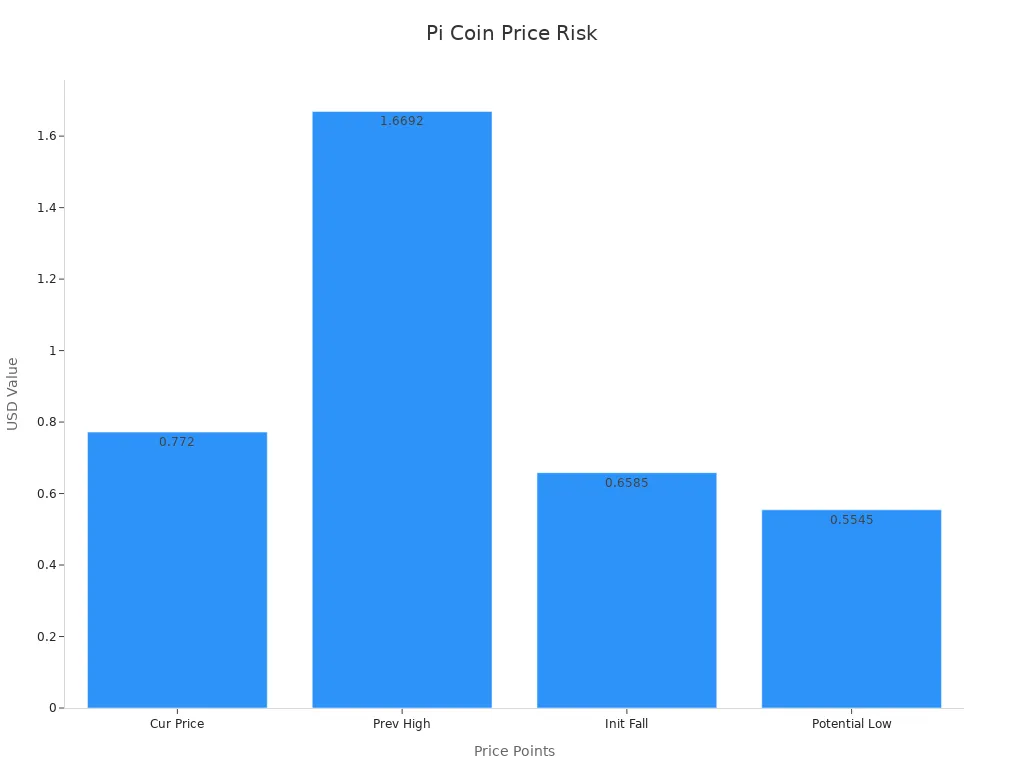
The unlocking of millions of tokens could flood the market, leading to price dilution. Additionally, technical indicators like RSI and MACD suggest bearish trends, which could further erode investor confidence. Concerns about centralization and accusations of token dumping by the foundation also pose significant risks. If these issues persist, the pi coin value might struggle to gain traction, and its price could fall below key support levels.
Moderate Predictions
A moderate outlook for Pi Network price predictions considers both the potential for growth and the risks involved. In this scenario, Pi Coin achieves steady progress without dramatic price swings. Analysts suggest the following price targets for the coming years:
Year | Conservative | Moderate | Bullish |
|---|---|---|---|
2026 | $5–$20 | $20–$50 | $50–$100 |
2027 | $10–$30 | $30–$80 | $80–$200 |
2028 | $15–$50 | $50–$120 | $120–$300 |
2029 | $20–$70 | $70–$150 | $150–$500 |
2030 | $30–$100 | $100–$250 | $250–$1000 |
In this scenario, the pi coin value in 2030 could range between $100 and $250 if the network achieves moderate adoption and ecosystem development. Factors like regulatory clarity, partnerships, and gradual user base growth would support this steady rise. While the price prediction for Pi Coin may not reach extreme highs, it would still represent significant growth from its current levels.
The moderate scenario reflects a balanced view of the future of Pi Coin. It accounts for both the opportunities and challenges that lie ahead, offering a realistic perspective on its potential.
Comparison with Other Cryptocurrencies
Pi Coin vs. Bitcoin
Bitcoin is the first cryptocurrency and remains the most well-known. It operates on a proof-of-work (PoW) system, which requires high computational power and energy consumption. Mining Bitcoin involves specialized hardware, making it less accessible to everyday users. In contrast, pi uses a mobile-first approach, allowing you to mine coins directly from your smartphone. This makes pi more inclusive and environmentally friendly.
Bitcoin has a fixed supply of 21 million coins, which creates scarcity and drives its value. Pi, on the other hand, is still in its developmental phase, and its total supply depends on user participation and network growth. While Bitcoin is widely accepted as a store of value, pi aims to build a utility-driven ecosystem. This difference highlights their unique roles in the cryptocurrency space.
Pi Coin vs. Ethereum
Ethereum is a leading cryptocurrency known for its smart contract functionality. It ranks among the top digital assets by market capitalization, reflecting its widespread adoption. Institutional interest in Ethereum has grown, further solidifying its position. In comparison, pi is still in its early stages, with its market capitalization yet to be established. Its future growth relies on user engagement and partnerships.
Ethereum has transitioned to a proof-of-stake (PoS) system, reducing its energy consumption. However, mining Ethereum still requires technical knowledge and investment. Pi’s mobile mining process is simpler and more accessible. While Ethereum supports a vast ecosystem of decentralized applications (DApps), pi is working to develop its own ecosystem. If successful, pi could become a strong competitor in the blockchain space.
Mining Efficiency and Inclusivity
Mining efficiency is a key factor that sets pi apart from other cryptocurrencies. Traditional mining methods, like those used for Bitcoin, consume significant energy and require expensive hardware. Ethereum’s PoS system has improved efficiency, but it still involves staking large amounts of cryptocurrency. Pi’s mobile mining process eliminates these barriers. You can mine pi without draining your phone’s battery or using additional resources.
Inclusivity is another strength of pi. Its user-friendly approach allows anyone with a smartphone to participate in the network. This makes pi accessible to people in regions where traditional mining is impractical. By focusing on inclusivity, pi has attracted millions of users worldwide, creating a strong community that supports its growth.
Real-World Use Cases
For any cryptocurrency to succeed, it must demonstrate practical applications. Pi aims to achieve this by integrating into real-world scenarios that benefit its users. You might wonder how pi could fit into your daily life. Let’s explore some potential use cases.
E-Commerce Transactions
Pi could become a popular payment method for online shopping. Its mobile-first approach makes it easy for users to send and receive payments instantly. Imagine purchasing goods or services from e-commerce platforms using pi, bypassing traditional banking systems. This could reduce transaction fees and make cross-border payments more accessible.Peer-to-Peer Transfers
Sending money to friends or family could become simpler with pi. You wouldn’t need a bank account or a third-party app. Instead, you could transfer funds directly through the Pi Network. This feature could be especially useful in regions with limited access to financial services.Decentralized Applications (DApps)
Developers could build DApps on the Pi Network to offer services like lending, gaming, or content sharing. These applications would use pi as their native currency, creating more demand for the coin. For example, you could play a game and earn pi as a reward, which you could then spend or save.Microtransactions
Pi could enable microtransactions for digital content. You might pay a small amount of pi to read an article, watch a video, or access premium features in an app. This use case could revolutionize how creators monetize their work.
Note: The success of these use cases depends on the Pi Network’s ability to deliver a secure and scalable platform. As the ecosystem grows, you could see pi becoming a part of everyday transactions.
Reliability of Price Predictions
Uncertainties in Cryptocurrency Markets
Cryptocurrency markets are known for their unpredictability. You might notice that prices can swing dramatically within hours. This volatility stems from factors like market sentiment, technological advancements, and external events. For pi, the lack of a fully operational market adds another layer of uncertainty. Without established trading patterns, predicting its future value becomes even more challenging. Additionally, the speculative nature of cryptocurrencies means that even small changes in demand or supply can lead to significant price fluctuations.
Limitations of Forecasting Models
Forecasting models for pi face several challenges. Current predictions often rely on Pi IOU prices, which do not reflect the actual value of the coin. These IOU prices are speculative and depend on limited trading activity. The absence of a fully functional market for pi further complicates long-term price prediction. Analysts also struggle with the wide range of variables that can influence pi’s value. Predictions vary significantly, highlighting the difficulty of accounting for external factors like regulatory changes or technological developments. These limitations make it hard to answer the question, “how reliable are pi coin price predictions?”
The lack of a fully operational market increases unpredictability.
Predictions vary widely due to external influences.
Importance of Long-Term Perspective
When evaluating pi’s potential, you should focus on the long-term perspective. Short-term price movements can be misleading and may not reflect the coin’s true value. Instead, consider the network’s roadmap, user base growth, and ecosystem development. These factors provide a clearer picture of pi’s potential over time. A long-term price prediction accounts for these elements and offers a more balanced view. By adopting this approach, you can better understand how pi might evolve as its ecosystem matures.
Predicting Pi Coin’s value in 2030 remains speculative. You’ve seen how factors like supply, demand, user growth, and ecosystem development shape its potential. Analysts offer a wide range of predictions, from bearish outcomes to bullish scenarios.
Tip: Focus on long-term trends rather than short-term fluctuations. This approach helps you make informed decisions about Pi Coin’s future.
Approach these predictions with cautious optimism. While Pi Coin shows promise, uncertainties in the crypto market remind you to stay vigilant and informed.
FAQ
1. What makes Pi Coin different from other cryptocurrencies?
Pi Coin stands out because you can mine it using a smartphone without draining your battery. Its energy-efficient process and focus on inclusivity make it accessible to everyone, unlike Bitcoin or Ethereum, which require expensive hardware or staking large amounts of cryptocurrency.
2. Can you trade Pi Coin on major exchanges?
Currently, Pi Coin is not tradable on major exchanges. It remains in its enclosed mainnet phase. Once the open mainnet launches, you might see it listed on popular platforms, allowing broader trading opportunities.
3. How does Pi Coin ensure security?
The Pi Network uses the Stellar Consensus Protocol (SCP). This system relies on trusted security circles formed by users. It ensures transactions are verified securely without the need for energy-intensive mining.
4. What factors could increase Pi Coin’s value by 2030?
Several factors could boost its value, including user base growth, ecosystem development, and integration with real-world applications. Partnerships with businesses and regulatory clarity could also play a significant role in driving demand.
5. Is investing in Pi Coin risky?
Like all cryptocurrencies, Pi Coin carries risks due to market volatility and regulatory uncertainties. Its current speculative nature adds to the unpredictability. You should research thoroughly and only invest what you can afford to lose.
Tip: Stay updated on Pi Network developments to make informed decisions about its potential.

