

Hong Kong stablecoin licensing will start on August 1, 2025. This will bring new rules for digital asset issuers. The Hong Kong stablecoin rules say issuers must get approval from the Hong Kong Monetary Authority. They also must follow strict transparency rules. In 2024, the global stablecoin market cap is about $162.5 billion. But Hong Kong does not have any licensed stablecoin issuers yet. The stablecoin regime gives current operators extra time to meet the new rules. Early preparation is very important for firms that want to join the Hong Kong stablecoin market under the new rules.
Key Takeaways
Hong Kong will start giving licenses to stablecoin issuers on August 1, 2025. They must get approval from the Hong Kong Monetary Authority (HKMA).
Issuers have to follow strict rules. They must know who owns stablecoins. They must stop money crimes. They must back stablecoins with safe assets. They must be open with their reports.
Companies need at least HK$25 million in capital. They must have a local office. They need strong leaders. They must apply for a license by September 30, 2025.
Current issuers have six months to adjust. They can get a temporary license if they follow the rules during this time.
The new rules help protect investors. Stablecoins must be safe and backed by real assets. Issuers will be checked often to stop fraud.
Key Rules for Hong Kong Stablecoin Issuers
Main Requirements
The Hong Kong stablecoin bill starts on August 1, 2025. It brings new rules for all stablecoin issuers. The Hong Kong Monetary Authority, or HKMA, will watch over these companies. The main rules are about knowing who owns the stablecoins, stopping money laundering, being open about actions, and managing risks well.
Description | |
|---|---|
Owner Identification | Every stablecoin owner must be known unless the issuer proves strong anti-money laundering steps. Issuers, banks, virtual asset providers, or trusted third parties can check who owns the stablecoins. |
Licensing Requirement | Stablecoin issuers need a license from the HKMA. They can apply between August 1 and September 30, 2025. |
AML/CFT Compliance | There are strict rules to stop money laundering and terrorism funding. Issuers must show they have good controls or check all owners. |
Transparency | The HKMA will share a list of licensed companies. Using stablecoins without a license is risky for users. |
Use of Technology | Blockchain analytics can help with rules, but they do not remove all risks. |
Regulatory Review | The HKMA will check the rules often and change them if needed. |
Issuers must back their stablecoins with safe, easy-to-sell assets. These assets must be kept separate and protected by trusted custodians. Issuers need at least HK$25 million in paid-up capital and a real office in Hong Kong. The HKMA wants issuers to have strong leadership, with independent board members and skilled managers.
Compliance Steps
Stablecoin issuers must follow many rules to meet the new standards. The HKMA gives clear instructions to help issuers understand what to do.
Owner Verification: Issuers must check who owns every stablecoin, even if they are not customers. They can do this directly or use trusted helpers. Some ways to check are small payments or special codes.
AML/CFT Controls: Issuers must use smart rules to stop money crimes. They must check customers and watch transactions with technology. If someone sends more than HK$8,000, they must collect and share sender and receiver details.
Reserve Asset Management: Stablecoins must be backed by safe, easy-to-sell assets. Issuers must check their reserves often and tell the public about their policies and audits.
Issuance and Redemption: Issuers must only make new stablecoins if they have enough reserves. They must let people trade stablecoins for cash at the same value within one business day.
Risk Management: Issuers must have strong plans to handle risks. This includes testing for problems and having good controls inside the company.
Corporate Governance: The HKMA wants clear company structures and independent checks. Leaders must have the right experience and work in Hong Kong.
Reporting and Disclosure: Issuers must send daily reserve updates, weekly reports to the HKMA, and regular news on their websites.
Business Conduct: Issuers must handle complaints, keep good records, and share true information. Lying about having a license is not allowed.
Tip: Talking to the HKMA early and checking for rule gaps can help issuers avoid problems and fines when getting a license.
Transitional Period
The hong kong stablecoin rules give current issuers six months to adjust. This starts on August 1, 2025, and lets them keep working while they try to meet all the new rules.
Key Aspect | Details |
|---|---|
Transitional Period Duration | |
License Application Submission | Within first 3 months after August 1, 2025 |
Conditions to Continue Operation | Submit application, get a reply from HKMA, and show a good plan to follow the rules |
Closure Deadline if Conditions Not Met | End of 4th month after August 1, 2025 |
Provisional License | Given if rules are followed; lets issuers keep working until a final choice is made |
Cease Operations After Rejection | Must stop within 1 month after being rejected |
Advertising Restrictions |
During this time, issuers must apply for a license in three months. The HKMA can give a temporary license if issuers show they are trying to follow the rules. Issuers must keep good reserves, let people trade stablecoins for cash in one day, and use strong checks on customers and transactions. If they do not apply or follow the rules, they must close in four months. The HKMA can give fines, stop licenses, or punish rule-breakers.
This period helps current issuers get ready for the new hong kong stablecoin licenses. Following the rules early is important because the HKMA will act fast if issuers do not obey. The new stablecoin licenses are meant to protect investors, keep the market safe, and match global rules.
Stablecoin Licensing Regime Process
Application Timeline
The Hong Kong Monetary Authority will start the stablecoin licensing on August 1, 2025. This is when companies can begin to apply. The HKMA wants issuers to contact them by August 31, 2025, for early help. Issuers must send in their full applications by September 30, 2025, to join the first group. The HKMA plans to give out the first stablecoin licences in early 2026.
Date | Event/Requirement |
|---|---|
August 1, 2025 | Stablecoin licensing regime begins; public registry launches |
August 31, 2025 | Deadline to contact HKMA for preliminary engagement |
September 30, 2025 | Deadline for formal application submission for first batch of licences |
Early 2026 | First stablecoin licences expected to be issued |
Note: If issuers miss the September 30, 2025 deadline, they cannot join the first round. They must stop working if they do not follow the rules.
How to Apply
Issuers need to follow a few steps to get a licence. First, they should contact the HKMA for advice. The HKMA will give feedback and explain what is needed. Next, issuers must prepare and send in their full application before the deadline.
Key steps include: 1. Contact the HKMA by email or another official way before August 31, 2025. 2. Gather all needed documents, like proof of paid-up capital (at least HK$25 million), details about the stablecoin manager, and company structure information. 3. Send the full application by September 30, 2025. 4. Make sure all rules are followed, such as anti-money laundering checks, wallet ownership checks, and reserve asset records.
The HKMA will look at the application and might ask for more details. Only issuers with strong business plans and good rule-following will move forward. The Hong Kong Monetary Authority can approve important staff and check applicants.
Tip: Talking to the HKMA early can make the application process easier.
Review and Approval
After the deadline, the HKMA will carefully check each application. They look for financial strength, technical skills, and rule-following. The HKMA also checks that stablecoins have safe, easy-to-sell reserves and that issuers can let people trade stablecoins for cash in one day.
A public list of licensed issuers will start on August 1, 2025. This list helps people check which companies have real licences. The HKMA warns everyone to stay away from unlicensed or fake companies.
The review can take a few months. The HKMA plans to give out the first licences in early 2026. Only a small number of licences will be given at first. Issuers who miss the early deadline must leave the market and could get fines or warnings.
Aspect | Details |
|---|---|
Review Period | Several months after September 30, 2025 |
First Licences Issued | Early 2026 |
Public Registry Launch | August 1, 2025 |
Limited Number of Licences | Only a few licences expected in the first round |
HKMA Enforcement | Fines, suspensions, revocations, and criminal prosecution |
The HKMA uses strict rules to keep the market and investors safe. Only companies that meet all the rules will get a licence.
Impact of Hong Kong Stablecoin Licences
For Issuers
Stablecoin issuers in Hong Kong will have more costs and rules to follow. The new licensing rules say issuers need full reserve backing and strong anti-money laundering checks. They also need at least HK$25 million in capital. Issuers must improve their technology and hire skilled workers. Small companies might find these rules hard, but they get six months to get ready.
Issuers must keep good reserves and do regular audits.
The HKMA will only give licenses to companies with strong leadership and clear operations.
Companies that meet the rules can get ahead and attract big clients.
Only a few licenses will be given at first, so early companies have an advantage.
The new rules push issuers to use better blockchain tools and real-time checks. This helps build trust and lets more people use stablecoins.
For Investors
The new licensing rules give investors more protection and trust in the market.
Licensed issuers must back stablecoins with safe assets and let people get cash quickly.
Regular checks and public reports help investors know their money is safe.
The HKMA stops fraud and bad business actions with strict rules.
Investors have clear rights, even if a company goes out of business.
The new rules lower risks like losing value or crime, making things safer for everyone.
These steps match global standards and bring in big investors, helping digital assets grow in regular finance.
Market Position
Hong Kong’s stablecoin rules make it a top place for digital assets. The city stands out because it controls things closely and has high safety standards.
Jurisdiction | Incorporation | Reserve Management | Unique Features |
|---|---|---|---|
Hong Kong | Separate, high-quality assets | Rules reach outside, strong leadership | |
EU (MiCA) | Varies | Varies | Same rules in 27 countries |
Singapore | Local | MAS standards | Only local companies can issue |
US | Federal/State | High standards | Shares rules with other countries |
Hong Kong’s clear rules and strong checks bring in big companies and new startups. Mainland companies can use Hong Kong for Web3 projects. Global investors see Hong Kong as a safe and well-run market. The rules help Hong Kong become a world leader in digital assets and show how to innovate safely.
Hong Kong’s stablecoin licensing regime will start on August 1, 2025. It sets high standards for issuers and others in the market.
The ordinance says issuers need a license, strong company rules, and must be open about what they do. This matches global trends and helps investors trust the market more.
Only issuers who follow all the rules will get licenses. This makes it harder to enter the market.
Issuers should do these things right away:
Meet the money and business rules.
Put in place AML and CTF controls.
Send an Expression of Interest by August 31, 2025.
Turn in a full application by September 30, 2025.
Date | Milestone/Event | Description |
|---|---|---|
August 1, 2025 | All issuers must get a license from the HKMA. | |
September 30, 2025 | Application deadline | Last day to send a full application for the first group. |
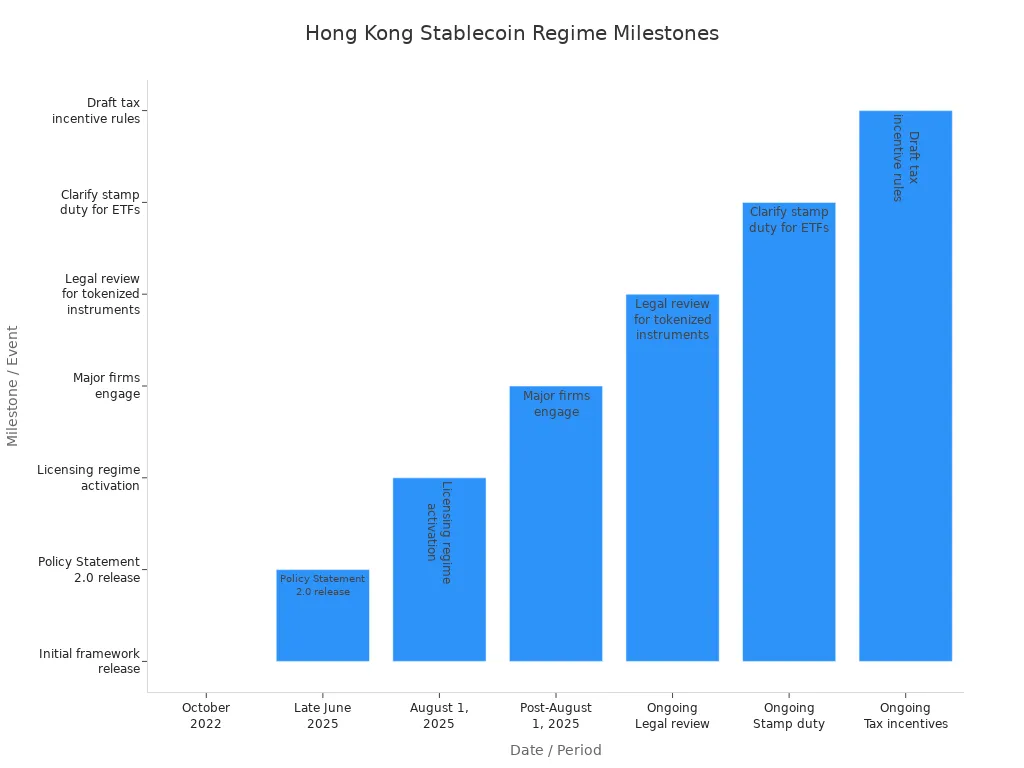
Keep checking HKMA news and legal advice. If you do not follow the rules, you could face legal trouble and lose trust in the market.
FAQ
What is the deadline for stablecoin license applications in Hong Kong?
Issuers have to send in their full license applications by September 30, 2025. The Hong Kong Monetary Authority will not look at late applications for the first group of licenses.
Who can apply for a stablecoin license?
Only companies with a local office and at least HK$25 million in paid-up capital can apply. They also need strong compliance systems. The HKMA wants applicants to show good leadership and strong risk management.
What happens if an issuer does not comply with the new rules?
The HKMA can give fines, stop or take away licenses, and start legal action. Issuers who do not follow the rules must stop working by the deadline.
How does the new regime protect investors?
Licensed issuers must back stablecoins with safe assets. They must give daily updates about reserves and let people get cash quickly. These rules help keep investors safe from fraud and loss.

