
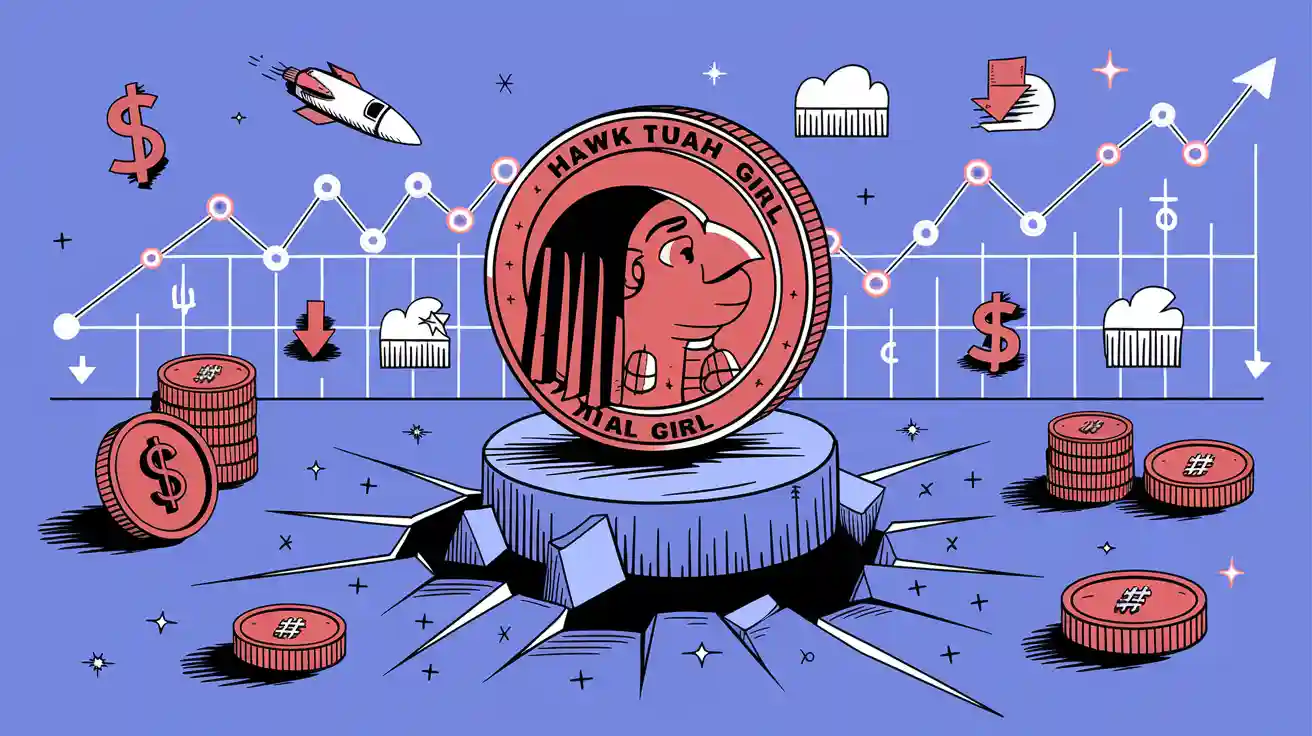
The Hawk Tuah Girl Crypto Coin ($HAWK) captured widespread attention as its value skyrocketed shortly after launch. It debuted with a market cap of $500 million, but within 20 minutes, the figure plummeted to $60 million. The coin’s price surged from $0.005492 to a peak of $0.04916 before collapsing by over 90%. A single trader profited $1.3 million by selling 135 million tokens, while another wallet controlled 17.5% of the supply, selling for a significant gain. These events, paired with 96% of the supply concentrated in 10 wallets, raised concerns of manipulation. Investors soon faced devastating losses, fueling outrage and skepticism about the coin’s legitimacy. The rise and fall of this memecoin highlighted the risks tied to celebrity-driven crypto ventures like Hawk Tuah Girl’s $HAWK.
Key Takeaways
The Hawk Tuah Girl Crypto Coin ($HAWK) rose and fell quickly. This shows how risky celebrity-backed cryptocurrencies can be.
Investors should be careful with projects that are highly controlled. About 96% of $HAWK’s coins were owned by a few wallets. This caused big changes in the market.
It is important to check facts and research before investing in crypto. Always look into how tokens are shared and if the project is trustworthy.
The SEC looked into $HAWK Coin but found no problems. This shows how hard it is to control the mostly unregulated crypto world.
The fall of $HAWK is a warning for investors. Be careful and think twice before putting money into risky investments.
The Rise of Hawk Tuah Girl and Her Crypto Venture

Haliey Welch’s Journey to Fame
Haliey Welch’s rise to fame was both unconventional and rapid. Initially, she gained attention by selling merchandise online, building a loyal fanbase through her relatable personality and creative branding. Her transition into the cryptocurrency world surprised many, as she had no prior experience in blockchain technology or finance. Welch marketed herself as a champion of community-driven projects, which resonated deeply with her followers.
Her decision to launch the $HAWK token was framed as an opportunity for fans to participate in a shared financial venture. Welch described the coin as a “community token,” emphasizing its potential to empower her supporters. However, the launch faced immediate criticism. Insiders controlled 96% of the token supply, and pre-sale dumping by these insiders caused significant financial harm to her fans. Critics accused Welch of orchestrating a “pump-and-dump” scheme, where the coin’s value was artificially inflated before insiders sold off their holdings. Despite these allegations, Welch’s lawyer denied any wrongdoing, explaining that the token distribution followed standard practices.
Welch cooperated fully with legal authorities during the fallout. The SEC investigated the situation but ultimately found no evidence of misconduct on her part. This allowed Welch to continue her involvement in the cryptocurrency space, though her reputation remained tarnished.
The Decision to Launch $HAWK Coin
The launch of $HAWK coin marked a pivotal moment in Welch’s career. The coin debuted with an impressive market capitalization of $490 million, reflecting the initial enthusiasm of her fanbase and crypto investors. Welch leveraged her social media presence to generate excitement, presenting the coin as a groundbreaking opportunity for financial growth.
However, the project quickly encountered challenges. Within hours of its launch, the market value dropped by 91%, reducing the capitalization to $41.7 million. A single wallet controlled 17.5% of the total token supply, raising concerns about centralization and insider manipulation. These issues undermined the coin’s credibility and led to significant financial losses for many investors.
Despite the setbacks, Welch’s ability to attract attention to her project demonstrated the power of celebrity influence in the crypto market. The rise and fall of $HAWK coin serve as a cautionary tale about the risks associated with investing in celebrity-endorsed cryptocurrencies.
The Launch of Hawk Tuah Girl Crypto Coin
Marketing Strategies and Initial Hype
Haliey Welch employed a multi-faceted marketing strategy to promote the launch of $HAWK Coin. Her extensive social media presence played a pivotal role in generating excitement. Welch used platforms like X (formerly Twitter) and Instagram to share teasers, memes, and promotional videos, creating a buzz among her followers. The coin quickly became a viral sensation, with hashtags and memes circulating widely across social media. This approach capitalized on the growing trend of meme-based cryptocurrencies, which often rely on humor and relatability to attract investors.
The launch campaign achieved remarkable initial success. Within hours, the coin reached a market capitalization of $500 million. However, the rapid rise was followed by an equally dramatic fall, with the market cap plummeting to $28 million shortly after. Welch addressed concerns about the crash in a post on X, stating that neither she nor her team sold any of their holdings. This statement aimed to reassure investors and maintain trust, though skepticism persisted. Accusations of potential scams and insider manipulation began to surface, with influencer Stephen Findeisen publicly confronting Welch about alleged “rug pulling.”
Metric | Value |
|---|---|
Market Cap Peak | $500 million |
Market Cap After Drop | $28 million |
Time of Market Cap Drop | Within hours of launch |
Despite the controversy, the initial hype demonstrated the power of celebrity influence in the crypto market. Welch’s ability to mobilize her fanbase and create a viral sensation underscored the effectiveness of her marketing efforts.
Early Success and Community Enthusiasm
The early days of $HAWK Coin were marked by significant community enthusiasm. The coin’s market capitalization soared to $490 million shortly after its debut, reflecting strong interest from both Welch’s fanbase and the broader crypto community. Many investors viewed the coin as an opportunity to participate in a project backed by a popular influencer, further fueling its rapid rise.
The viral nature of the coin’s branding played a crucial role in its initial success. Memes associated with $HAWK Coin spread rapidly online, turning the project into a viral sensation. This widespread attention attracted a diverse group of investors, from casual fans to seasoned crypto traders. Welch’s portrayal of the coin as a community-driven initiative resonated with her audience, fostering a sense of collective ownership.
However, the enthusiasm was short-lived. The coin’s value experienced a drastic decline of over 90% within hours, leading to significant financial losses for many investors. Despite Welch’s claims that the project was not a cash grab, the market performance painted a different picture. The sharp drop in value highlighted the volatility of meme-based cryptocurrencies and the risks associated with investing in celebrity-endorsed projects.
The Fall of Hawk Tuah Girl Crypto Coin

The Price Crash and Investor Losses
The dramatic fall of the Hawk Tuah Girl Crypto Coin shocked both fans and investors. Shortly after its launch, the coin’s market cap plummeted from $490 million to $60 million, wiping out over 91% of its value. This sudden crash left many investors facing massive losses, with some losing their entire investments. The coin’s price, which initially surged to $0.04916, dropped to nearly zero within hours.
Several factors contributed to this collapse. A significant portion of the token supply—96%—was concentrated in a few wallets. These wallets, controlled by insiders, sold off large amounts of tokens during the initial hype. Additionally, 17% of the tokens were presold without any lock-up period, allowing early holders to sell immediately. This practice created a “pump-and-dump scheme,” where the value was artificially inflated before insiders cashed out. The consequences of these actions were devastating for ordinary investors, who were left holding a worthless memecoin.
The project also collected nearly $2 million in transaction fees, raising further questions about its financial practices. One wallet alone profited $1.3 million, fueling suspicions of insider manipulation. These events highlighted the risks of investing in dodgy memecoins and the lack of transparency in such projects.
Accusations of Crypto Scams and Insider Trading
As the coin’s value collapsed, allegations of crypto scams and insider trading began to surface. Many investors accused the project of being a scam designed to enrich insiders at the expense of the community. The interconnected wallets holding 96% of the token supply suggested coordinated efforts to manipulate the market. Critics pointed to the absence of a lock-up period for presold tokens as evidence of insider trading practices.
The project’s financial gains also raised eyebrows. The team collected millions in transaction fees, while a few wallets made substantial profits. These profits, combined with the rapid decline in value, led to widespread allegations of a rug pull. Influencers and crypto analysts publicly criticized the project, calling it a textbook example of a pump-and-dump scheme. The rise and fall of the Hawk Tuah Girl Crypto Coin became a cautionary tale about the dangers of celebrity-endorsed projects.
Despite the allegations, Haliey Welch denied any wrongdoing. She claimed that the token distribution followed standard practices and that neither she nor her team sold their holdings during the crash. However, these statements did little to restore trust among investors. The controversy surrounding the coin tarnished Welch’s reputation and raised questions about her involvement in the project.
Community Backlash and Legal Threats
The fallout from the coin’s collapse sparked intense backlash from the community. Many investors, feeling betrayed, took to social media to express their anger. They accused Welch and her team of misleading them and profiting at their expense. The hashtag #HAWKScam trended on platforms like X (formerly Twitter), amplifying the outrage.
Some investors threatened legal action, claiming they had been victims of fraud. The allegations of insider trading and the concentration of tokens in a few wallets became central to these complaints. Regulatory authorities, including the SEC, launched investigations into the project. Although Welch cooperated fully with these inquiries, the legal scrutiny added to the project’s troubles.
The community backlash also extended to Welch’s personal brand. Many of her fans, who had supported her transition into the crypto space, felt disillusioned. The incident served as a stark reminder of the risks associated with celebrity-driven crypto ventures. It also highlighted the need for greater transparency and accountability in the industry.
Legal Implications and Regulatory Scrutiny
SEC Investigation and Its Outcome
The collapse of $HAWK Coin drew immediate attention from regulatory authorities. The SEC launched an investigation to determine whether the project violated securities laws. The agency focused on allegations of insider trading and the lack of transparency in token distribution. Investigators scrutinized the wallets that controlled 97% of the token supply, suspecting coordinated efforts to manipulate the market. They also examined the absence of a lock-up period for presale tokens, which allowed early investors to sell immediately.
Despite the intense SEC scrutiny, the investigation concluded without legal penalties for Haliey Welch or her team. The SEC found no concrete evidence of fraud or securities violations. Welch’s legal team argued that the token distribution followed industry norms and that no insider sales occurred during the crash. While this outcome spared Welch from legal jeopardy, it did little to restore investor confidence. The case highlighted the challenges regulators face in proving misconduct in the largely unregulated crypto market.
Comparisons to Other Crypto Scams
The rise and fall of $HAWK Coin mirrored patterns seen in other well-documented crypto scams. Many of these projects exhibit similar characteristics, such as rapid market fluctuations and high levels of centralization. For example:
$HAWK Coin reached a market cap of $490 million before collapsing by 93%, a trajectory common in fraudulent schemes.
Just ten wallets held 97% of the total supply, reflecting the centralization typical of scams.
Over half of presale investors sold their tokens immediately, collectively profiting $3 million, a behavior often observed in pump-and-dump schemes.
These parallels underscore the importance of transparency and disclosure in the crypto industry. Projects that lack clear governance and equitable token distribution often leave investors vulnerable. The $HAWK Coin case serves as a reminder of the risks associated with speculative investments and the need for stricter regulatory oversight.
The Aftermath of Hawk Tuah Girl Crypto Coin
Current Status of $HAWK Coin
The Hawk Tuah Girl Crypto Coin, once a viral sensation, now exists as a shadow of its former self. Following its dramatic collapse, the coin’s market value has plummeted to just $116,613.32, a stark contrast to its initial $500 million market cap. This represents a staggering 99.96% decline from its all-time high. The coin’s market ranking has also dropped significantly, currently sitting at #2718, far below its earlier prominence. Over the past seven days, its price has declined by 5.74%, reflecting a continued downward trend. General sentiment surrounding the coin remains pessimistic, with little hope for recovery among investors.
The fallout from the coin’s failure has extended beyond its financial metrics. Accusations of a rug pull and insider trading have tarnished its reputation, leaving a lasting impact on the crypto community. Although the SEC dropped its investigation without filing charges, the incident has prompted increased regulatory scrutiny. The case has become a cautionary tale, highlighting the risks of investing in celebrity-endorsed projects like Hawk Tuah Girl’s $HAWK Coin.
Despite its diminished status, the coin still holds a small presence in the market. Some traders continue to buy and sell it, likely speculating on its potential for a minor rebound. However, the overwhelming majority of its original investors have moved on, viewing the coin as a lost cause. The collapse of $HAWK Coin serves as a stark reminder of the volatility and risks inherent in the crypto market.
Where Is Haliey Welch Now?
Haliey Welch, the creator of Hawk Tuah Girl Crypto Coin, has largely retreated from the public eye following the coin’s collapse. Once a prominent figure on social media, Welch now maintains a lower profile, focusing on rebuilding her personal brand. She continues to engage with her followers but avoids discussing $HAWK Coin or her involvement in the crypto space. This shift suggests an effort to distance herself from the controversy and regain the trust of her audience.
Reports indicate that Welch has returned to her roots in merchandise and lifestyle branding. She has launched new product lines and resumed collaborations with other influencers, leveraging her remaining fanbase to sustain her career. However, her reputation remains tarnished among many former supporters. The allegations of insider trading and the financial losses suffered by her fans have left a lasting stain on her image.
Despite the backlash, Welch has not faced any legal consequences. The SEC investigation concluded without charges, and she was not named as a defendant in the federal lawsuit filed against the creators and promoters of $HAWK Coin. This legal outcome has allowed her to avoid significant penalties, but it has not absolved her in the court of public opinion. Many investors still hold her accountable for their losses, viewing her as a central figure in the coin’s failure.
The collapse of $HAWK Coin has also influenced Welch’s approach to future ventures. She has reportedly adopted a more cautious stance, avoiding high-risk projects and focusing on transparent, community-driven initiatives. Whether this shift will restore her credibility remains uncertain, but it underscores the lessons learned from the coin’s downfall. Welch’s story serves as a reminder of the responsibilities that come with leveraging social media influence for financial ventures.
The Hawk Tuah Girl Crypto Coin serves as a stark reminder of the risks tied to celebrity-endorsed cryptocurrencies and memecoins. The $HAWK Coin phenomenon, much like the $PNUT token that fell from $2.47 to $0.25, underscores the volatility of these investments. Investors often face significant financial losses due to market manipulation and the absence of consumer protections. Legal cases, such as those against pump.fun, which earned $500 million in fees from unregistered securities, highlight the ethical concerns surrounding these ventures.
This case emphasizes the importance of due diligence and transparency in the crypto market. Social media campaigns can create hype, but they rarely guarantee long-term value. Regulatory oversight remains crucial to protect investors and ensure accountability. Both creators and investors must recognize the volatile nature of digital assets and approach such projects with caution.
FAQ
What caused the collapse of $HAWK Coin?
The collapse occurred due to insider token sales, lack of transparency, and market manipulation. A few wallets controlled most of the supply, leading to a “pump-and-dump” scenario. These factors caused the coin’s value to plummet, leaving investors with significant losses.
Did Haliey Welch face legal consequences?
No, Haliey Welch did not face legal consequences. The SEC investigated the project but found no evidence of fraud or securities violations. However, the controversy damaged her reputation and raised questions about her role in the coin’s failure.
Is $HAWK Coin still active?
Yes, $HAWK Coin remains active but has lost most of its value. Its market cap has dropped by over 99%, and investor interest has significantly declined. Some traders still speculate on its price, but the coin holds little promise for recovery.
What lessons can investors learn from $HAWK Coin?
Investors should conduct thorough research before investing in cryptocurrencies, especially celebrity-endorsed projects. Transparency, token distribution, and regulatory compliance are critical factors to evaluate. The $HAWK Coin case highlights the risks of speculative investments and the importance of due diligence.
How has this incident impacted the crypto industry?
The $HAWK Coin collapse has increased awareness of the risks tied to memecoins and celebrity-backed projects. It has also prompted calls for stricter regulatory oversight to protect investors. The incident serves as a cautionary tale for both creators and investors in the crypto space.

