

Bitcoin’s investment potential in 2025 draws attention from investors seeking strong returns. Recent bitcoin 2025 prediction models show a price range from $77,000 to over $200,000, with bitcoin price prediction analysts pointing to institutional adoption and regulatory shifts as key factors. For example, MicroStrategy’s purchase of 11,000 BTC for $1.1 billion and ETF inflows of $4.5 billion signal rising confidence. The bitcoin price prediction market also responds quickly to U.S. regulatory news, as seen when price surged to nearly $109,000. These trends shape the long-term outlook and guide investors considering BTC as part of their portfolio.
Key Takeaways
Bitcoin’s price in 2025 is expected to rise significantly, with most experts predicting values between $120,000 and $210,000, driven by strong institutional interest and clearer regulations.
Institutional adoption and ETF inflows are major forces boosting Bitcoin’s growth, making it more stable and attractive to large investors.
Regulatory clarity helps reduce price swings, but uncertainty and geopolitical events can still cause sudden market changes, so staying informed is crucial.
Investors should manage risk by using strategies like dollar-cost averaging, setting stop-loss orders, and limiting Bitcoin exposure to fit their personal tolerance.
Adding Bitcoin to a diversified portfolio can offer high returns and help balance risk, but careful planning and patience are key to navigating its volatility.
Bitcoin 2025 Prediction
Bitcoin Price Prediction 2025
Bitcoin 2025 prediction models show a wide range of possible outcomes. Many analysts expect bitcoin to reach new all-time highs, with price prediction 2025 targets often clustering between $120,000 and $210,000. Some forecasts suggest even higher targets, while a few remain more conservative. The bitcoin price prediction landscape draws from both historical data and advanced modeling. For example, the Stock-to-Flow model estimates a price above $200,000, while the Quantile and Power Law models from Bitcoin Magazine offer a scientific approach based on long-term trends.
Note: Historical cycle analysis shows that bitcoin often peaks about one to one and a half years after a halving event. This pattern supports the idea that 2025 could see significant price movement, especially if institutional demand and ETF inflows continue to rise.
Expert and Institutional Bitcoin Predictions
A broad range of experts and institutions contribute to btc price predictions for 2025. Bitcoin Magazine compiles forecasts from well-known figures such as Hal Finney, Max Keiser, Peter Brandt, and Chamath Palihapitiya. Institutional research from Bitwise Investments, Bernstein Analysts, and Standard Chartered also shapes the bitcoin price prediction narrative. These sources use a mix of quantitative models and market research to set their targets.
Bitcoin Magazine uses models like Delta Top, Top Cap, and Terminal Price to interpret market conditions and set price targets.
Bitwise Investments provides institutional-grade analysis, drawing on a team with experience at BlackRock, Millennium, and Meta. Their research supports a price prediction 2025 target near $200,000.
Bernstein Analysts and Standard Chartered both cite institutional adoption and ETF inflows as key drivers for their btc price predictions.
Statistical analyses, such as those by Timothy Peterson and Polymarket, set targets ranging from $59,040 (bear case) to $138,617 (bull case).
On-chain metrics, including diminishing bitcoin reserves on exchanges, point to a possible supply shock that could push price higher.
AI and machine learning models now play a growing role in bitcoin price prediction. These models use data from blockchain metrics, macroeconomic indicators, and sentiment analysis to adjust targets dynamically. For example, an AI-driven strategy outperformed traditional buy-and-hold approaches, achieving a total return of over 1,600% from 2018 to 2024. This adaptability strengthens the credibility of btc price predictions for 2025.
Price Prediction 2025 Table
The following table provides a bitcoin price predictions overview, comparing major expert and institutional targets for 2025. This table highlights the consensus range and notes on each forecast.
Source / Analyst | Forecasted Bitcoin Price for 2025 | Notes on Range or Assumptions |
|---|---|---|
Standard Chartered | $120,000 – $250,000 | Reflects institutional inflows |
Fundstrat (Tom Lee) | $150,000 – $250,000 | Bullish, cites global liquidity expansion |
Bernstein Analysts | Around $200,000 | Based on institutional demand and spot ETFs |
Bitwise | Around $200,000 | Crypto-friendly regulatory environment |
Coincodex | $59,986 – $177,384 | Potential 312.90% increase |
Mike McGlone (Bloomberg) | $100,000 | Expects flourishing crypto market |
Cointelegraph Models | Around $130,000 | Linked to halving events and market cycles |
Stock-to-Flow Model | Over $200,000 | Predicts acceleration starting 2024 |
CoinPedia | $61,357 – $140,449 | Bullish trend based on adoption and financial services |
Techopedia | $21,500 – $98,000 | Conservative, aims to surpass $100,000 |
CoinShares Head of Research | $141,000 | Conditional on US ETF approval |
JMP Securities | Up to $280,000 | Based on ETF inflows and price multipliers |
Robert Kiyosaki | $350,000 | Bitcoin as hedge against financial crisis |
Most btc price predictions for 2025 cluster between $120,000 and $210,000. Some outliers push the upper bound to $250,000 or higher, while conservative estimates remain near $60,000 to $100,000. This consensus reflects optimism about bitcoin’s future, driven by institutional adoption, ETF inflows, and regulatory clarity.
The bitcoin 2025 prediction landscape continues to evolve as new data and models emerge. Investors should monitor these targets and the underlying factors that shape them. The trend toward higher institutional participation and clearer regulations supports the case for strong bitcoin price prediction outcomes in 2025.
Drivers of Bitcoin Price
Institutional Adoption
Institutional adoption stands as a major force behind bitcoin’s recent growth. Corporations and investment funds now hold over 5% of the total bitcoin supply. Since early 2024, corporate bitcoin holdings have surged by 226%, with 134 companies reporting bitcoin on their balance sheets by mid-2025. Centralized entities, including sovereign treasuries, control more than 30% of all bitcoin. This shift has changed the crypto landscape, as institutional investors now use bitcoin for strategic treasury management and as a hedge against inflation. Experts note that institutional capital can amplify market moves, with each dollar invested sometimes boosting bitcoin’s market cap by up to $25. However, large institutional sales could trigger volatility, so investors must watch these trends closely.
Institutions hold 5.39% of total supply
Over 70% of institutional investors plan to invest in digital assets
ETF Inflows
ETF inflows provide a clear signal of institutional confidence in bitcoin. Spot bitcoin ETFs, approved in 2024, have attracted over $65 billion in assets by April 2025. These products allow investors to gain exposure to bitcoin without direct ownership, making it easier for large funds to participate. The IBIT ETF, for example, grew its market share from 47.6% to 71.3% in less than a year, reflecting strong demand. ETF inflows have helped reduce bitcoin’s realized volatility by 75% compared to previous peaks, supporting more stable price growth. Monthly data shows positive inflows even after market corrections, highlighting ongoing interest.
ETF Name | Market Share Jan 2024 | Market Share Sep 2024 | Notable Stats |
|---|---|---|---|
IBIT | 47.6% | 71.3% | Largest daily gain 10.77% |
GBTC | 22.8% | 7.7% | Most volatile |
FBTC | 16% | 10.5% | Second most traded |

Regulatory Impact
Regulation shapes the crypto market and influences bitcoin price prediction models. Supportive rules from the U.S. Congress and other governments have encouraged more institutions to enter the market. Studies show that clear regulations increase adoption and reduce price volatility, while unclear or strict rules can cause speculative trading and sharp price swings. For example, after the 2024 U.S. presidential election, optimism about crypto-friendly policies helped bitcoin reach new all-time highs. Regulatory news often triggers rapid price changes, making it a key factor in btc price predictions and crypto market analysis.
Halving and Supply
Bitcoin’s fixed supply of 21 million coins creates scarcity, which drives price growth. The halving event in April 2024 cut mining rewards from 6.25 to 3.125 BTC per block. Historically, each halving has led to higher prices within a year. After the 2024 halving, bitcoin’s price rose by 33%, showing resilience and strong demand. The table below highlights the impact of past halving events on price.
Halving Event | Date | Block Reward Before | Block Reward After | Price Before Halving | Price After Halving (approx.) |
|---|---|---|---|---|---|
First | Nov 28, 2012 | 50 BTC/block | 25 BTC/block | ~$10 | >$1000 within 1 year |
Second | Jul 9, 2016 | 25 BTC/block | 12.5 BTC/block | ~$400 | Nearly $20,000 by end 2017 |
Third | May 11, 2020 | 12.5 BTC/block | 6.25 BTC/block | ~$9,000 | >$60,000 in early 2021 |
Fourth | Apr 20, 2024 | 6.25 BTC/block | 3.125 BTC/block | ~$65,000 | >$100,000 by end of 2024 |

These drivers—adoption, ETF inflows, regulation, and halving—combine to shape btc price predictions and set targets for 2025. Investors should monitor these factors to understand the trend and potential for new all-time highs in the crypto market.
Risks and Volatility
Regulatory Uncertainty
Regulatory uncertainty remains a major risk for bitcoin and the broader crypto market. Changes in government policies can cause sudden shifts in price. Studies show that global economic policy uncertainty often leads to sharp moves in bitcoin prices. For example, when countries like China ban crypto trading or mining, the market reacts quickly. Researchers use advanced models to confirm that regulatory events in major economies, such as the United States and China, have a direct impact on bitcoin’s price and volatility. During periods of high uncertainty, bitcoin often acts as a hedge, but it can also experience large swings.
Cointegration tests reveal a strong link between economic policy changes and bitcoin price movements.
Granger causality tests show that policy uncertainty can cause changes in bitcoin prices during certain periods.
Time series analyses confirm that bitcoin returns and volatility respond to regulatory news and policy shifts.
The GARCH-MIDAS model helps separate short-term and long-term effects of regulation on bitcoin’s volatility.
Market Corrections
Market corrections are common in the crypto world. Bitcoin has a unique volatility profile compared to traditional assets. Advanced econometric models, such as GARCH-ARJI and HAR-RV, show that bitcoin prices can jump suddenly, especially during crisis periods like the COVID-19 pandemic. These jumps create short-term volatility, but recent data points to some stabilization.
On-chain analytics show that major holders, including U.S. institutions, now sell less, which supports market stability.
Increased accumulation by large holders suggests a long-term bullish outlook for btc.
The April 2024 halving event is expected to support price growth through late 2025.
The current consolidation phase acts as a healthy reset, reducing short-term volatility and preparing for future gains.
Tip: Investors should monitor both short-term corrections and long-term trends to manage risk in the crypto market.
Geopolitical Factors
Geopolitical events can cause rapid changes in bitcoin price and overall crypto market sentiment. Historical data shows that conflicts, economic crises, and regulatory crackdowns often lead to price spikes or drops. The table below highlights key events and their impact on bitcoin:
Geopolitical Event / Numerical Indicator | Description | Impact on Bitcoin Price |
|---|---|---|
Rising geopolitical risk due to escalating conflict | Surge in Bitcoin prices as investors sought safe-haven assets | |
Russia-Ukraine conflict (2022) | Disruptions in energy supply, economic sanctions | Increased Bitcoin demand due to restricted traditional banking access and market volatility |
US withdrawal from Afghanistan | Heightened geopolitical uncertainty | Synchronous movements in Bitcoin and geopolitical risk indices observed |
Greek financial crisis (2015) | Capital controls and economic instability | Bitcoin used as an alternative asset, price spikes observed |
China regulatory crackdowns (2021) | Forced relocation of miners, energy market shifts | Fluctuations in Bitcoin prices linked to mining disruptions and market corrections |
Higher-order moments (variance, skewness, kurtosis) | Statistical measures capturing volatility, asymmetry, and tail risks | Crucial for understanding Bitcoin’s price volatility and extreme market movements during geopolitical events |
These examples show that bitcoin and other crypto assets often react to global events. Investors should stay alert to geopolitical risks, as they can influence both price and volatility.
Bitcoin Investment Returns

Return Scenarios
Bitcoin offers a wide range of return scenarios for 2025. Statistical models, such as the Geometric Brownian Motion (GBM), help forecast future price paths. These models assume that bitcoin prices follow a lognormal distribution, which means prices stay positive and returns remain stable in relative terms. This approach allows investors to simulate different outcomes with confidence.
In May 2025, bitcoin trades near $95,000 after recovering from a spring drawdown.
Technical analysis shows support at $74,000 and resistance at $109,000.
Historical data reveals that May often brings a 7.4% average return, but results can vary.
Expert forecasts for the end of 2025 range from $100,000 to $200,000.
Some analysts believe bitcoin could reach $150,000–$200,000 by year-end.
Bullish scenarios depend on institutional adoption, supply constraints after the halving, and strong on-chain fundamentals.
Risks include macroeconomic challenges, leverage-driven volatility, competition from other crypto assets, and global events.
Market sentiment and options data point to possible price increases and short liquidations soon.
Bitcoin’s market capitalization stands above $1.8 trillion, showing its dominant position in the crypto market.
Investors should remember that while the potential for high returns exists, the path to those gains may include sharp swings and periods of uncertainty.
Risk/Reward Profile
Bitcoin’s risk/reward profile in 2025 stands out among major assets. Macroeconomic factors such as inflation, geopolitical tensions, and economic instability shape its role as an alternative investment and a possible inflation hedge. Institutional adoption continues to grow, with pension funds and ETFs bringing more capital and stability to the market. These changes help reduce volatility and improve the market’s structure.
Bitcoin still shows higher daily volatility than traditional assets. In 2025, daily volatility averages 3.7%, and 27% of days see returns above the S&P 500’s 95th percentile. This volatility creates opportunities for investors who use active management strategies, such as options selling. Many see volatility not as a risk, but as a chance to earn returns through movement in price.
Institutional adoption and market maturity have led to a steady decline in realized volatility. The shift from retail to institutional holders has improved liquidity and stability. As a result, bitcoin now fits better into diversified portfolios. Investors can use these trends to manage risk and seek returns, even as the crypto market evolves.
Note: Bitcoin’s risk/reward profile offers both challenges and opportunities. Investors should assess their risk tolerance and use proper strategies to capture potential gains.
Comparison to Other Assets
Bitcoin’s performance stands out when compared to other asset classes. Studies show that bitcoin acts more like a risk asset, with positive links to stocks, bonds, and commodities. It shows a negative correlation with the U.S. dollar, which is a traditional safe-haven. During market shocks, bitcoin’s connection to risk assets grows stronger. Over the long term, it can serve as a hedge against the dollar and as a safe haven for stocks and crude oil. For most other assets, bitcoin acts as a diversifier.
The table below compares investment returns across major asset classes over different time frames:
Time Frame | Bitcoin Returns | S&P 500 Returns | Gold Returns | Crude Oil Returns | 5-Year Treasuries Returns | 10-Year Treasuries Returns |
|---|---|---|---|---|---|---|
Year-to-Date (YTD) | 129.0% | 28.3% | 32.2% | -0.13% | 5.3% | 8.2% |
1-Year | 153.1% | 33.1% | 34.8% | -3.8% | -2.5% | -0.4% |
3-Year | 79.0% | 34.1% | 53.1% | 6.1% | 267.8% | 218.0% |
5-Year | 1,283.6% | 96.7% | 84.6% | 25.3% | 169.5% | 149.9% |
10-Year | 26,931.1% | 193.3% | 125.8% | 4.3% | 157.1% | 86.8% |
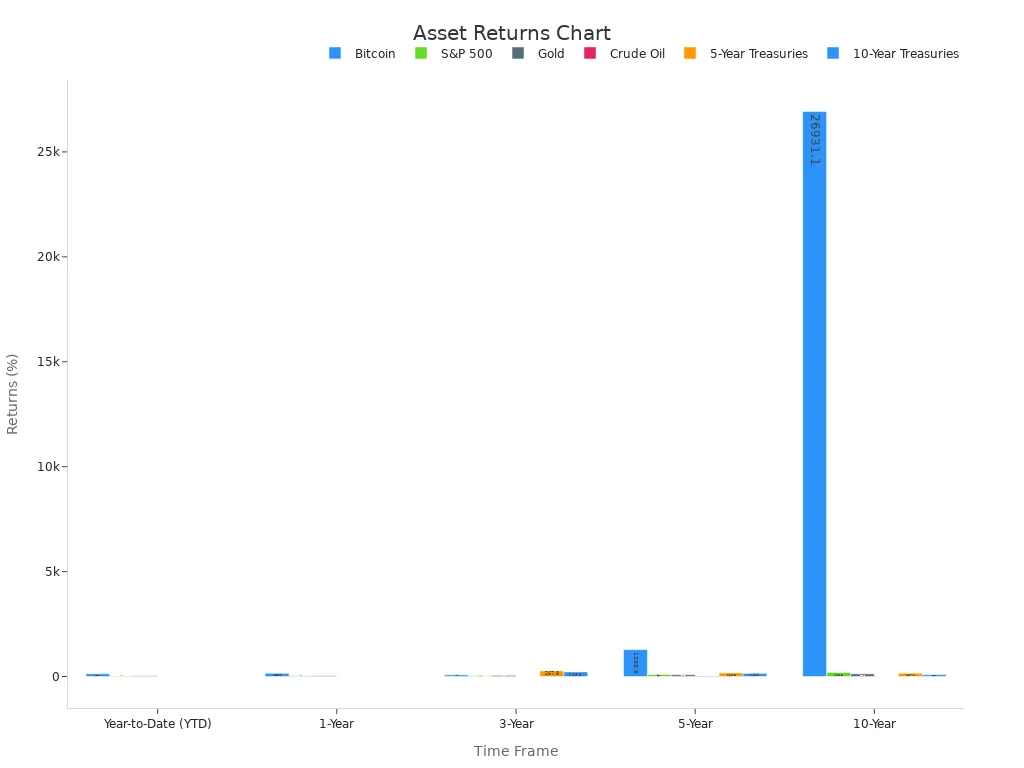
Bitcoin’s returns far exceed those of stocks, gold, crude oil, and U.S. Treasuries, especially over five and ten years. In 2024, bitcoin led all major assets in year-to-date growth. This trend highlights its potential for high investment returns, but also reminds investors of the need to manage risk in a volatile market.
Investors seeking strong growth and diversification may consider bitcoin as part of a balanced portfolio. Its long-term outlook remains positive, but careful planning is essential.
Positioning for 2025
Risk Management
Investors face unique challenges when managing risk in the bitcoin market. Historical price swings highlight the need for disciplined strategies. Many use tools like Average True Range (ATR) and Bollinger Bands to measure volatility and set stop-loss levels. Limiting exposure to amounts that fit personal risk tolerance remains essential. Experts recommend allocating only 2-5% of capital per bitcoin trade to control downside risk. Dynamic stop-loss orders, adjusted for recent volatility, help prevent premature exits. Some investors hedge with futures or options to protect against sudden price moves. Regular portfolio rebalancing and dollar-cost averaging can smooth returns and reduce the impact of short-term fluctuations. Emotional discipline is key, as impulsive decisions during volatile periods often lead to losses. Research shows that volatility spikes often follow regulatory news or hacking incidents, so monitoring news impact helps manage risk.
Timing and Entry
Timing plays a critical role in bitcoin investment outcomes. Some investors try to predict short-term price movements, but this approach requires constant monitoring and carries high risk. Most lose money attempting to time the market. Long-term holding, or “time in the market,” offers a more consistent path to potential gains, as seen in past bull cycles. Dollar cost averaging (DCA) allows investors to buy fixed amounts regularly, reducing the effect of volatility. Technical indicators such as moving averages, RSI, and Fibonacci retracements can guide entry and exit points. Combining several indicators improves reliability. Setting clear exit points and using trailing stop-losses helps lock in gains and manage risk. Historical trends show that bitcoin often experiences 20-40% pullbacks, even in bull markets. Patience and a well-defined plan support better investment outcomes.
Portfolio Allocation
Optimizing portfolio allocation with bitcoin requires balancing growth and risk. Research from VanEck suggests that adding up to 6% crypto exposure—split evenly between bitcoin and Ethereum—to a traditional 60/40 portfolio maximizes risk-adjusted returns. This approach only modestly increases drawdowns. Wilshire Indexes finds that a 1-2% bitcoin allocation keeps risk manageable, while higher allocations can shift risk concentration toward bitcoin. Institutional models for 2025 recommend a core-satellite structure: 40% bitcoin, 20% Ethereum, 30% altcoins, and 10% stablecoins for crypto-only portfolios. This mix balances liquidity, growth potential, and risk management. Recent data from CoinShares shows that advisors now represent 50% of 13-F bitcoin holdings, signaling a shift toward long-term strategic ownership. Funds like the CoinShares Valkyrie Bitcoin Fund offer accessible exposure without the complexities of direct ownership. As institutional adoption grows and supportive policies emerge, investors can position for bitcoin’s potential while maintaining a diversified investment strategy.
Bitcoin’s 2025 investment potential stands on strong foundations. Academic studies highlight its growing role as a hedge and diversifier, while on-chain data shows that bitcoin trade volume rises in countries with weak monetary controls. Most forecasts place the price between $120,000 and $210,000, driven by institutional adoption and regulatory clarity.
Investors should weigh both the opportunities and risks.
Aligning bitcoin exposure with personal risk tolerance and financial goals remains essential.
FAQ
What makes Bitcoin a unique investment in 2025?
Bitcoin offers limited supply, global accessibility, and strong institutional interest. These features set it apart from traditional assets. Many investors see Bitcoin as a hedge against inflation and a tool for portfolio diversification.
How can investors manage Bitcoin’s volatility?
Investors use strategies like dollar-cost averaging, stop-loss orders, and portfolio rebalancing. These methods help reduce risk and smooth returns. Staying informed about market news also supports better decision-making.
Are Bitcoin ETFs safe for beginners?
Bitcoin ETFs provide regulated, easy access to Bitcoin exposure. They remove the need for direct crypto storage. Beginners benefit from familiar brokerage platforms and added investor protections.
What risks should investors watch in 2025?
Key risks include regulatory changes, market corrections, and geopolitical events. Investors should monitor news, set clear risk limits, and avoid overexposure to a single asset.
Can Bitcoin outperform stocks and gold in 2025?
Historical data shows Bitcoin has delivered higher long-term returns than stocks or gold. However, past performance does not guarantee future results. Investors should balance potential gains with personal risk tolerance.

