
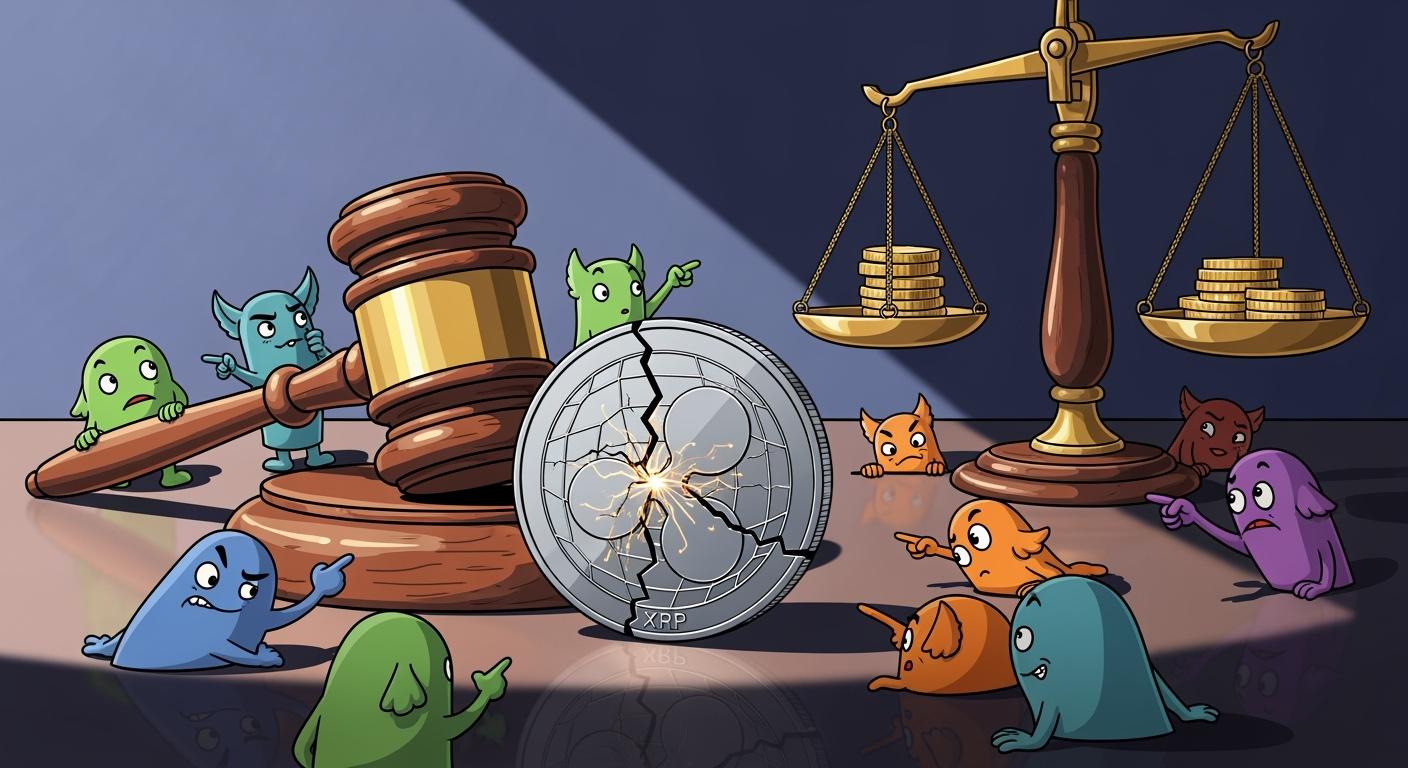
The SEC vs. Ripple lawsuit concluded with a landmark settlement in May 2025. This resolution in the long sec v. ripple case created a powerful legacy for the crypto industry.
It established a critical precedent for digital asset regulation.
It catalyzed a fundamental shift in U.S. cryptocurrency regulation.
The agreement between the SEC and Ripple ended the historic sec ripple battle. This new regulatory path moves the SEC away from ambiguity. The outcome reshapes crypto regulation and the future of cryptocurrency, setting a new course for its regulation.
Key Takeaways
The SEC vs. Ripple lawsuit ended in May 2025. Ripple paid a large fine. The court said XRP itself is not a security.
The court made a key difference. Selling XRP to big investors was like selling a security. Selling XRP on exchanges to regular people was not.
This lawsuit changed how crypto is regulated in the U.S. It pushed for clearer rules instead of unclear enforcement.
The case helped create new crypto laws. These laws define different types of crypto assets. They also say which government group will watch over them.
The lawsuit’s end made investors feel more sure about crypto. This led to more money coming into the crypto market. It also helped new crypto technologies grow.
The Final Verdict in the SEC v. Ripple Lawsuit
The final phase of the historic sec v. ripple legal battle brought a complex but decisive conclusion. The journey to the final judgment involved critical appeals, a landmark court ruling, and ultimately, a settlement that sent shockwaves through the crypto industry. This resolution provided the market with long-awaited, albeit nuanced, regulatory clarity.
The Landmark Split Decision
The core of the final verdict stems from Judge Analisa Torres’s landmark summary judgment. The court did not classify the XRP token itself as a security. Instead, the ruling focused on the context of its sales, creating a pivotal distinction between different types of XRP transactions. This split decision in the ripple case became the foundation for the lawsuit’s outcome.
Institutional Sales: The court found that Ripple’s direct sales of XRP to institutional investors were unregistered security sales. These buyers knew they were purchasing from Ripple. They expected the company to use the funds to develop the ecosystem and increase XRP’s value.
Programmatic Sales: In contrast, the court determined that Ripple’s programmatic sales of XRP on public crypto exchanges were not securities transactions. In these blind bid-ask transactions, buyers did not know the seller’s identity. Therefore, they could not have a reasonable expectation of profit based on Ripple’s efforts.
Howey Test and XRP’s Classification
The court’s analysis hinged on the application of the Howey Test, a long-standing legal framework used by the SEC to identify investment contracts. The test examines whether a transaction involves:
An investment of money
In a common enterprise
With a reasonable expectation of profits derived from the efforts of others
For Ripple’s institutional sales, the court found that all three prongs were met.
Investment of Money: Institutional buyers paid money directly to Ripple for XRP.
Common Enterprise: The court identified a “horizontal commonality.” Ripple pooled investor funds, and the fortunes of buyers were tied to the success of the Ripple enterprise.
Expectation of Profits: Ripple’s own marketing and communications led institutional buyers to expect that the company’s efforts would increase the value of their XRP holdings.
However, the analysis differed for programmatic XRP transactions on secondary markets. The court concluded these sales failed the third prong of the Howey Test. Because buyers on exchanges were anonymous, they could not have formed an expectation of profit specifically from Ripple’s managerial efforts. This distinction was the critical factor in the court’s decision and a major point of contention for the SEC.
The Final Settlement in the Ripple SEC Case
The path to the final settlement was intense. The SEC filed its appellate brief on January 15, 2025. The agency challenged the district court’s ruling, arguing it wrongly distinguished between institutional and programmatic sales of XRP. This appeal, filed with the U.S. Court of Appeals for the Second Circuit, signaled the SEC’s intent to fight the landmark precedent.
Despite the appeal, the years-long battle concluded in May 2025. The SEC and Ripple reached a final settlement agreement. The ripple sec case ended with Ripple paying a substantial fine. The court left the $125 million penalty intact, rejecting a joint proposal from the sec ripple parties to reduce it. The judgment also maintained a pre-existing ‘obey-the-law’ injunction against Ripple for future institutional sales, as the court prioritized deterrence and public interest. The U.S. Court of Appeals for the Second Circuit then approved a joint stipulation to dismiss the appeals, officially ending the sec vs. ripple lawsuit.
The timeline below summarizes the key milestones in the sec v. ripple labs legal battle.
Date | Event |
|---|---|
Dec 22, 2020 | SEC files lawsuit against Ripple Labs. |
Jul 13, 2023 | Judge Torres delivers the landmark split-decision ruling. |
Aug 7, 2024 | Court issues final judgment and penalties for institutional sales. |
Jan 15, 2025 | SEC files its appellate brief to challenge the ruling. |
May 2025 | The sec ripple battle concludes with a final settlement. |
The market’s reaction to the end of the ripple sec case was immediate and explosive. Investors, relieved by the conclusion of the long lawsuit, drove the price of XRP up significantly. The cryptocurrency’s value soared to over $3.30, reflecting newfound confidence and a perception of greater regulatory certainty for the crypto asset. This outcome in the sec v. ripple labs case reshaped the landscape for digital asset regulation in the United States.
The Lasting Legacy of the SEC vs. Ripple Battle

The conclusion of the sec vs. ripple lawsuit marked more than just the end of a legal dispute; it signaled a turning point for the entire U.S. crypto industry. The judgment and subsequent settlement forced a critical re-evaluation of the SEC‘s “regulation-by-enforcement” strategy. This approach had created a climate of uncertainty, and the ripple outcome became the primary catalyst for change, pushing the industry toward a future defined by clearer rules and legislative action.
Precedent from SEC v. Ripple Labs
The most significant legacy of the sec v. ripple labs case is the legal precedent it established. The court‘s ruling introduced a nuanced but powerful principle: a digital token like XRP is not, in and of itself, a security. Instead, its classification depends entirely on the context and manner of its sale. This precedent separates the digital asset itself from the way it is sold.
The court‘s analysis created a vital legal distinction based on the Howey Test:
Aspect of Sale | Institutional Sales | Programmatic Sales (Exchanges) |
|---|---|---|
Security Status | Investment Contract (Security) | Not an Investment Contract |
Reasoning | Buyers expected profit from | Buyers did not know the seller’s identity. |
| Ruled in favor of the | Ruled against the |
This ruling stood in stark contrast to the SEC‘s broader enforcement campaign. In the years leading up to the May 2025 settlement, the agency brought numerous high-profile actions against major crypto players.
The
SECcharged Coinbase and Kraken with operating as unregistered exchanges.It filed 13 charges against Binance and its founder.
The agency also pursued actions against firms like Consensys, Uniswap, and Crypto.com.
The ripple case outcome challenged the foundation of this strategy, suggesting that a one-size-fits-all approach to digital asset regulation was legally flawed. The implications of this judgment are profound, forcing a move away from blanket classifications and toward a more detailed, fact-based analysis for XRP and other cryptocurrencies.
A Catalyst for New Crypto Legislation
The ambiguity exposed by the long sec v. ripple battle created an urgent demand for legislative clarity. The ripple sec case demonstrated that existing securities laws were ill-equipped for the nuances of cryptocurrency. In response, Congress accelerated its efforts to create a dedicated framework for crypto regulation.
Following the events of the ripple sec case, several key pieces of legislation moved forward. The Guiding and Establishing National Innovation for U.S. Stablecoins (GENIUS) Act passed both the House and Senate in mid-2025. This bill established the first clear federal guidelines for stablecoin issuance and governance. Lawmakers also advanced market-structure legislation like the CLARITY Act, designed to end the jurisdictional tug-of-war between the SEC and the CFTC.
Note: This new wave of
crypto regulationsaims to provide clear rules of the road, defining asset categories, assigningregulatory oversight, and protecting consumers without stifling innovation.
Key provisions in the proposed crypto regulation include:
Defining Asset Categories: Dividing
cryptoassets into digital commodities, investment contract assets, and stablecoins.Clarifying Jurisdiction: Granting the CFTC authority over digital commodities and the
SECauthority over investment contract assets.Protecting Investors: Requiring digital assets to be held by qualified custodians and modernizing recordkeeping rules.
This legislative momentum represents a direct consequence of the sec v. ripple labs lawsuit, pushing the U.S. toward a more stable and predictable regulatory environment.
The Future After the SEC Ripple Ruling
The ripple case has fundamentally reshaped the future of cryptocurrency regulation in the United States. The implications extend beyond XRP, fostering a new regulatory paradigm. In a significant May 2025 statement, SEC Commissioner Hester Peirce, as the new head of the agency’s Crypto Task Force, called for a “rational and coherent path forward.”
“We are charting a new paradigm at the
SEC. The old approach ofregulation-by-enforcement evaded soundregulatorypractice. It is time for crypto clarity.” — SEC Commissioner Hester Peirce, May 2025
This shift is already taking shape. The task force is actively considering requests for exemptive relief that would allow firms to use blockchain technology for issuing and trading securities under specific conditions. These proposals would require robust disclosures and security policies, offering a pathway for innovation within a compliant framework.
Experts predict this newfound clarity will unlock tremendous growth for the U.S. crypto industry into 2026 and beyond.
Institutional Dominance: An anticipated influx of over $300 billion in institutional capital for Bitcoin is expected, with major players like Morgan Stanley integrating
cryptotrading for retail clients. The price ofXRPitself, which soared past $3.30 after the settlement, reflects this renewed confidence.DeFi Mainstreaming: The Decentralized Finance (DeFi) market, valued at $21 billion in 2025, is projected to exceed $231 billion by 2030 as it integrates with traditional finance.
NFT and Metaverse Evolution: NFTs are moving beyond collectibles toward functional uses like digital passports and fractional ownership of real-world assets.
Scalability Improvements: Mass adoption of Layer 2 solutions will dramatically increase transaction speeds and lower costs for networks like Ethereum and Bitcoin, making
XRPand other digital assets more viable for payments and DeFi.
The sec ripple lawsuit ultimately served as a crucible, forging a new and more defined future for cryptocurrency in America. The industry is now moving from an era of legal battles to one of legislative building and explosive innovation.
The sec ripple lawsuit concluded with a landmark settlement for Ripple. This outcome established a vital legal distinction for token sales. The legacy of the Ripple case is a fundamental shift away from the SEC‘s ambiguous enforcement. It created a demand for clear regulation. This new regulatory direction sets a defined course for the U.S. crypto industry’s growth. The SEC‘s altered approach after its battle with Ripple provides the cryptocurrency market with newfound confidence.
The U.S.
cryptomarket now projects a Compound Annual Growth Rate (CAGR) of 12.7% from 2025 to 2030, reflecting the impact of theSEC‘s new clarity following theRipplecase.
FAQ
What was the final outcome of the SEC vs. Ripple lawsuit?
The lawsuit ended with a May 2025 settlement. Ripple paid a $125 million fine. The court’s ruling stood, establishing that programmatic XRP sales were not securities. This outcome set a major legal precedent for the crypto industry.
Why did the price of XRP increase after the settlement?
The XRP price surged past $3.30. Investors showed relief after the long lawsuit concluded. The settlement provided much-needed regulatory clarity. This outcome boosted market confidence significantly.
What is the main legal precedent from the Ripple case?
The case set a powerful legal precedent. A digital asset’s classification depends on its sale context, not the asset itself. The court separated institutional sales (securities) from programmatic sales on exchanges (not securities).
How did the lawsuit change crypto regulation in the U.S.?
The case catalyzed a major regulatory shift 📈. It moved the U.S. away from ambiguous enforcement toward clear legislation. Congress advanced new crypto laws. The SEC began developing more defined rules for the industry’s future.

