

Is bitcoin dead in 2025? The data says no. Bitcoin’s network processes around 400,000 transactions daily, moving nearly $45 billion on-chain each day. Recent trading volumes hit record highs, with a single day in March 2025 reaching $112 billion. The blockchain remains active, with robust security and traceability. Crypto markets show resilience, and institutional activity has grown. The following table highlights key metrics that prove bitcoin’s ongoing strength:
Metric Category | 2025 Key Findings |
|---|---|
Active Addresses | ~735,000 daily |
Transaction Volume | 390,000–400,000 transactions; ~$45B transferred daily |
Holder Behavior | Realized cap > $900B (all-time high); 74% supply illiquid |
Price Forecasts | $150K–$200K expected by late 2025 |
Bitcoin’s blockchain activity and market resilience answer the question: is bitcoin dead? The evidence points to sustained vitality in the crypto space.
Key Takeaways
Bitcoin remains very active in 2025, processing over 400,000 transactions daily with strong network security and growing blockchain use.
User adoption is high worldwide, with over 820 million crypto wallets and increasing mobile and institutional participation.
Bitcoin’s price shows resilience, reaching new highs despite market volatility, supported by strong investor demand and regulatory clarity.
Technological upgrades and AI partnerships strengthen Bitcoin’s blockchain, while DeFi and Layer-2 solutions expand its use cases.
Blockchain technology grows beyond finance, improving supply chains, healthcare, voting, and more, signaling a broad future impact.
Is Bitcoin Dead?
Activity on the Blockchain
The question “is bitcoin dead” continues to echo across the crypto market in 2025. However, the blockchain tells a different story. Bitcoin processes over 460,000 transactions every day, with an average of 19,184 transactions per hour. The network creates about 157 blocks daily, and each block contains thousands of transactions. This high level of activity shows that the crypto market remains vibrant and that users trust the blockchain for secure transfers.
Metric | Value |
|---|---|
Transactions last 24h | 460,408 |
Average transactions per hour | 19,184 |
Blocks created last 24h | 157 |
Average block time | 9 minutes 7 seconds |
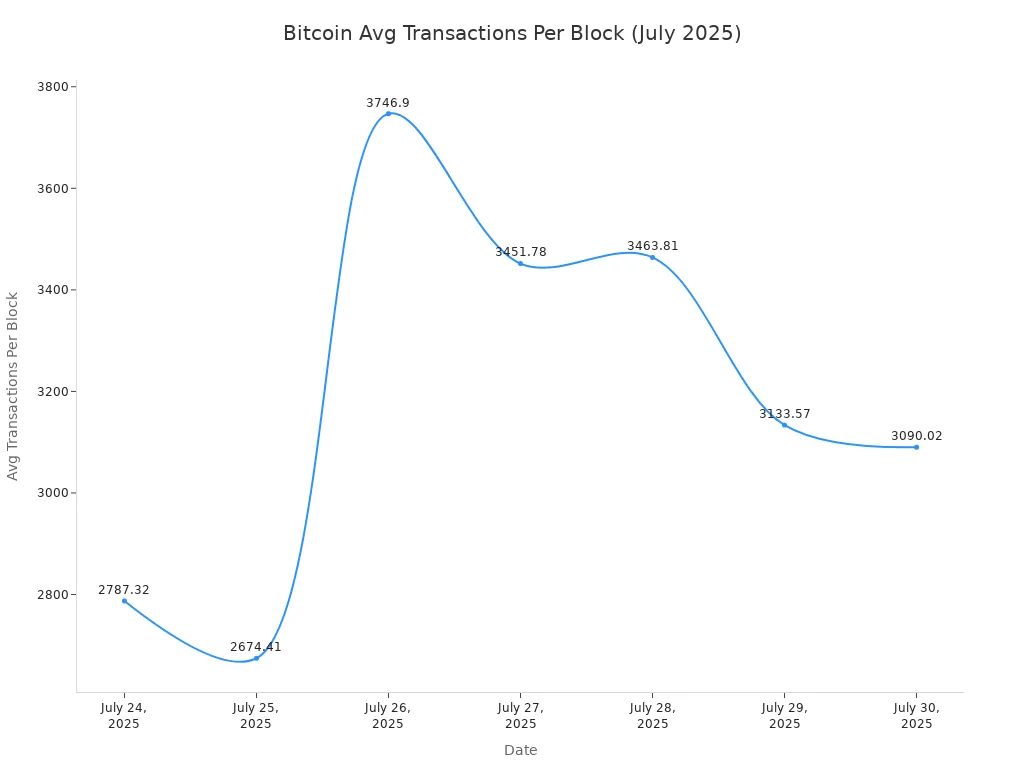
The average number of transactions per block also remains strong. For example, from July 24 to July 30, 2025, the average ranged from about 2,674 to 3,746 transactions per block. This steady flow highlights the ongoing demand for bitcoin in the crypto market.
Date | Average Transactions Per Block |
|---|---|
July 30, 2025 | 3090.02 |
July 29, 2025 | 3133.57 |
July 28, 2025 | 3463.81 |
July 27, 2025 | 3451.78 |
July 26, 2025 | 3746.90 |
July 25, 2025 | 2674.41 |
July 24, 2025 | 2787.32 |
Bitcoin developers have reached consensus on major protocol upgrades in 2025. These upgrades introduce new features that make transactions more programmable and flexible. Over half of the top 20 bitcoin miners now partner with AI and high-performance computing firms. This integration brings new technology into the crypto market and strengthens the blockchain’s security.
The rise of crypto continues as the Bitcoin DeFi market nearly doubles in size. More bitcoin is locked in DeFi smart contracts and staking protocols. This growth shows that users and investors see value in using bitcoin for more than just payments. The crypto market’s expansion into DeFi signals a new era for blockchain innovation.
User and Institutional Interest
User adoption of bitcoin remains strong in 2025. Over 820 million active crypto wallets exist worldwide, and 68% of these wallets hold bitcoin. Mobile wallet usage has reached 72%, showing that users want easy access to the crypto market. In regions like Asia-Pacific, 350 million people use crypto wallets, making up 43% of the global total. Africa, Latin America, Europe, and North America also show steady growth in wallet adoption.
Metric / Region | 2025 Data / Growth Rate |
|---|---|
Total active crypto wallets | Over 820 million |
Bitcoin held in active wallets | 68% of all active wallets |
MetaMask users | 143 million |
Trust Wallet users | 115 million |
Coinbase Wallet users | 70 million |
Hot wallet usage | 178% of users rely on hot wallets |
Cold wallet ownership growth | 34% year-over-year increase |
Mobile wallet usage | 72% of users prefer mobile wallets |
Asia-Pacific active users | 350 million (43% of global total) |
Africa wallet growth rate | +38% year-over-year |
Latin America wallet users | 92 million |
Europe wallet users | 140 million |
North America wallet users | 134 million |
KYC-linked wallets | 67% of active wallets |
DeFi wallet users | 198 million (24% of total wallets) |
NFT-linked wallets | 294 million (33% year-over-year increase) |

Institutional interest in bitcoin has reached new heights. By April 2025, spot bitcoin ETFs worldwide manage over $65 billion in assets. BlackRock’s iShares Bitcoin Trust alone holds more than $18 billion. About 59% of institutional investors now allocate at least 10% of their portfolios to bitcoin and other digital assets. Corporate treasuries and sovereign wealth funds continue to add bitcoin to their holdings, showing confidence in the crypto market’s future.
Metric | Figure/Value | Timeframe |
|---|---|---|
Total AUM of Spot Bitcoin ETFs worldwide | Over $65 billion | By April 2025 |
BlackRock’s iShares Bitcoin Trust (IBIT) AUM | Over $18 billion | End of Q1 2025 |
Institutional investors allocating ≥10% to Bitcoin and digital assets | Approximately 59% | By Q2 2025 |
Corporate treasury Bitcoin holdings | Steadily increasing | Q1 2025 onwards |
Sovereign Wealth Funds involvement | Methodical accumulation trend | By Q2 2025 |
The crypto market also sees major wealth management platforms recommending bitcoin allocations of 2% or more. At least five Nasdaq 100 companies and five nation-states have added bitcoin to their balance sheets or sovereign wealth funds. This broad adoption signals that the rise of crypto is not just a trend but a shift in how investors view the cryptocurrency market.
The answer to “is bitcoin dead” in 2025 is clear. Bitcoin remains a top-performing asset, with strong user and institutional support. The crypto market thrives on innovation, adoption, and resilience.
Blockchain Activity
Transaction Volumes
Bitcoin continues to demonstrate strong transaction volumes in 2025. The network processes hundreds of thousands of transactions daily, reflecting ongoing demand and active participation. The total bitcoin supply remains capped at 21 million, with over 19.7 million already mined. This limited bitcoin supply drives competition among users and miners, keeping transaction activity high. Each day, the market sees significant movement of bitcoin supply, as users transfer, trade, and stake their holdings.
The hashrate, which measures the computational power securing the network, reached a record 1,222.41 EH/s on June 30, 2025. By August 1, it remained elevated at 1,060.10 EH/s. These figures show that miners continue to invest in hardware and energy to secure the blockchain. The hashrate increased by 42% compared to the previous year, with daily values in late June and July fluctuating between 700M TH/s and over 1 billion TH/s. This growth signals confidence in the market and the underlying technology.
On July 30, 2025, the hashrate was 869.13M TH/s, up 22% from the previous day.
On July 25, it reached 1.004B TH/s.
The bitcoin supply remains tightly held, with most coins in long-term storage.
Security and Traceability
Security and traceability have become central to the bitcoin ecosystem. In 2025, regulators like the New York State Department of Financial Services issued new guidance for monitoring crypto transactions. Blockchain analytics tools now help identify illicit activity, using geolocation and IP blocking to enhance compliance. These advances make it harder for criminals to exploit the bitcoin supply.
Improved blockchain analytics have shifted illicit activity away from bitcoin, making the network safer for users and investors.
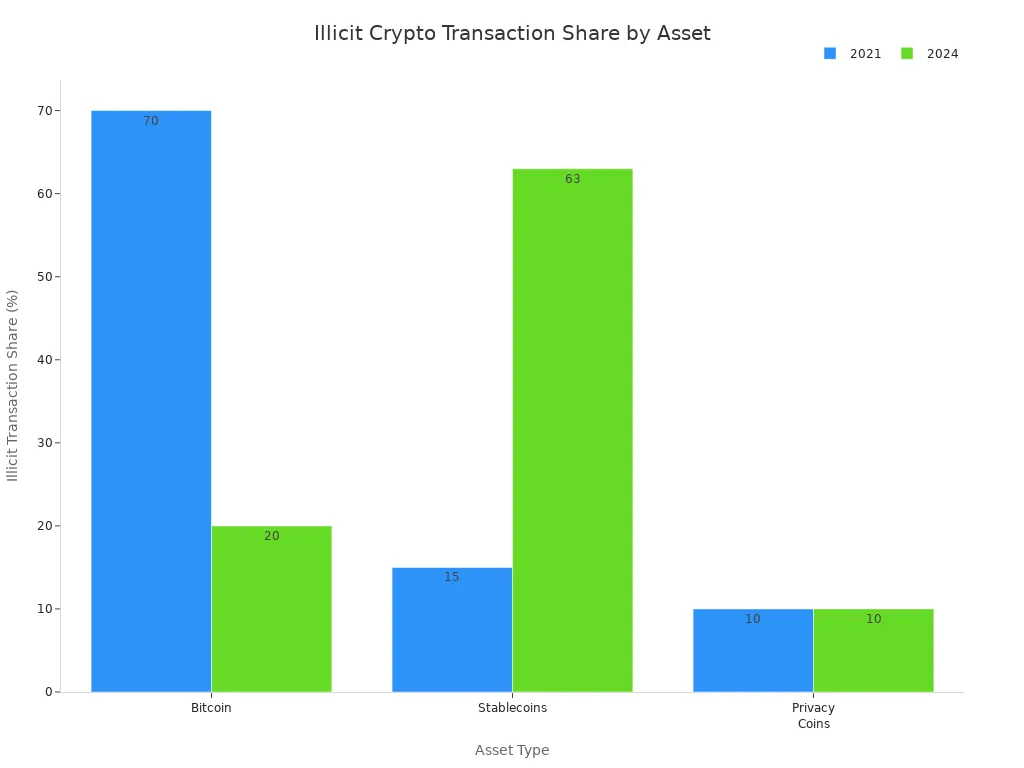
The impact of traceability is clear in recent crime statistics. In 2024, illicit crypto transactions accounted for only 0.14% of total on-chain volume, down from 0.61% in 2023. Bitcoin’s share of illicit transactions dropped from 70% in 2021 to just 20% in 2024. Criminals now prefer stablecoins and privacy coins, as the traceable nature of bitcoin supply deters illegal use.
The market benefits from these changes. As blockchain analytics improve, the bitcoin supply becomes more secure, and the network’s reputation grows stronger.
Bitcoin Price and Market Resilience
Price Trends in 2025
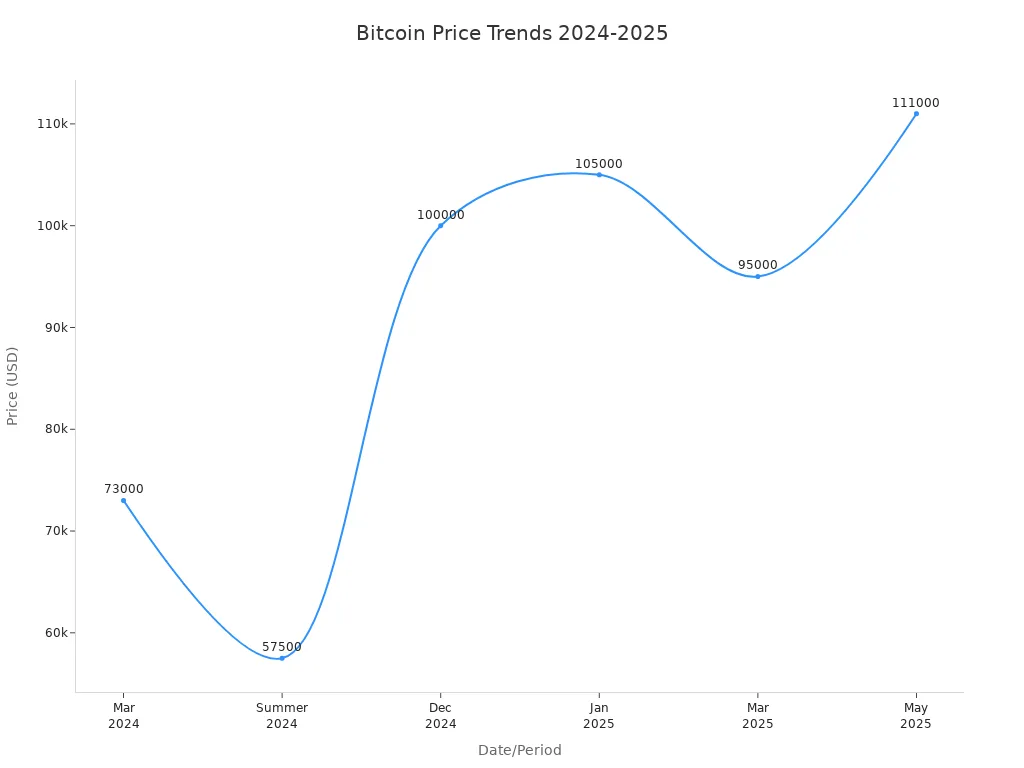
The bitcoin price in 2025 has shown both historic highs and sharp corrections. In March 2024, the price climbed above $73,000 after the approval of bitcoin ETFs, surpassing the previous all-time high. By December 2024, the price exceeded $100,000, driven by a crypto-friendly U.S. administration. January 2025 saw continued momentum, but March brought a temporary decline due to uncertainty over the Strategic Bitcoin Reserve. In May 2025, the price briefly surged past $111,000, setting a new record. Despite intermittent corrections, the year-to-date return stands at 15%, following a 121% gain in 2024. This pattern highlights the market volatility and the potential for both risk and reward in the crypto market.
Date/Period | Price Milestone | Key Event/Driver | Comparison to Historic Highs |
|---|---|---|---|
March 2024 | Above $73,000 | Bitcoin ETFs officially permitted, inflow of funds | Surpassed previous all-time highs (~$69,000 in 2021) |
Summer 2024 | ~$55,000-$60,000 | Price correction after ETF surge | Below peak but within historical volatility range |
December 2024 | Surpassed $100,000 | Election victory of crypto-friendly Trump | New all-time high, exceeding all prior records |
January 2025 | Market boost | Trump’s executive order on digital assets | Continued upward momentum |
March 2025 | Price decline | Disappointment over Strategic Bitcoin Reserve plans | Temporary setback amid volatility |
May 2025 | Brief surge past $111,000 | New all-time high before falling back | Highest price ever recorded |
Crypto Market Dynamics
The crypto market in 2025 displays high market volatility and rapid shifts in investor sentiment. Several factors shape the cryptocurrency market:
Q1 2025 saw bitcoin down 12% and Ethereum down 45%, with altcoins underperforming.
Macroeconomic pressures, such as inflation and slowing growth, affected the market.
Regulatory changes, including the removal of SEC Chair Gary Gensler, signaled a more crypto-friendly environment.
Institutional investor interest grew, with venture capital and ETF fund flows supporting market stability.
Technological advances, like AI integration and blockchain upgrades, offer new opportunities and potential for growth.
Bitcoin halving events reduced supply, increasing demand and supporting its role as a store of value.
Investor sentiment and market forecasts remain sensitive to regulatory news and global events.
The crypto market’s resilience comes from its ability to adapt to changing supply, demand, and investor expectations.
Regulatory Impact
Regulatory developments in 2025 have a significant impact on the crypto market and bitcoin price stability. The U.S. passed the GENIUS Act and introduced the FIT21 Act, clarifying oversight and encouraging institutional participation. President Trump’s executive orders established a Strategic Bitcoin Reserve, boosting confidence in bitcoin as a national asset. The SEC approved in-kind creation and redemption for crypto ETPs, making bitcoin investment products more efficient. The repeal of SAB 121 and introduction of SAB 122 removed barriers for banks to custody digital assets, increasing institutional investor opportunities. In the European Union, MiCAR imposed strict rules, but provided legal certainty and stability for the cryptocurrency market. These actions reduce market volatility and support the potential for mainstream adoption.
Regulatory Development | Description | Impact on Bitcoin | Status |
|---|---|---|---|
GENIUS Act | Stablecoin regulation, bipartisan support | Stabilizes related assets, supports bitcoin ecosystem | Pending Senate vote |
FIT21 Act | Defines digital assets as commodities/securities | Clarifies oversight, boosts confidence | Passed House, pending Senate |
Trump Executive Orders | Strategic Bitcoin Reserve, digital asset stockpile | Increases government involvement, boosts adoption | Signed, ongoing |
SEC Crypto ETP Approvals | In-kind creation/redemption for ETPs | Improves efficiency, encourages participation | Implemented 2025 |
SAB 122 | Removes custody barriers for banks | Increases institutional investment | Effective January 2025 |
Bank-like rules for crypto assets | Legal certainty, consumer protection | Implemented 2025 |
Future Outlook
On-Chain and Off-Chain Signals
The future of crypto depends on both on-chain and off-chain signals. Analysts use these signals to make predictions about the market and its opportunities. On-chain data, such as transaction volume and wallet activity, shows how users interact with digital assets. Exchange balances help experts understand selling pressure and accumulation trends. When more assets move off exchanges, it often signals bullish sentiment and potential for price growth.
Layer-2 solutions have become a key part of the 2025 outlook. These innovations increase scalability and allow for new use cases in decentralized finance. The total value locked in Layer-2 platforms has grown by 600% this year, showing strong adoption and potential for future growth. Institutional adoption, including spot ETFs, brings more capital and supports the rise of crypto. Experts use these signals to make projections about the future of crypto and its mainstream adoption.
On-chain and off-chain signals together provide a clearer picture of the market’s future and help guide investment decisions.
Expert Predictions and Projections
Source/Forecaster | |
|---|---|
Mike Novogratz | New all-time highs expected in 2025 |
Peter Brandt | $200,000 target for 2025 |
Tone Vays | Bullish with lows around $39,000 and target $200,000 in 2025 |
Larry Fink (BlackRock CEO) | Directionally bullish, no specific price target |
Galaxy Digital | Up to $150,000, directionally bullish |
Pantera Capital | Up to $148,000 |
Bernstein | Up to $150,000 in 2025 |
Microstrategy | Up to $125,000 in 2025 |
Bitcoin Price 2026 | Forecast range between $99,910 and $200,000, with potential to exceed $200,000 |
Bitcoin Price 2027 | Expected to trade above $200,000 assuming institutional interest continues |
Bitcoin Price 2030 | Expected to exceed $200,000, with targets up to $250,000 |
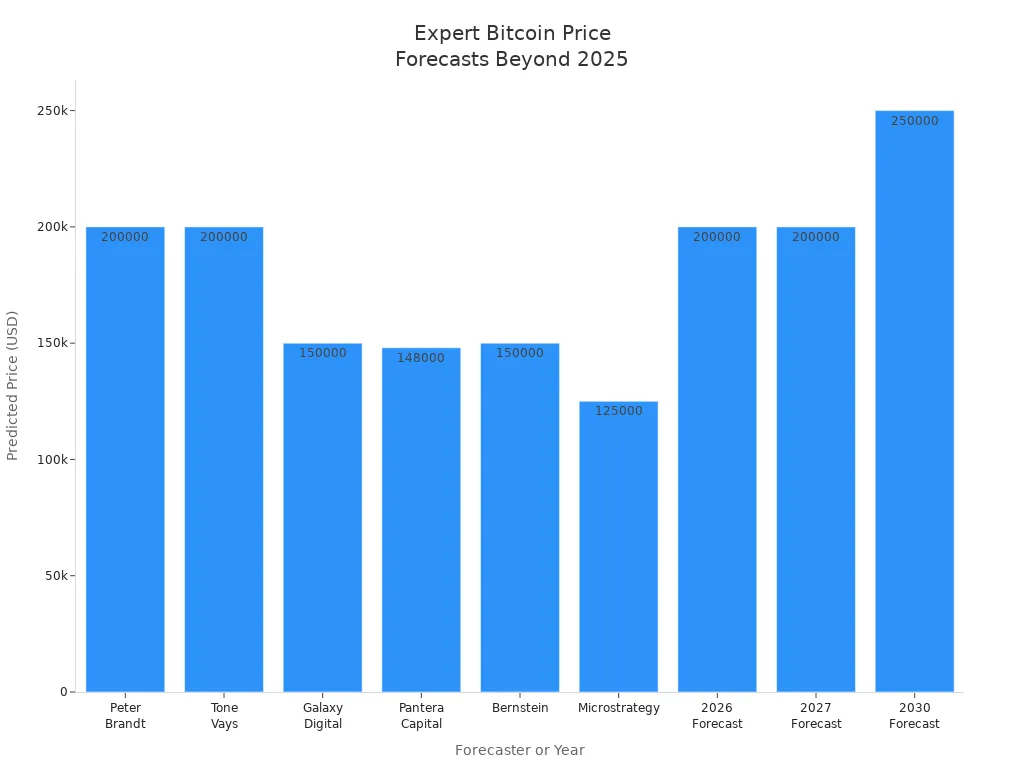
Most expert predictions for the future of crypto remain bullish. Many see opportunities for new all-time highs and project prices above $150,000 by 2025. These projections reflect the potential for growth and the rise of crypto as a mainstream asset.
Broader Blockchain Applications
The future of crypto extends beyond finance. Blockchain technology now supports a wide range of use cases across industries. Companies use blockchain for supply chain management, product traceability, and protection against cyber attacks. Healthcare organizations use it for secure patient records and pharmaceutical tracking. Voting systems, intellectual property management, and energy trading also benefit from blockchain’s transparency and security.
Application Area | Description | Additional Notes |
|---|---|---|
Supply Chain Management | Provides end-to-end visibility and traceability, addressing discrepancies and authenticity. | RFID tags enable customers to verify product provenance. |
Protection Against Cyber Attacks | Enhances data security by storing encrypted data, preventing unauthorized access. | Builds customer trust and protects company data. |
Transparent Product Reviews | Blockchain-secured review systems prevent tampering, ensuring authentic customer feedback. | Increases brand credibility and customer loyalty. |
Voting and Governance | Tamper-proof, auditable voting systems enhance election security and transparency. | Eliminates voter fraud and data manipulation. |
Intellectual Property Management | Speeds up and secures IP registration, supports NFT-based ownership and trading. | Improves accuracy and cost-effectiveness. |
Energy Trading | Enables direct energy trading with immutable records of consumption and generation. | Combines blockchain with IoT for efficient energy markets. |
Education | Verifies credentials and certifications securely, supports decentralized e-learning content. | Gives institutions and learners control over educational data. |
Media and Entertainment | Helps artists secure revenue and copyrights, combats piracy and fraud. | Supports fair compensation and content protection. |
Gaming | Enables true ownership of in-game assets as NFTs, supports play-to-earn models. | Examples include Axie Infinity and The Sandbox. |
Future Trends | AI integration, energy-efficient consensus models, cross-chain interoperability. | These trends enhance automation, sustainability, and connectivity of blockchain applications. |
The 2025 outlook highlights opportunities for blockchain to drive efficiency and trust in many sectors. As more organizations explore these use cases, the potential for widespread acceptance grows. The future of crypto will rely on both financial and non-financial innovations, creating new opportunities and supporting the rise of crypto as a transformative force.
The crypto market in 2025 demonstrates strong resilience, with investor demand driving a supply deficit and supporting price stability. Institutional investor accumulation and long-term holding trends help mitigate downside risks, even as retail investor behavior shifts. Technological upgrades and a secure blockchain ecosystem reinforce adaptability, while the market’s price performance after the halving signals ongoing strength. Looking to the future, investor focus should remain on price charts, supply flows, and ETF inflows. The crypto market’s evolution depends on investor adoption, supply dynamics, and price cycles, making ongoing monitoring essential for every investor.
FAQ
What keeps Bitcoin secure in 2025?
Bitcoin uses advanced cryptography and a global network of miners. These miners validate transactions and protect the blockchain. Security upgrades and real-time monitoring tools help prevent attacks. The network’s high hashrate shows strong protection against threats.
How do institutions use Bitcoin now?
Institutions hold Bitcoin as a reserve asset. Many invest through spot ETFs or add Bitcoin to their balance sheets. Some use Bitcoin for cross-border payments. Wealth managers recommend small allocations for portfolio diversification.
Is Bitcoin still volatile in 2025?
Yes, Bitcoin remains volatile. Prices can rise or fall quickly. Market events, regulations, and investor sentiment drive these changes. Many investors accept this risk for the chance of higher returns.
Can users track Bitcoin transactions?
Yes. Blockchain explorers let anyone view transaction histories. Improved analytics tools make tracking easier. Most transactions remain public and traceable, which helps law enforcement and builds trust.
What new uses does blockchain have outside finance?
Companies use blockchain for supply chain tracking, digital identity, and secure voting. Healthcare providers store patient records on blockchain. The technology supports energy trading and digital art ownership as well.

